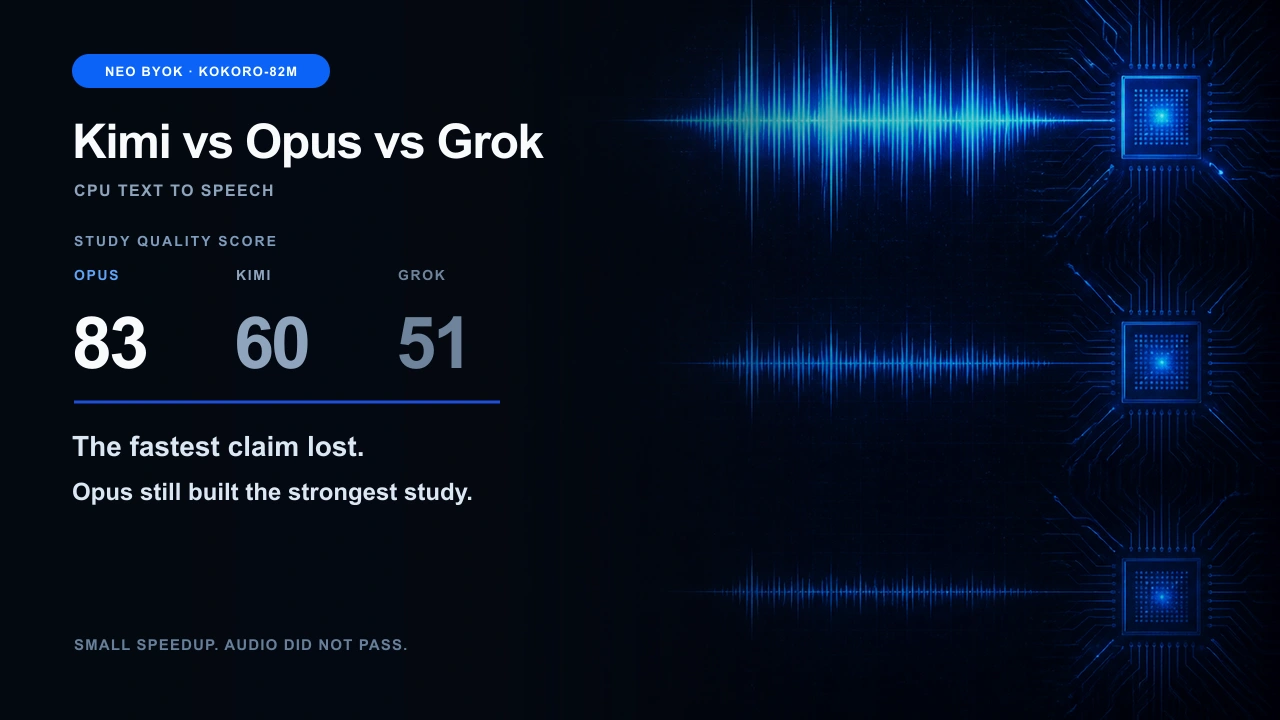
Study scores: Opus 83, Kimi 60, Grok 51. Grok's best verified gain was about 6–8% in one setup, but audio checks failed, so nothing shipped.
In plain English
Kokoro-82M turns text into speech. We asked three frontier models (Kimi K3, Opus 5, and Grok 4.6) to make it faster on CPU through the same Neo Bring Your Own Key (BYOK) workflow. (Earlier: Kimi vs Opus only.)
None of the three proved a change that should ship unchanged.
The numbers that matter
| What | Number | Plain meaning |
|---|---|---|
| Opus study score | 83/100 | Strongest research writeup and method |
| Kimi study score | 60/100 | Solid middle |
| Grok study score | 51/100 | Useful exploration; weak proof |
| Grok INT8 (one pipeline loaded) | ~6–8% faster | Real, modest, repeatable in that setup |
| Grok INT8 (both pipelines loaded) | ~2–3% faster | Below our keep threshold |
| Audio checks on that INT8 path | 18/18 failed | Not safe to ship as tested |
83/100 is not "fastest speech." It ranks how trustworthy the optimization study was. Speed still had to survive a second measurement, and the audio still had to match.
What we asked them to do
- Profile Kokoro on CPU
- Try optimizations
- Report what to ship
Then we scored the reports, re-ran the speed claims, and checked whether the speech still matched the original.
The journey, simply
- Same task, same model, three submissions
- All three found the same rough bottleneck (heavy convolution / vocoder work)
- Score the studies: Opus 83, Kimi 60, Grok 51
- Re-measure Grok's INT8 idea under a stricter protocol
- Speed shows up in one setup (~6–8%); shrinks when both models sit in memory (~2–3%)
- Audio gates fail, so reject for production
Opus 5: best study (83); thread speedup did not hold as a shippable win
Kimi K3: mid study (60); thread idea also rejected after replay
Grok 4.6: weakest study (51); real ~6–8% idea, audio failed
Quick glossary
| We say… | Meaning |
|---|---|
| Study / artifact score | How good the optimization report and evidence were (out of 100) |
| INT8 | Smaller number format meant to run faster; can hurt audio if applied badly |
| Process-isolated | Only the fast path loaded: cleaner speed test |
| Resident | Original and optimized both loaded: closer to some real deployments |
| Audio gate | Checks that sped-up speech still matches the original closely enough |
Hear why audio blocked shipping
These clips are from the blind retest pack (unlabeled on purpose). If the optimization were safe, pairs should sound essentially the same. They did not pass the objective gates.
Sample 01
Sample 02
More samples and a score sheet are in the technical section below.
Bottom line for a quick read
- Opus 5 wrote the strongest study (83/100).
- Grok 4.6 found a modest real speedup (~6–8% isolated), not the huge factor in the original writeup.
- Audio failed on that path, so it does not ship.
- Lesson: profiling skill, a clever idea, hard proof, and production judgment are different things. This task needed all four.
Explore the source on GitHub · Try Neo AI Engineer →
Full technical writeup
TL;DR
Opus 5 remains the strongest research artifact at 83/100, ahead of Kimi K3 at 60 and Grok 4.6 at 51.
Grok's score does not mean it had no useful idea. Two full retests found Linear-only INT8 6.18-7.91% faster in process isolation, but only 2.45-3.38% faster with both pipelines resident. Every objective audio comparison failed.
The fair verdict is: a modest deployment-sensitive optimization, weakly justified in the original submission, and not safe to ship as tested.

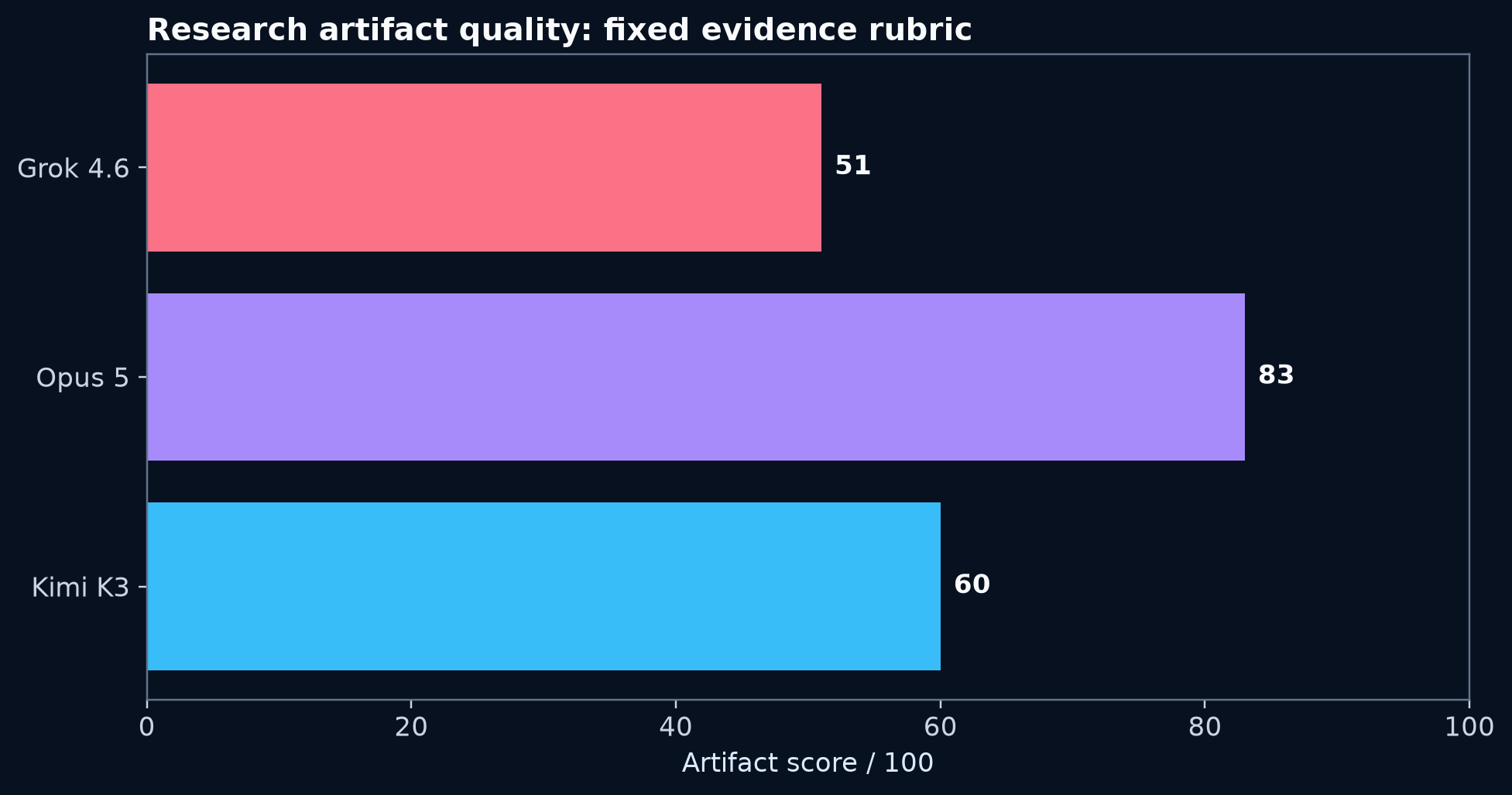 Three-way study quality scores for Kimi K3, Opus 5, and Grok 4.6
Table of contents
- Outcome in one table
- Why Grok scored low
- The profile was useful
- Audit the scoreboard
- First replay: the headline disappears
- Full retest: deployment shape matters
- The audio still blocks production
- What the result means
- What should be tested next?
- Artifacts map
- Technical bottom line
Outcome in one table
| Submission | Artifact score | Claimed winner | Independent verdict |
|---|---|---|---|
| Kimi K3 | 60 | Two ORT threads | +2.80%; reject |
| Opus 5 | 83 | Three ORT threads | -9.81%; reject |
| Grok 4.6 | 51 | PyTorch Linear-only INT8 | 6.18-7.91% isolated; audio fails |
This ranks three repositories for one task, not the underlying language models generally.
Why Grok scored low
Grok was good at exploration. It earned 29 of 40 points for profiling and optimization coverage. It profiled MKLDNN operators, measured memory, tested BF16, compilation, threads, caching, dynamic quantization, ONNX, and OpenVINO, and preserved useful failures.
Most lost points came from the trust layer:
- 7/25 for experimental and statistical rigor.
- 5/15 for correctness and audio validation.
- 2/5 for maintainability.
The submitted report mixed workloads, lacked paired confidence gates, ranked dummy OpenVINO inference beside working TTS, used an unsupported perceptual MSE threshold, and recommended output it described as noticeably degraded. That is why the artifact scored 51. It is not a claim that Grok is generally bad at optimization.
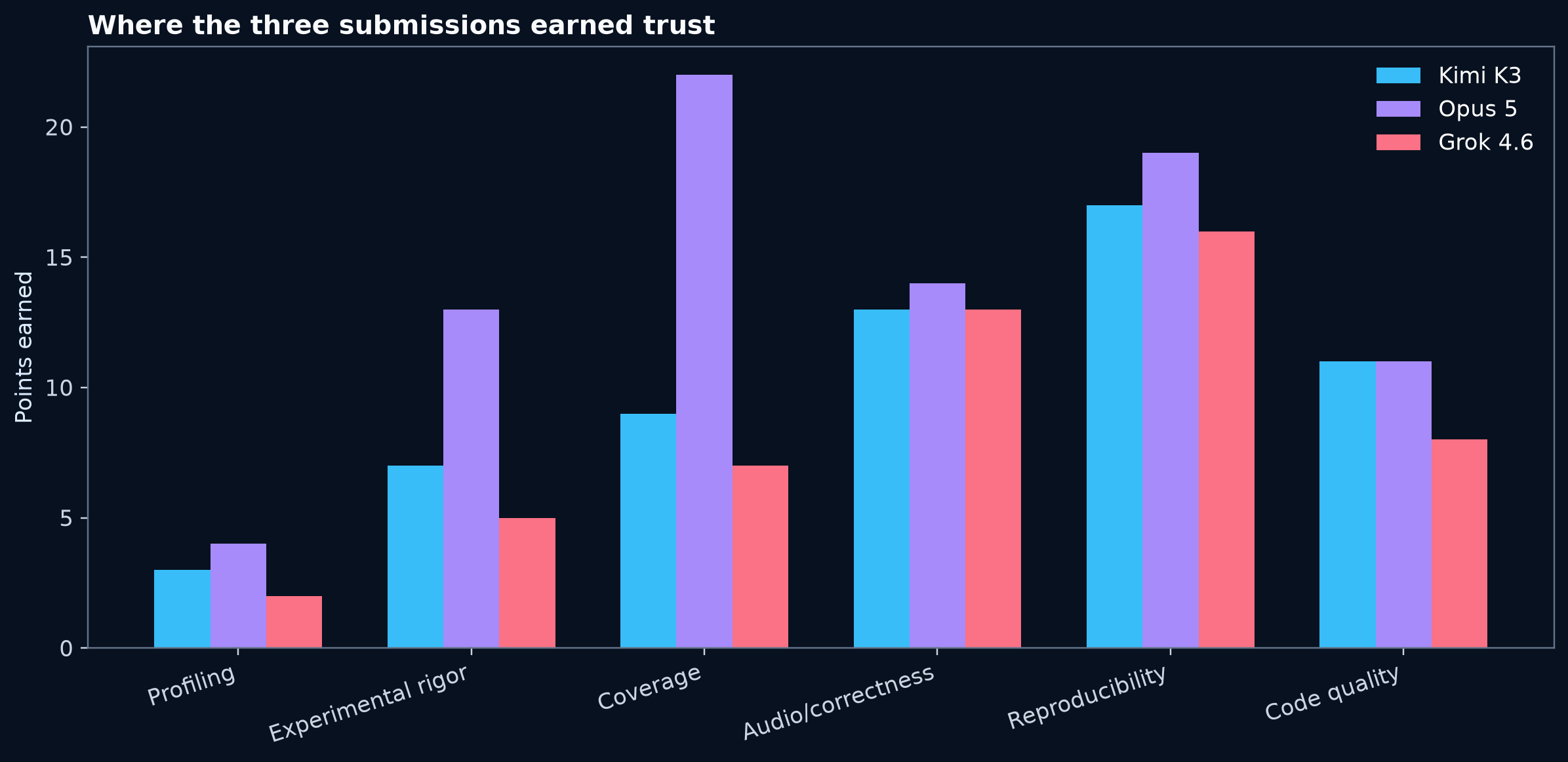 Rubric breakdown for the three Kokoro optimization artifacts
Inspect the output: original Grok report · machine-readable scorecard
The profile was useful
All three submissions point to convolution-heavy waveform synthesis.
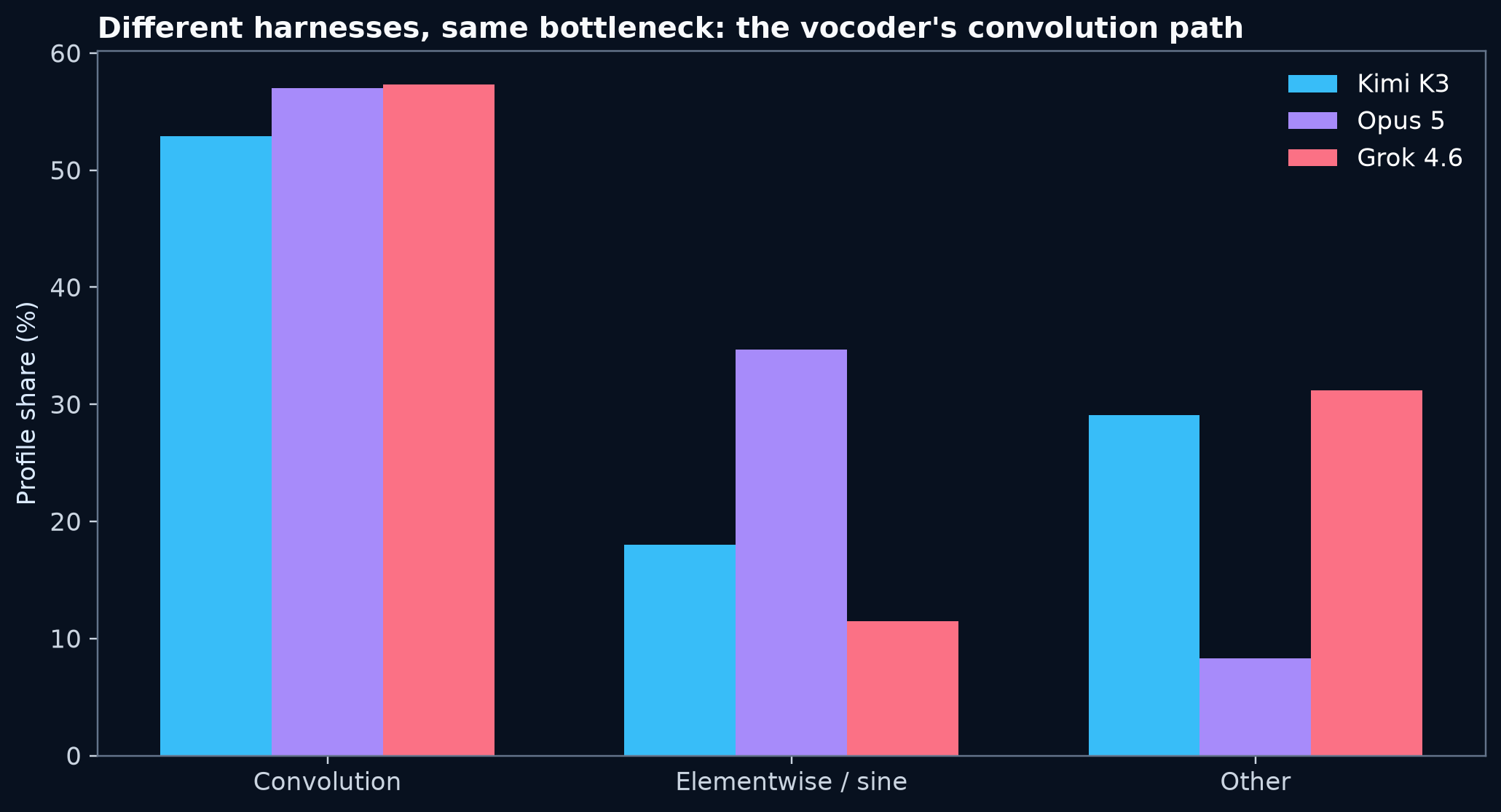 Hotspot comparison across the three Kokoro CPU profiles
Grok measured MKLDNN convolution at 57.3% of self CPU time, followed by normalization and elementwise work. That independently agrees with the ONNX studies: Kokoro's generator/vocoder is the real optimization surface.
The surprising part is that Linear layers were a small profile component, yet Linear-only dynamic quantization became the production recommendation.
Inspect the output: submitted profiling report · PyTorch profiler summary · submitted spectrogram figure
Audit the scoreboard
Grok's 7.08-second FP32 baseline is real, but belongs to a 15-row short/medium/long run. Its displayed 52-pass, four-length baseline averages 15.80 seconds.
The submitted 1.82× INT8 ratio also reproduces arithmetically, but its FP32 rows omit text labels and audio durations while INT8 rows describe different-duration outputs. Correct arithmetic can answer the wrong question.
OpenVINO's 1.12-second result is not TTS at all: it consumes random dummy tensors, records zero audio duration, and produces no validated speech. It is a backend probe, not a deployable winner.
Inspect the output: submitted timing CSV · submitted comparison tables · claim-by-claim audit
First replay: the headline disappears
The first paired replay used 21 comparisons and found +2.78% median, CI [-0.11%, +4.20%]. That missed the fixed 5% gate.
The result was directionally useful but noisy, especially for long speech. We therefore ran a much stronger protocol twice.
Full retest: deployment shape matters
Each run included:
- 30 balanced FP32-vs-FP32 A/A pairs.
- 60 resident FP32-vs-INT8 pairs.
- 12 process-isolated block pairs.
- Fixed prompts, voice, speed, affinity, seeds, thresholds, and ABBA ordering.
- Two warm-ups and five timed syntheses per isolated process block.
| Lane | Run 1 | Run 2 | Verdict |
|---|---|---|---|
| A/A control | -0.66% | +0.25% | Valid |
| Resident INT8 | +3.38% | +2.45% | Below 5% |
| Process-isolated INT8 | +6.18% | +7.91% | Repeatable speed pass |
| Objective audio | Fail | Fail | Reject |
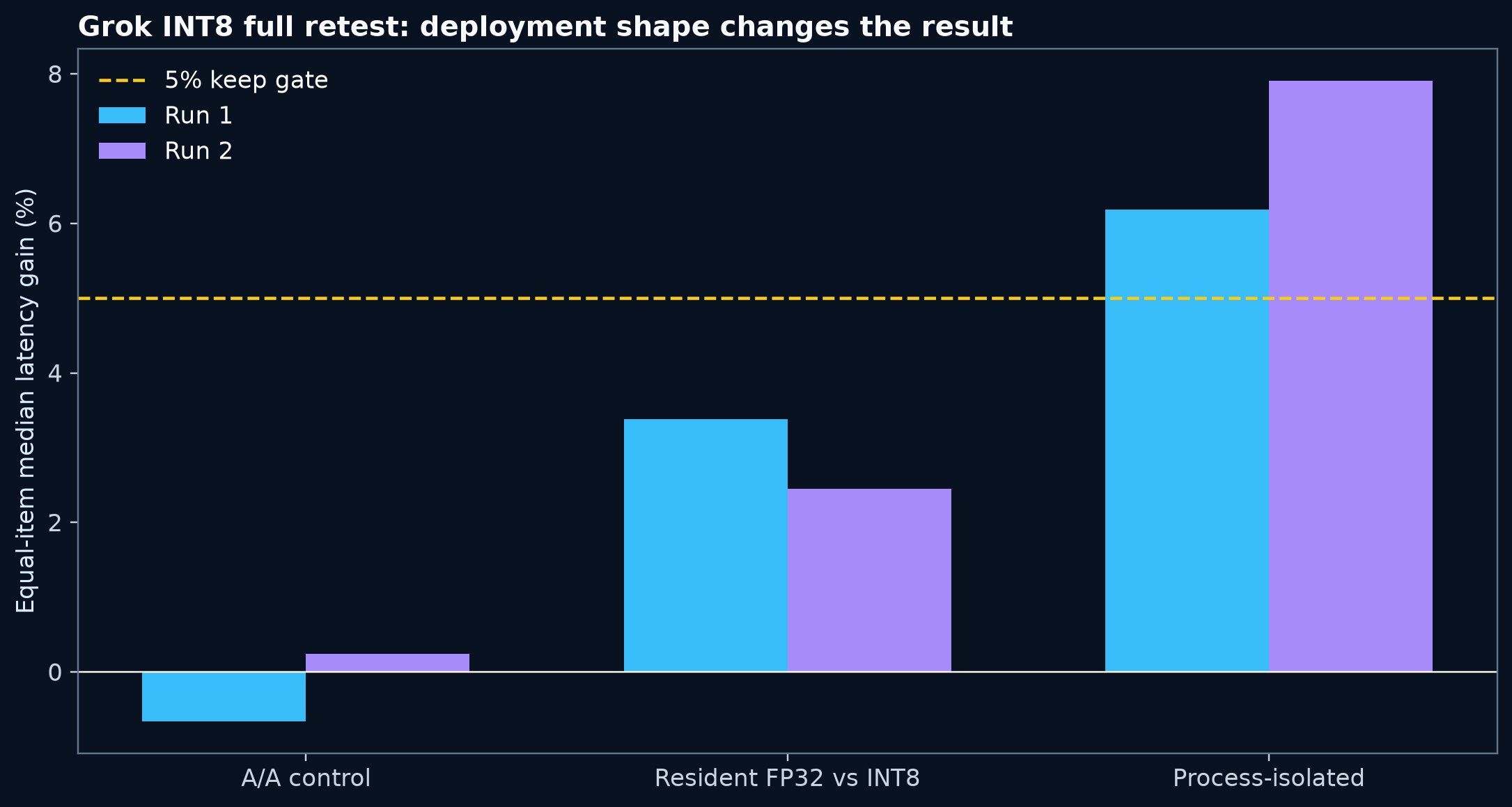 Full retest speed for Grok Linear-only INT8
Cold start did not provide a separate win: median fresh-process totals were 13.31 s for FP32 and 13.34 s for INT8, because quantization preparation offsets the faster first synthesis.
This is the important correction: Grok's optimization idea was not empty. It repeatedly produced a modest warm-inference gain when only one model pipeline was resident. The benefit shrank below the keep threshold when FP32 and INT8 pipelines coexisted.
That is a deployment-sensitive result, not the submitted 1.82× universal win.
Inspect the output: two-run summary · run 1 records · run 2 records · cold-start records
The audio still blocks production
The fixed gate required duration drift ≤2%, log-mel RMSE ≤3 dB, waveform correlation ≥0.30, RMS drift ≤25%, and finite non-silent output.
All 18 of 18 full-retest comparisons failed. Median log-mel error was:
| Prompt | Median log-mel RMSE |
|---|---|
| Short | 11.0 dB |
| Medium | 16.9 dB |
| Long | 18.0 dB |
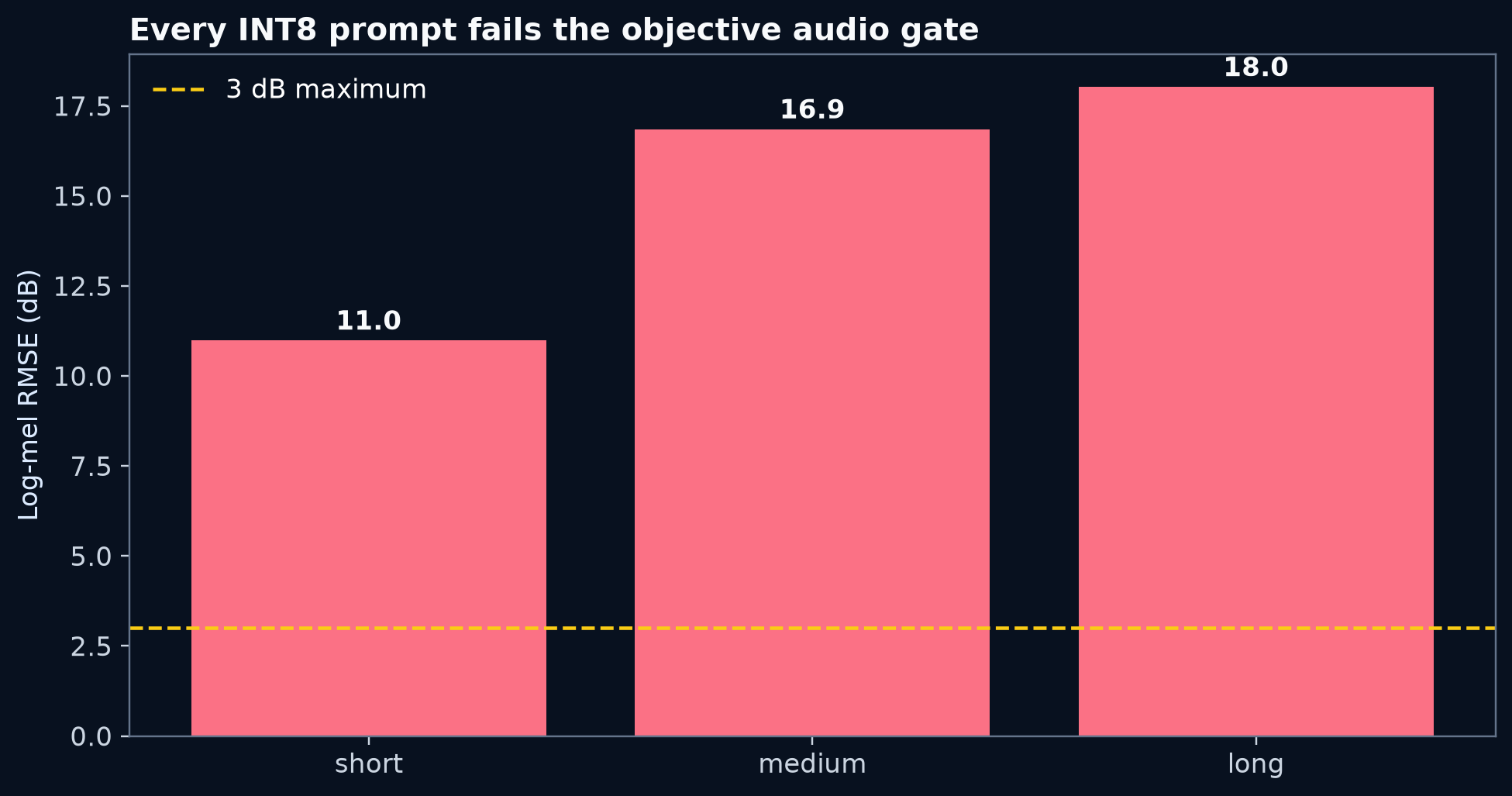 Full retest audio quality for Grok Linear-only INT8
If you already heard samples above, here is the full blind pack. Listen without revealing which files are FP32 or INT8:
Sample 01
Sample 02
Sample 03
Sample 04
Sample 05
Sample 06
Record intelligibility, naturalness, artifacts, and overall quality in the listening score sheet. Only after scoring, open the answer key to identify the FP32 and INT8 samples. Human ratings remain pending.
What the result means
The 51/100 artifact score stays unchanged. Independent evaluator work cannot retroactively improve the methodology of the submitted repository.
Separately, the verified performance assessment is now:
Quality-limited rejection. Linear-only INT8 has a repeatable 6-8% process-isolated latency benefit, only 2-3% resident benefit, and unacceptable objective audio differences.
That is more favorable, and more precise, than saying Grok was simply bad.
What should be tested next?
These are follow-up experiments, not work already completed in this comparison:
- Find the source of the audio damage. Separate weight-normalization removal from INT8 quantization to see which change breaks fidelity.
- Quantize selectively. Test small groups of Linear layers and retain only combinations that preserve speech.
- Strengthen the quality gate. Add intelligibility checks and scored human listening before calling an optimization deployable.
- Finish the OpenVINO path. Run real text through the complete TTS pipeline instead of timing dummy tensors.
- Optimize the real hotspot. Explore convolution kernels and Snake/sine fusion, where all three profiles show more potential than Linear layers.
Artifacts map
| Path | Role |
|---|---|
| REPORT_2.md | Full audit, scoring, protocol, and exact intervals |
| Retest summary | Two-run verified verdict |
| Run 1 / Run 2 | Complete raw timing and quality records |
| Blind pack | Randomized listening samples and score sheet |
| Grok submission | Original curated artifact |
Technical bottom line
Opus 5 still produced the most trustworthy research artifact (83/100). Grok 4.6 did find a modest real optimization (~6–8% isolated), but its original evidence overstated the gain and its output failed quality validation. Kimi’s and Opus’s thread-based speed claims also did not survive as shippable wins after independent replay.
The lesson is not "Grok is bad." It is that profiling skill, optimization ideas, experimental proof, and production judgment are separate capabilities, and this task rewarded all four.
Try NEO in your IDE
Use NEO with your preferred model keys while keeping the workflow, tools, and evidence in one place:
- VS Code: Install NEO for VS Code
- Cursor: Install NEO for Cursor