

sft-auditor: Find What's Wrong in Your Fine-Tuning Dataset Before You Train

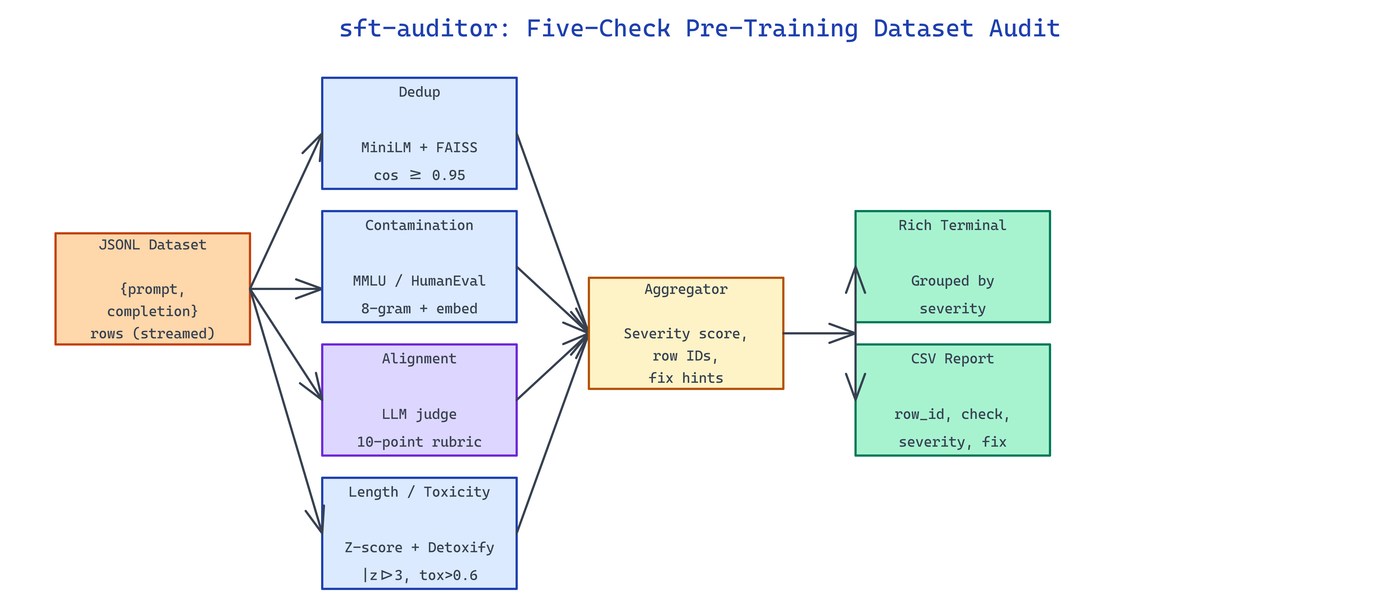 Pipeline Architecture
The Problem
Teams spend four-figure GPU bills fine-tuning on datasets with hidden duplicates, leaked MMLU questions, and system-prompt violations — then wonder why eval numbers look suspicious and deployed models refuse to follow instructions.
NEO built sft-auditor to catch all five failure modes in a single pre-training pass so bad data never reaches the optimizer.
Five Checks in One Pass
sft-auditor runs five independent checks over a JSONL fine-tuning dataset with {prompt, completion} fields and produces a consolidated report. Each check outputs a severity score, affected row IDs, and an actionable fix recommendation.
python audit.py --input dataset.jsonl --output report.csv --checks all
The auditor streams the file so it scales to multi-million-row datasets without loading everything into memory; embedding computations are batched and cached on disk keyed by prompt hash.
Duplicate Detection and Contamination Scans
The dedup check encodes every prompt with sentence-transformers/all-MiniLM-L6-v2 and runs an approximate nearest-neighbor search (FAISS IndexFlatIP) with a cosine similarity threshold of 0.95. Matches are grouped into duplicate clusters with a canonical row marked for retention — surfacing soft duplicates that hash(prompt) alone would miss.
Benchmark contamination runs two scans: MMLU contamination compares prompts against the full 15,908-question MMLU test set, and HumanEval contamination compares completions against the 164-problem reference implementations. Both use n-gram overlap (8-gram minimum) plus embedding similarity to catch paraphrased leaks.
| Check | Method | Threshold | Output |
|---|---|---|---|
| Duplicates | MiniLM + FAISS | cos ≥ 0.95 | Cluster groups |
| MMLU leak | 8-gram + embed | any match | Row + source Q |
| HumanEval leak | 8-gram + embed | any match | Row + source fn |
| Alignment | LLM judge | score < 6/10 | Row + rationale |
| Length anomaly | Z-score | |z| > 3 | Row + length |
| Toxicity | Detoxify | score > 0.6 | Row + labels |
Alignment, Length, and Toxicity Signals
The alignment check prompts a judge LLM with both the expected system behavior and the (prompt, completion) pair, scoring how well the completion respects the system role on a 10-point rubric. Scores below 6 are flagged with the judge's rationale attached. Length anomalies surface completions that are absurdly short or long via a Z-score computed over the dataset's own length distribution. Toxicity uses the Detoxify multi-label classifier and flags any row exceeding 0.6 on any of its six categories.
Output is rendered via Rich in the terminal for interactive review and written to CSV for pipeline integration:
python audit.py \
  --input sft_dataset.jsonl \
  --checks dedup,mmlu,humaneval,alignment,length,toxicity \
  --output audit_report.csv \
  --toxicity-threshold 0.6
The terminal view groups findings by severity and shows a sampled row from each issue type; the CSV contains one row per finding with {row_id, check, severity, details, fix} so downstream pipelines can filter, patch, or block training automatically.
How to Build This with NEO
Open NEO in VS Code or Cursor and describe what you want to build. A good starting prompt for this project:
"Build a JSONL fine-tuning dataset auditor that runs five checks in a single streaming pass: semantic duplicate detection with MiniLM embeddings and FAISS, MMLU and HumanEval contamination scans using n-gram overlap plus embedding similarity, alignment scoring via an LLM judge with a 10-point rubric, length anomaly detection using Z-scores, and toxicity flagging with Detoxify. Render findings with Rich in the terminal and export to CSV."
NEO generates the project structure and core implementation. From there you iterate — add custom benchmarks beyond MMLU, wire the output into a CI gate that blocks training on severity-high findings, or build an auto-fix mode that removes or rewrites problematic rows. Each request builds on what's already there.
To run the finished project:
git clone https://github.com/dakshjain-1616/sft-auditor
cd sft-auditor
pip install -r requirements.txt
python audit.py --input examples/sft_dataset.jsonl --output report.csv
Review the terminal summary for severity counts and open report.csv for the full per-row findings with fix recommendations.
NEO built a pre-training audit tool that catches dataset problems before they cost GPU hours, and produces a single consolidated report that ops teams can act on. See what else NEO ships at heyneo.com.
Try NEO in Your IDE
Install the NEO extension to bring AI-powered development directly into your workflow:
- VS Code: NEO in VS Code
- Cursor: Install NEO for Cursor