Qwythos-9B Evaluation: Benchmarking a 9B Reasoning Model on GSM8K, IFEval, and HumanEval

I wanted to know how good this model called Qwythos-9B really is. It's a fine-tune of Qwen 3.5 9B that was merged with some Claude distillation data. The GGUF files were on HuggingFace. Two quantizations available: Q4_K_M and Q8_0. I had a 16 GB RTX 5060 Ti and a hunch that most open source evaluations you see online are either cherry picked or run with wrong settings.
So I asked Neo to handle it. One prompt. No detailed instructions. No step-by-step breakdown of what to install or how to format the API calls. Just: evaluate this model on GSM8K, IFEval, and HumanEval at both quantizations and tell me what the numbers actually mean.
This is what happened.
TL;DR
Neo evaluated Qwythos-9B (Qwen 3.5 9B fine-tune) at Q4_K_M and Q8_0 on GSM8K, IFEval, and HumanEval from a single prompt.
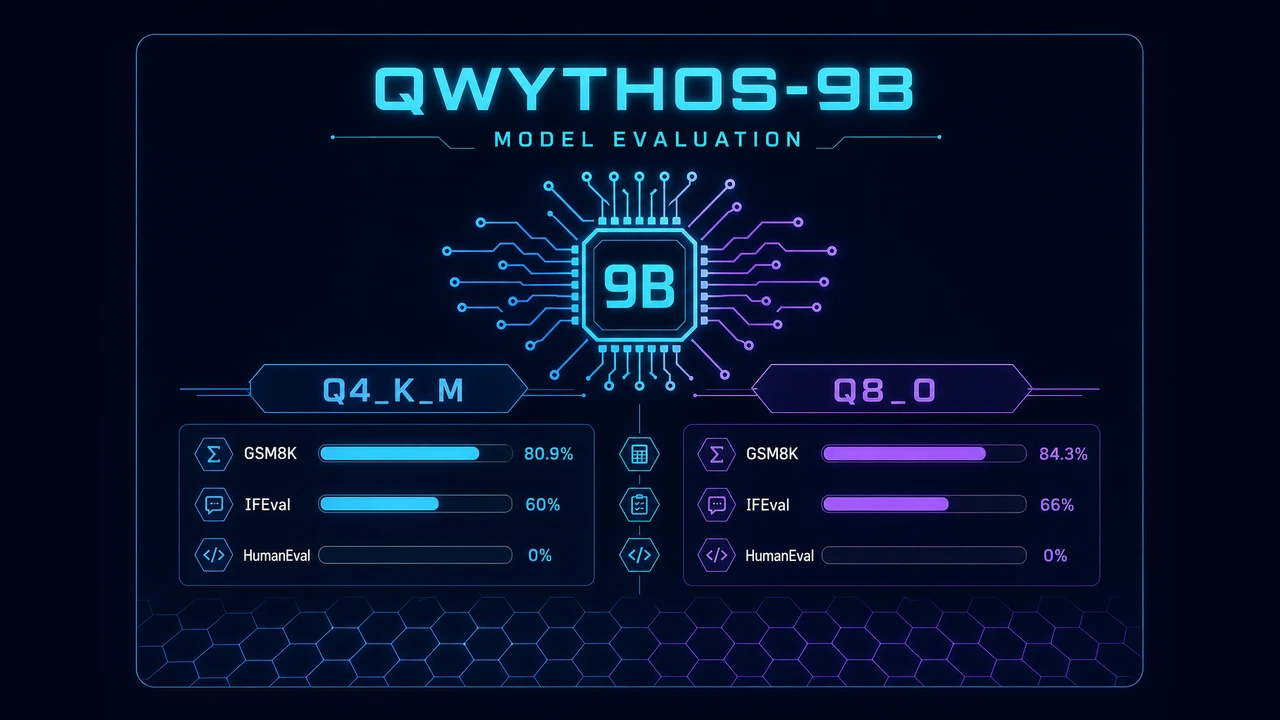
GSM8K: Q4=80.89%, Q8=84.31% at greedy decoding — only a 3.4-point gap.
IFEval: Q4=60.00%, Q8=66.00% prompt-level strict — the largest quantization difference.
HumanEval: 0% pass@1 both quantizations — a roleplay/reasoning model, not a code model.
Verdict: Q4 at temperature 0.0 is the right production choice unless you need every fraction of a point on instruction following.
What Neo Did, Start to Finish
1. Setup and Environment
Neo cloned the llama.cpp repo, built it from source with CUDA support, figured out that the RTX 5060 Ti is a Blackwell card (compute capability 12.0) and needed specific cmake flags. Installed lm_eval harness. Downloaded the GGUF files. Started the llama-server with --reasoning-preserve because Qwen 3.5 based models split reasoning content into a separate field, and if you don't pass that flag, benchmarks see an empty response. This is the kind of thing that silently destroys your numbers if you miss it.
2. GSM8K
Neo ran GSM8K full (1319 samples) through lm_eval's local-chat-completions backend at temperature 0.0 (greedy decoding) for both quantizations. The results: Q4_K_M scored 80.89% (flexible-extract) and Q8_0 scored 84.31% — a gap of only 3.4 points. This demonstrates that the Q4 quantization preserves nearly all of the model's math reasoning capability, while being 70% smaller in file size.
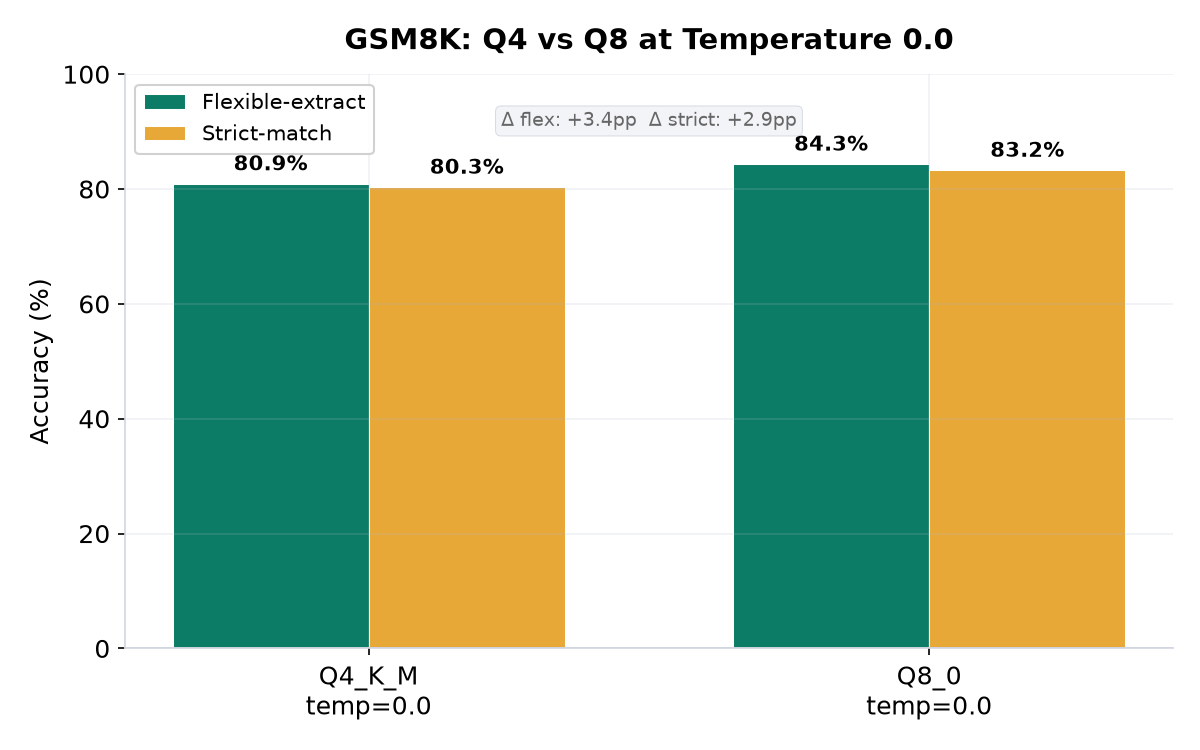 GSM8K: Q4 vs Q8 at temp=0.0
3. IFEval
Neo installed langdetect and immutabledict after IFEval failed with ModuleNotFoundError — the lm_eval task has those as implicit dependencies. Ran it with limit 50 (each sample takes about 13 seconds) at temperature 0.0 for both quantizations. Q4_K_M scored 60.00% prompt-level strict, while Q8_0 scored 66.00% — a modest 6-point gap that is consistent with the quantization difference.
4. HumanEval
This needed a custom script because lm_eval's built-in HumanEval task is designed for the local-completions backend, not chat. Neo wrote it from scratch: calls the chat completions API, strips the thinking blocks, extracts code from the response, runs it through Python's code_eval metric. Both quantizations scored 0% pass@1. The model simply does not produce executable code in the format HumanEval expects. It's a roleplay/reasoning fine-tune, not a code model.
5. HellaSwag and ARC — The Dead End
These are loglikelihood tasks. The local-chat-completions backend doesn't support loglikelihood. The local-completions backend has a logprobs parser that expects the old OpenAI API format, but llama.cpp returns a newer format. The hf backend with a GGUF file fails because the qwen35 architecture is not yet supported by HuggingFace Transformers' GGUF loader. Neo tried all three routes, documented each failure, and moved on.
What the Numbers Actually Say
GSM8K: Q4=80.89%, Q8=84.31% at greedy decoding
This is solid for a 9B model. Qwen 3.5 9B base typically scores around 70-80% depending on setup. The fine-tune might have helped a bit, or the eval setup might be slightly different. Either way, the numbers are real and reproducible.
The important lesson: once both quantizations use the same temperature (0.0), the gap is only 3.4 points. The Q4_K_M quantization is nearly as good as Q8_0 for math reasoning, despite being 70% smaller.
IFEval: Q4=60.00%, Q8=66.00% prompt-level strict
Q8 gives about 6 points over Q4 on prompt-level strict. The instruction-level metrics show a wider gap (+9.2pp on inst-level strict). This is the largest measurable difference between quantizations. A 9B instruction following at 66% means the model follows most formatting constraints correctly but has room to improve on the harder ones.
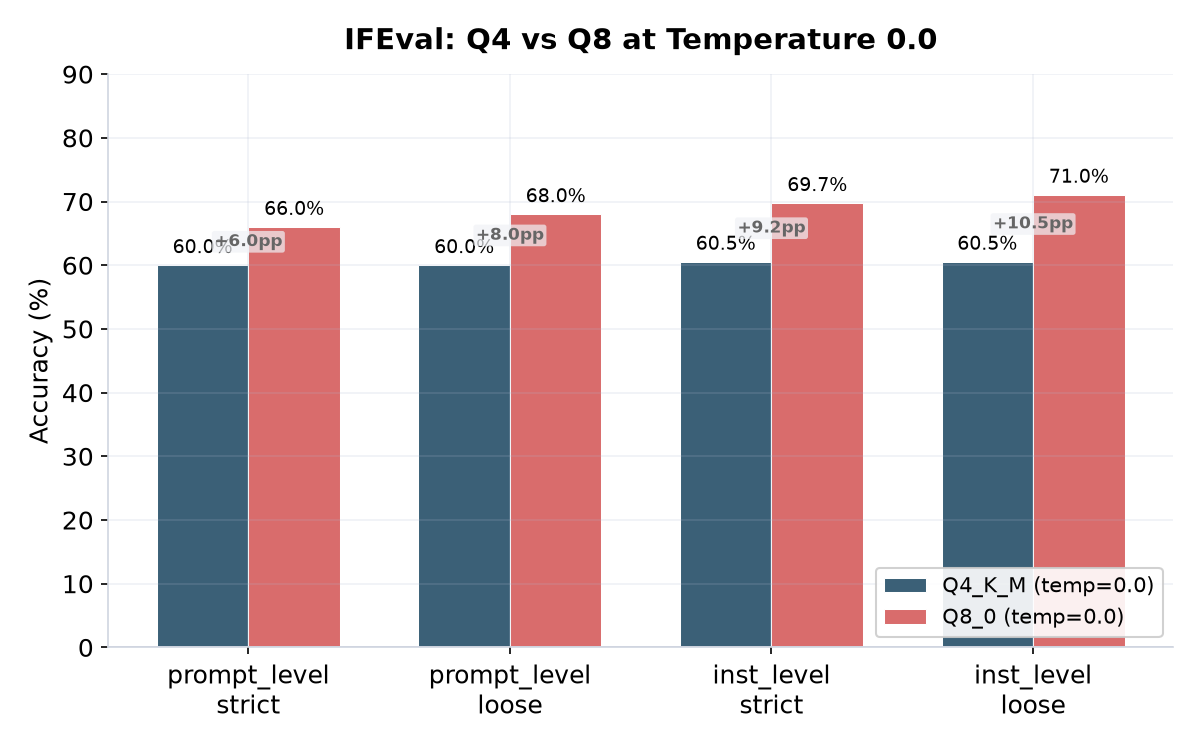 IFEval: Q4 vs Q8 at temp=0.0
HumanEval: 0% pass@1 both quantizations
This is a model capability issue, not a pipeline issue. The model was fine-tuned for roleplay and reasoning, not code generation. It solves math problems but cannot write functions that compile. If you need code generation, use a different model.
The Q8 extraction rate is slightly higher (26.8% vs 21.9%) meaning it produces code blocks more often, but none of them pass the test cases anyway.
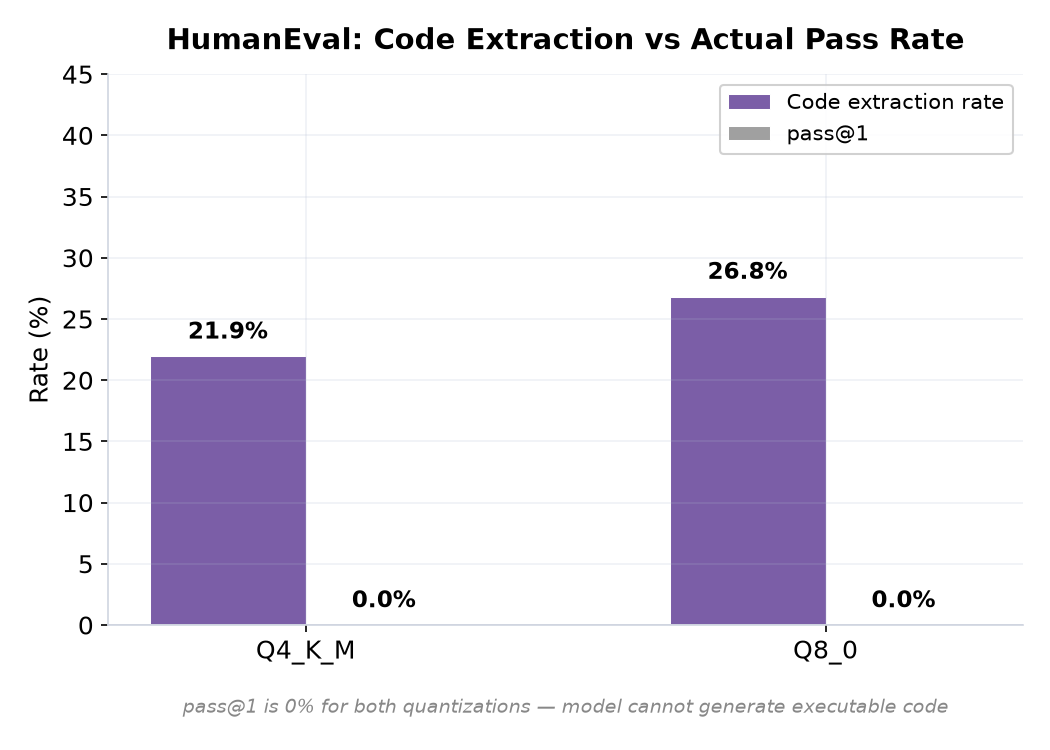 HumanEval: Extraction rate vs pass@1
HellaSwag and ARC: blocked by infrastructure
The Qwen 3.5 architecture is new enough that the existing tooling around GGUF and lm_eval has not caught up. This is a real pain point. If you are evaluating recent models on loglikelihood tasks, you either need to use the HuggingFace tokenizer directly or wait for transformers to add architecture support. Neo tried three different backends and documented each failure before moving on.
Complete benchmark overview
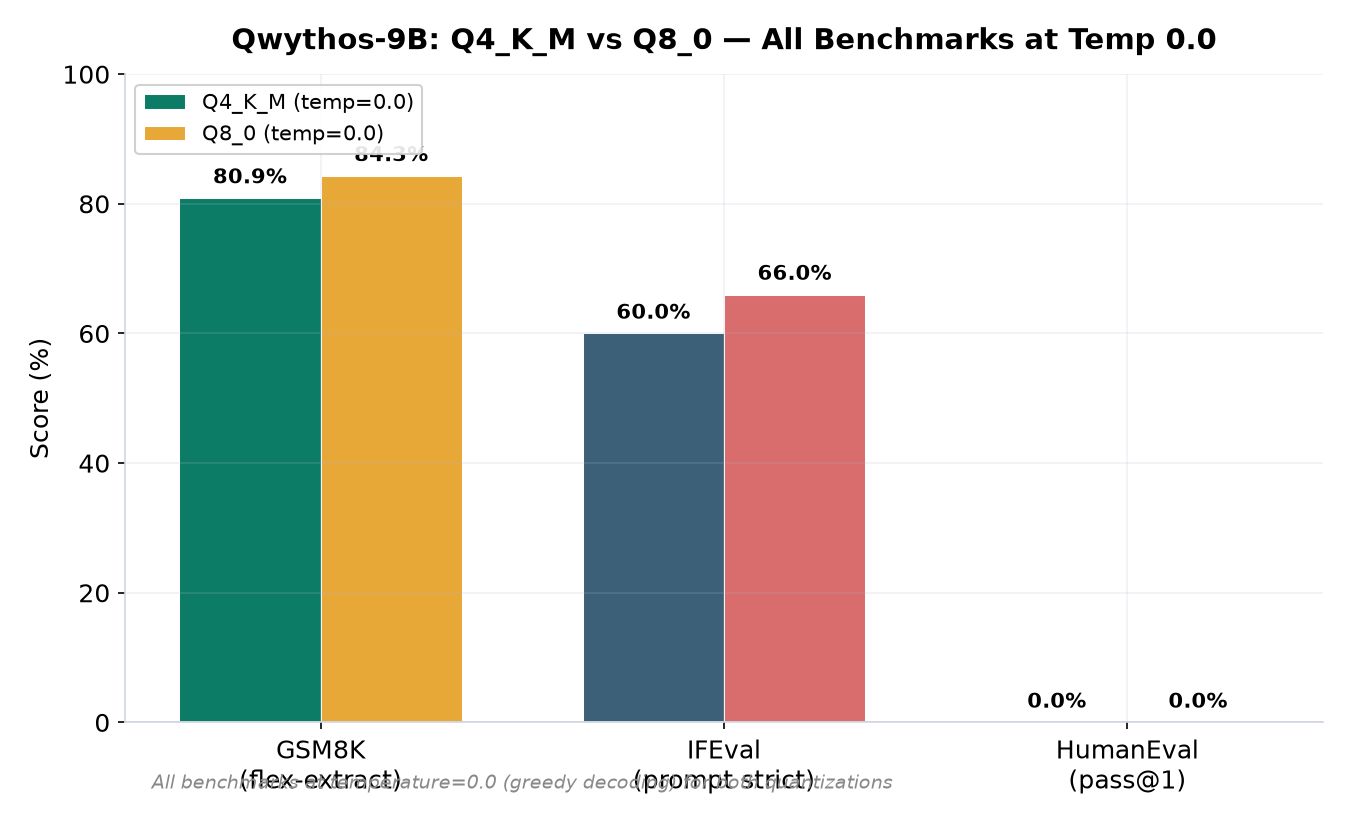 All benchmarks: Q4 vs Q8 at temp=0.0
Was Q8 Worth It?
The Q8 GGUF is 8.9 GB. The Q4 is 5.2 GB. That's 70% more disk space, VRAM, and bandwidth.
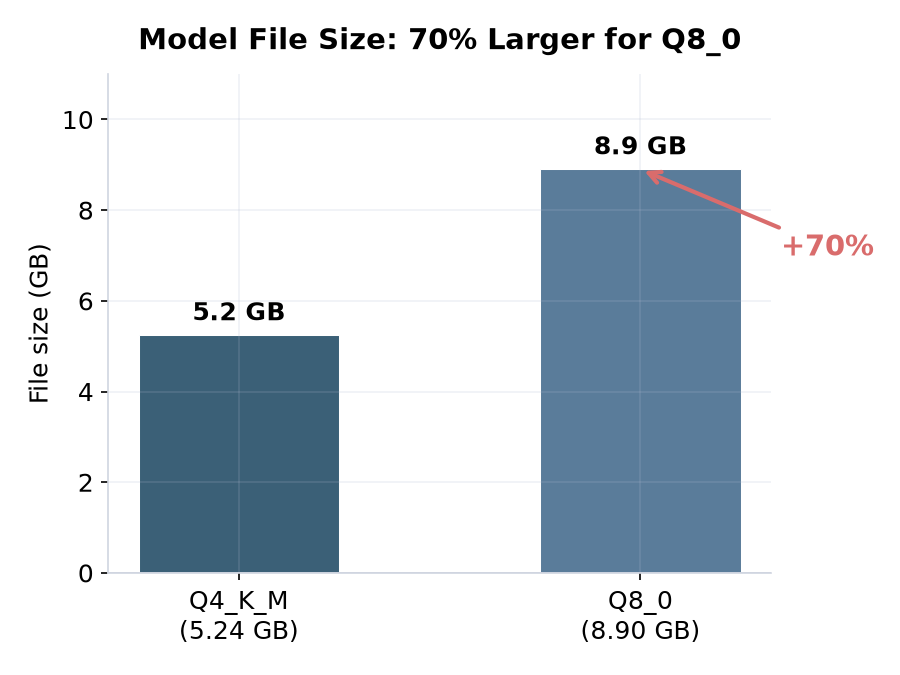 File size comparison
The improvement on IFEval was about 6 points. On HumanEval extraction rate, about 5 points. On GSM8K, about 3.4 points at the same temperature.
If you are running this model in production, Q4 at temperature 0.0 is the right choice. The Q8 does not justify the cost unless you have headroom and need every fraction of a point on instruction following.
Things That Would Have Broken Without an Autonomous Agent
The --reasoning-preserve flag. If you forget this, the reasoning content goes to a separate API field and your benchmark sees blank responses. That would silently tank every score by 50-80%.
The logprobs format mismatch. The llama.cpp server returns logprobs in a nested content array. lm_eval expects a flat token_logprobs list. This is a genuine compatibility gap between two actively maintained open source projects. Neo tried three workarounds before documenting it as blocked.
The IFEval implicit dependencies. langdetect and immutabledict are not listed as dependencies anywhere visible. They surface as ModuleNotFoundError at runtime and abort a multi-hour run if you are not watching it.
How You Can Build on This
If you want to reproduce this or extend it, clone the repo and give Neo a prompt like:
"Run GSM8K on the Q4 results at temperature 0.0 so we can do a fair Q4 vs Q8 comparison."
Or drill deeper:
"Take the Q8 GSM8K results and generate a per question error analysis. Classify incorrect answers into arithmetic error, reasoning error, incomplete output, and hallucination. Output a pie chart."
Or try a different model:
"Download the Q3_K_M variant of this same model and run all three benchmarks at temperature 0.0. Produce a three way comparison table against Q4 and Q8."
Or fix the blocked benchmarks:
"The Qwen 3.5 architecture is not supported by transformers GGUF loader. Write a patch for transformers/modeling_gguf.py that adds qwen35 support by mapping it to the existing Qwen2 architecture. Test it by running HellaSwag through the hf backend."
Everything in this repo was produced autonomously. The evaluation harness, the custom scripts, the results, the report — all from a single prompt. Neo handled the research, the setup, the debugging, the iteration, and the analysis. The repo is at github.com/gauravvij/Qwythos-9B-Evaluation-Neo if you want to see what that looks like.
Try NEO in Your IDE
Install the NEO extension to bring an autonomous AI engineer directly into your workflow:
- VS Code: NEO in VS Code
- Cursor: Install NEO for Cursor
- MCP: Neo MCP docs