
How NEO Improved the Pi Coding Agent from 82% to 95%

Performed using NEO AI Engineer
An AI agent improved another AI agent. We gave NEO one high-level brief: run an automated research loop and make the pi coding agent better at QuixBugs. We did not tell it which failures to target or which prompt changes to make.
NEO ran the benchmark, inspected the failed attempts, formed hypotheses, edited pi, and measured each revision. It stopped after five general instructions raised pi's development score from 49/60 to 57/60. The frozen version then solved 19/20 tasks on a sealed holdout, up from a stored baseline of 16/20.
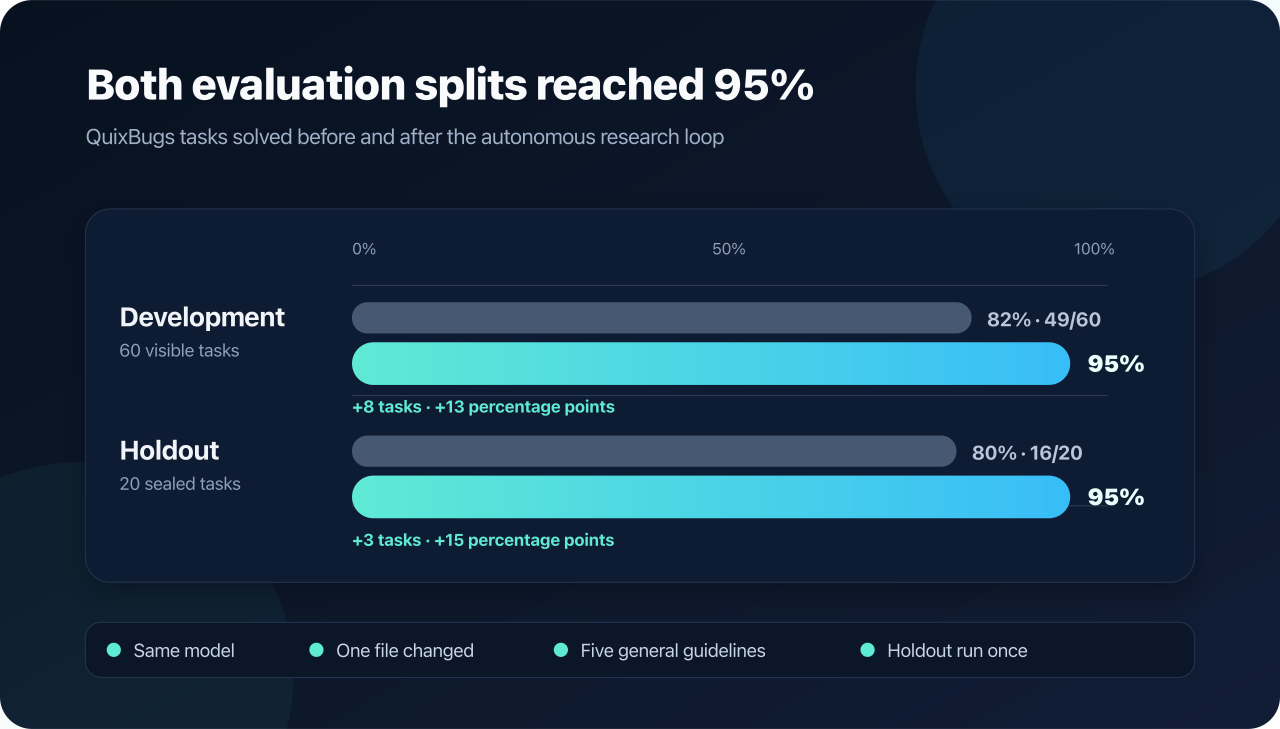 NEO's changes raised both development and holdout scores to 95%
The short version
| Evaluation split | Before | After | Change |
|---|---|---|---|
| Development, 60 tasks | 49/60, 82% | 57/60, 95% | +8 tasks, +13 percentage points |
| Sealed holdout, 20 tasks | 16/20, 80% | 19/20, 95% | +3 tasks, +15 percentage points |
The language model stayed fixed throughout: openrouter/z-ai/glm-5.3-flash. NEO changed one file, pi/packages/coding-agent/src/core/system-prompt.ts. It did not modify model weights, the benchmark, the grader, or individual task solutions.
The holdout set remained sealed until the development loop had stopped. NEO ran it once on the frozen final version.
What “autonomous” meant in this experiment
“Autonomous” can describe anything from a fixed chain of model calls to a system that chooses its own actions. Here, it has a specific meaning. A person set the objective and constraints, then NEO chose what to inspect, which hypothesis to test, and whether to keep each change.
This was not a chat session where a person diagnosed every failure and supplied the next prompt edit. NEO operated the experimental loop itself:
- ran pi on all 60 development tasks;
- decoded pi's action traces and read the grader output;
- grouped failures by their underlying cause;
- proposed one general hypothesis;
- changed only pi's system prompt;
- ran type checks, tests, and a build;
- measured the updated agent on the same development split;
- kept or rejected the change from the evidence.
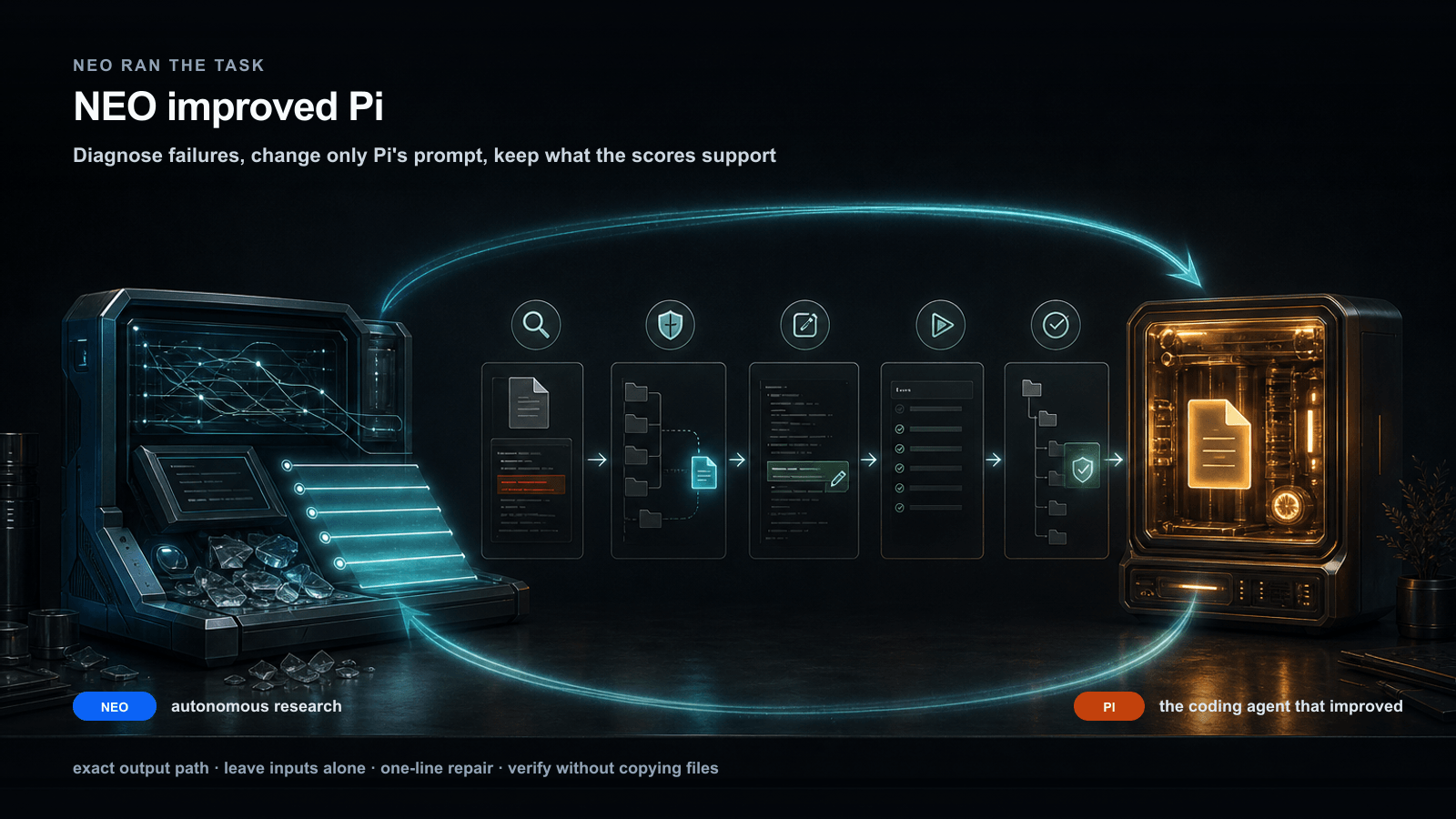 NEO ran the research loop and improved the Pi coding agent
Automating a benchmark command would not be enough. NEO also interpreted trajectories, revised its diagnosis after a regression, and stopped when another prompt change risked fitting noise.
The repository contains the full ledger in experiment_notes.md. The scored run outputs live under quixbugs/jobs/ in the working experiment environment.
The experiment changed one surface only
QuixBugs contains 80 small bug-fixing tasks: 40 in Java and 40 in Python. The experiment used 60 tasks for development and reserved 20 as a sealed holdout set.
| Component | Fixed or changed? | Detail |
|---|---|---|
| Language model | Fixed | openrouter/z-ai/glm-5.3-flash |
| Development set | Fixed | 60 tasks used during the research loop |
| Holdout set | Fixed and sealed | 20 tasks used once after the loop stopped |
| Grader | Fixed | Functional tests plus an exact one-line-change check |
| pi system prompt | Changed | Five general guidelines in one TypeScript file |
That setup does not remove every source of randomness. Model outputs still vary between attempts. It does isolate the engineering surface NEO was allowed to change.
Why correct code could still score zero
Each task had two important checks. First, the repaired program had to pass its functional tests. Second, the submitted fix had to differ from the original by exactly one line.
The second rule created an important trap. pi could identify the bug and produce working code, yet still score zero. For example, it sometimes edited the original file and then copied that file to the required output path. The two files were now identical, so the grader saw a zero-line difference.
This is less like answering a coding question and more like working inside a strict delivery process. A correct repair is not enough. The agent must also preserve the input, write to the exact destination, and satisfy the requested change format.
The baseline showed one dominant failure
The fresh development baseline solved 49 of 60 tasks, or 82%. NEO inspected all 11 failures. It did not immediately add generic advice to “reason harder.”
It found three groups:
| Failure class | Tasks | What went wrong |
|---|---|---|
| Zero-line difference | 7 | Python code worked, but pi changed the input file and produced an output identical to it. |
| Incorrect Java repair | 3 | The one-line rule passed, but Java tests failed. |
| Incorrect Python repair | 1 | The Python functional tests failed. |
Seven of the 11 losses shared one behavioral cause. The largest opportunity was therefore not deeper algorithmic reasoning. It was reliable file handling.
This diagnosis shaped the first experiment. It also illustrates the value of reading an agent's trajectory, which is the record of its actions and reasoning during a task. Final scores say which tasks failed. Trajectories can explain why.
H1 fixed the output-file trap
NEO's first hypothesis was direct: pi was mutating the supplied source before creating the requested result. General instructions about output fidelity should prevent that pattern.
It added two guidelines. One told pi to write the complete result to the exact output path named by the task. The other told pi to leave supplied input files unchanged unless the task explicitly requested an in-place edit. In shortened form:
Write the complete result to exactly the named output path.
Leave provided input files unchanged unless an in-place edit is requested.
The next development run solved 55/60 tasks, or 92%. That was six more successes than the baseline.
Because agent runs are stochastic, NEO did not treat one run as definitive. A three-attempt confirmation solved 164 of 180 task attempts, a 91% mean. The two apparent regressions from the first H1 run did not repeat. Only java-minimum_spanning_tree failed in all three attempts.
NEO kept H1. The evidence supported a repeatable gain, and the change addressed a general behavior rather than a list of benchmark cases.
H2 showed how good advice can backfire
After H1, the remaining failures pointed toward minimal edits and weak self-checking. pi sometimes rearranged code when the task required one substituted line. It also relied on informal checks instead of the project's own tests.
NEO added two more guidelines:
- replace the faulty line in place instead of restructuring nearby code;
- before finishing, run the project's checks and compare the old and new files.
The result fell slightly from H1's single-run score of 55/60 to 54/60. It still remained five tasks above the baseline, but the drop required investigation.
NEO decoded all six failed trajectories. Three Java failures shared a new cause. When a direct javac command failed because of the package layout, pi created a java_programs/ directory and copied or moved the source into it. The grader then found two files defining the same class and failed with duplicate class.
The verification instruction was reasonable in isolation. Its interaction with Java packaging made the submitted workspace invalid.
The failure followed a consistent chain:
verify with javac
→ hit a package-layout error
→ copy the file into java_programs/
→ leave two definitions of the same class
→ fail the grader with “duplicate class”
The other three failures had different causes. One was a network failure while Gradle downloaded a dependency. One was a genuine minimum-spanning-tree logic error. One Python repair returned the correct subsets in the wrong order.
A three-attempt H2 run scored 163/180, or a 90.6% mean. That was effectively level with H1's 91% mean. More importantly, the failure analysis exposed a precise and fixable side effect. NEO retained H2 as a stepping stone and targeted that side effect next.
H3 constrained verification instead of removing it
NEO did not remove the verification rule. It narrowed it. The fifth guideline told pi not to move or duplicate the named source file. pi could test in place or use a separate temporary directory without changing the submitted workspace.
The next development run solved 57/60 tasks, or 95%. Searches across the H3 grader output found zero duplicate class errors. The failure class introduced by H2 had disappeared.
H3 gained eight passing tasks relative to H2 and lost three. Those three losses came from previously inconsistent tasks, and none involved duplicate classes. The specific behavior targeted by H3 was gone.
NEO kept the change and froze this version. The complete development path was not a smooth climb:
| Version | Prompt change | Development score | Decision |
|---|---|---|---|
| Baseline | None | 49/60, 82% | Diagnose failures |
| H1, iteration 1 | Output path and input preservation | 55/60, 92% | Keep |
| H2, iteration 2 | Minimal edit and self-verification | 54/60, 90% | Investigate, then keep as a stepping stone |
| H3, iteration 3 | Verification without duplicate files | 57/60, 95% | Keep and freeze |
The H2 dip matters. Without it, the result would look like prompt wording found by trial and error. In practice, the regression supplied the evidence for H3.
Why NEO stopped at 95%
The final development run still failed three tasks, but they did not form one clean cluster:
java-breadth_first_searchchanged two lines despite the one-line contract;java-shortest_pathsproduced a Java repair that failed functional tests;python-topological_orderingrepeated the earlier zero-line-difference behavior.
All three had varied across earlier runs. No single task-independent prompt rule clearly addressed them without risking the gains already made.
Stopping was part of the research process. Continuing to tune against three unrelated development failures could have fitted the prompt to noise. NEO froze pi at the H3 state rather than chasing a perfect development score.
One sealed run tested whether the gain transferred
An improvement on the tasks used during research can come from overfitting. The 20-task holdout provided a stronger test because NEO had not used those results to select its hypotheses.
The stored holdout baseline was 16/20, or 80%. On the frozen H3 prompt, the single final run solved 19/20, or 95%. All ten Java tasks passed, along with nine of ten Python tasks. The only failure was python-possible_change.
The holdout run took 16m 49s. It used 319,075 input tokens and 32,204 output tokens, with a recorded model cost of $0.0155.
The holdout does not prove that every coding benchmark will improve by 15 percentage points. It does show that the selected guidelines transferred to unseen QuixBugs tasks in this split. That is stronger evidence than the development score alone.
There are two important limits. The final H3 development score came from one attempt per task, and H3 did not receive its own three-attempt confirmation. The holdout comparison also uses a stored baseline rather than a fresh paired rerun. These results support the improvement, but they do not remove run-to-run variance.
What changed in pi
The five retained instructions can be summarized without the implementation syntax:
- Write a requested result to the exact path and filename.
- Preserve supplied inputs unless an in-place edit is explicitly requested.
- For a one-line repair, replace that line without restructuring the file.
- Run the project's own checks and inspect the final difference before finishing.
- Verify without moving source files or creating duplicate package trees.
These are not QuixBugs answers. They are operating rules for working inside a repository with strict output contracts.
The improvement also did not come from changing the language model. The same model ran before and after. The measured variable was the guidance around how pi handled files, minimal changes, and verification.
What we learned
First, agent failures are often procedural. Seven baseline tasks contained functionally correct Python, but file handling converted those repairs into zero scores.
Second, more verification is not automatically better. H2's instruction encouraged useful checking, especially on Python, but also caused pi to damage Java workspaces. The next gain came from studying that side effect, not from adding broader encouragement.
Third, autonomous research needs experimental discipline. NEO changed one factor at a time, used repeated runs when a result was ambiguous, preserved a sealed holdout, and stopped at a defensible plateau.
Finally, system prompts can be a meaningful engineering surface. Five task-independent instructions improved both measured splits to 95%. The claim is deliberately narrow: it applies to this agent, model, benchmark, harness, and split.
The interesting result is not simply that a longer prompt scored higher. NEO found concrete behavioral failures, tested targeted changes, detected a regression it had caused, and corrected it. That made this an autonomous research loop rather than a prompt-editing demo.
Reproduce the evaluation
Run the development split with:
cd quixbugs
PYTHONPATH=. ./.venv/bin/harbor run \
  -c dev.yaml --env-file .env -k 1 --job-name <name>
PYTHONPATH=. python3 summarize.py jobs/<name>
Run a holdout candidate with:
cd quixbugs
PYTHONPATH=. ./.venv/bin/harbor run \
  -c holdout.yaml --env-file .env -k 1 --job-name <name>
PYTHONPATH=. python3 summarize.py jobs/<name>
To match the recorded setup, install fd-find and set PI_NO_LOCAL_LLM=1 for the pi test suite. Pass the env-file option with .env to Harbor. On the four-core experiment machine, jobs had to run sequentially. The full pi gate used three commands because one chained command exceeded the available timeout:
cd pi
npm run check
PI_NO_LOCAL_LLM=1 npm test
npm run build
The detailed evidence is in experiment_notes.md. The final implementation is in pi/packages/coding-agent/src/core/system-prompt.ts, frozen at the experiment's H3 revision.
Try NEO in Your IDE
Install the NEO extension to bring AI-powered development directly into your workflow:
- VS Code: NEO in VS Code
- Cursor: Install NEO for Cursor