Making Parakeet Faster on CPU

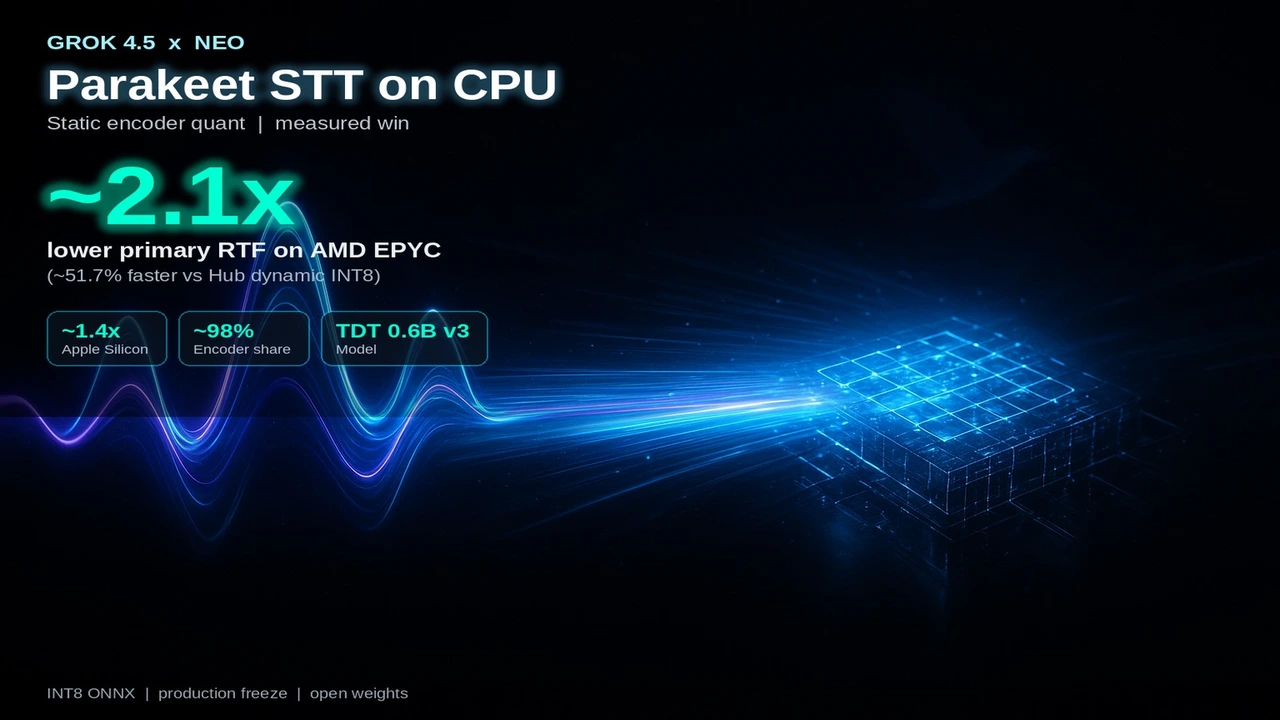
Neo took NVIDIA Parakeet TDT 0.6B v3 on CPU, profiled it, ran keep/discard ladders, and froze a static-QDQ production pack that cuts primary RTF by about half on EPYC.
TL;DR
What Neo built: A CPU profiling and experiment harness around Parakeet TDT 0.6B v3 in ONNX, plus keep/discard ladders for runtime knobs and encoder static quantization.
EPYC result: Primary RTF 0.038156 → 0.018432 (~2.07×), freeze gates green on a small English set.
Apple Silicon: Same packs on long audio with chunking still showed ~1.42× relative win.
What did not work: Runtime-only tuning (threads, ORT graph opts, app-level chunking) never cleared a honest ≥5% keep gate. The encoder was always the bottleneck.
- Repo: gauravvij/parakeet-optimization
- Production weights: gvij/parakeet-tdt-0.6b-v3-onnx-static-qdq-pc
- Baseline weights: istupakov/parakeet-tdt-0.6b-v3-onnx
- Personal workflow write-up: using-neo-grok-parakeet-cpu.md
Neo, an autonomous AI engineering agent, took a high-level goal, built the harness, ran the ladders, froze a production config, and published code plus weights. The work ran end to end inside Neo's VS Code harness with Grok 4.5 (xAI) via Neo's Bring Your Own LLM Key (BYOK) path. That is a practical note more than branding: long multi-step ML research loops (profile → hypothesize → implement → gate → discard) are exactly where a strong reasoning model plus an agent that can write and run code pays off.
This post assumes you already know RTF, ONNX Runtime, and static vs dynamic INT8. Trivial setup steps are skipped unless something unexpected forced a fix.
Outcome in one table
| Host / path | Baseline | Production | Relative |
|---|---|---|---|
AMD EPYC 9V74, 8 vCPU, full-file, primary RTF = geo-mean(medium_15s, long_30s) | RTF 0.038156 (~26.2× RTFx) | RTF 0.018432 (~54.3× RTFx) | ~51.7% lower RTF ≈ 2.07× |
Apple Silicon (user Mac), ~28 min English speech, chunk window 30 s / overlap 2 s, intra=8 | RTF 0.047576 (~21.0×) | RTF 0.033564 (~29.8×) | ~29.5% lower RTF ≈ 1.42× |
Quality freeze on EPYC (small English set, not a full multilingual suite): absolute JFK WER 0.0 for both configs; pairwise mean WER ~0.087 (3/5 exact normalized match; diffs concentrated on looped synthetic tails). Decision: FREEZE_PRODUCTION.
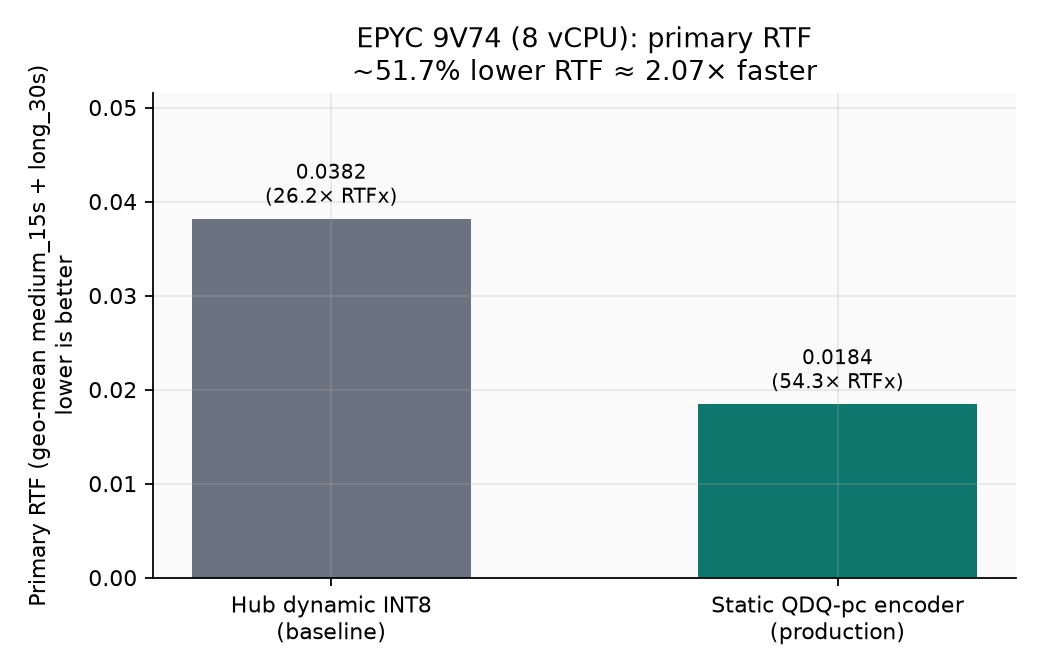 EPYC primary RTF
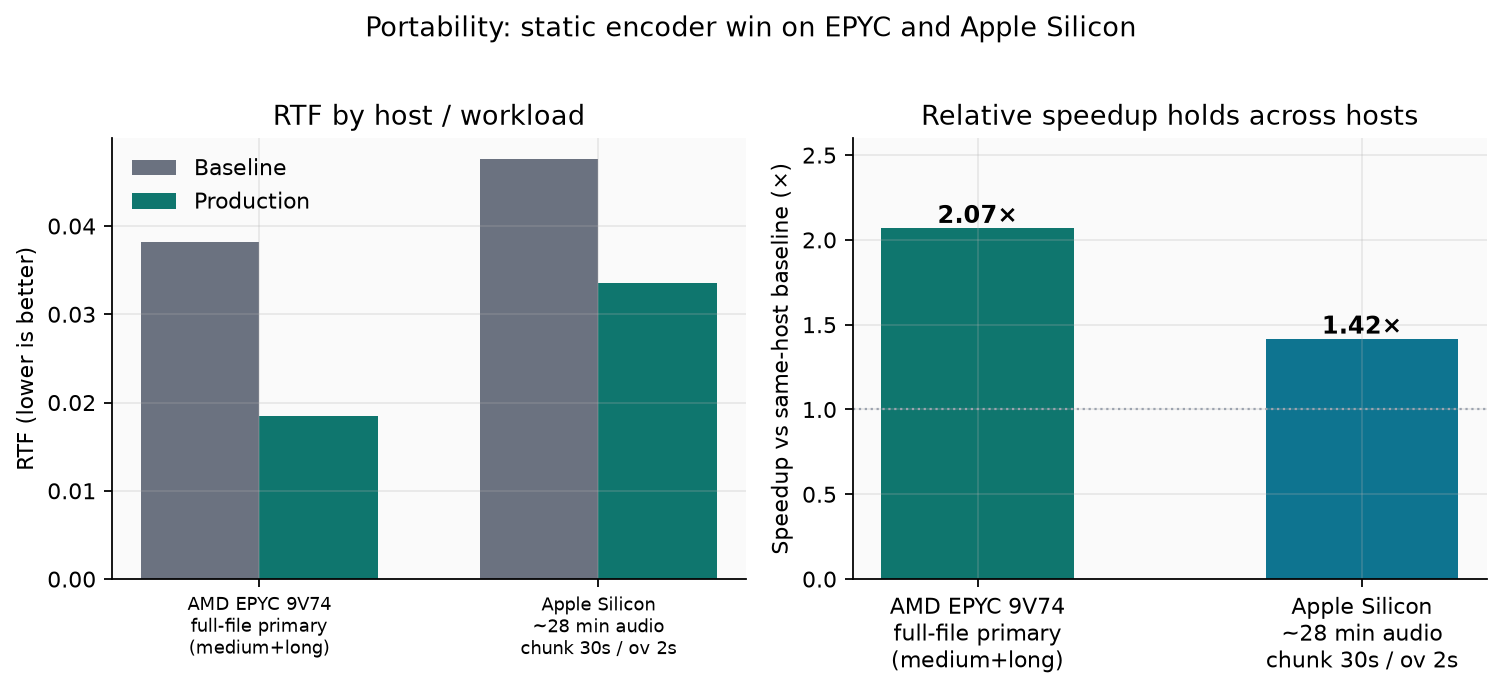 Cross-platform RTF and speedup
Absolute RTFx is host- and path-specific. The portable claim is the relative static-vs-dynamic encoder win, not "54× everywhere."
Starting point
Target model: nvidia/parakeet-tdt-0.6b-v3, consumed as INT8 ONNX via onnx-asr + ONNX Runtime CPU EP (no GPU on the primary host).
Public dynamic INT8 pack used as baseline:
istupakov/parakeet-tdt-0.6b-v3-onnx- encoder ~652 MB INT8, decoder joint ~18 MB,
nemo128frontend, vocab/config
Primary host:
- AMD EPYC 9V74, 8 logical CPUs, AVX-512 + VNNI
- ORT 1.27.0, providers effectively
CPUExecutionProvider(Azure EP present but not the optimization story) - ~63 GB RAM
Metric design (fixed before the ladders so we would not move goalposts):
- Primary speed: geometric mean of mean RTF on
medium_15sandlong_30s(lower better) - Keep gate: ≥ 5% primary RTF improvement vs reference + quality OK
- Quality: non-empty real speech; normalized match or high token overlap vs reference; later absolute JFK WER for freeze
Warmup 1 + repeats 3 for timed recognize() paths. Shell time includes model load; production numbers use warm inference / --benchmark style measurement.
Phase 1: Profile before optimizing
Neo built a profiling harness (scripts/profile_parakeet_cpu.py) rather than guessing knobs.
What the stage split said
On medium_15s at 4 threads, instrumented stages:
| Stage | Share |
|---|---|
| Encoder (FastConformer) | ~97.8% |
| Frontend (mel / STFT path) | ~1.1% |
| Decoder (TDT joint) | ~1.1% |
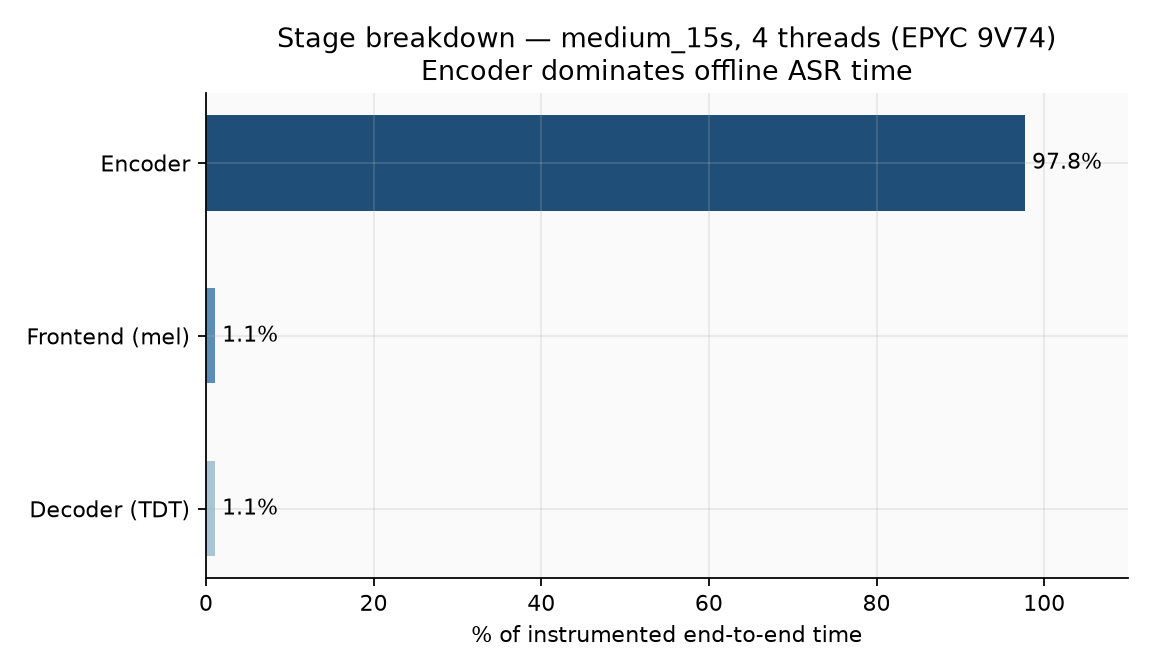 Stage breakdown
Offline batch=1 throughput is encoder-bound. Tuning the TDT decoder first would have been the wrong ROI.
What the ORT operator profile said
Inside the encoder profile window, after stripping session scaffolding noise, the heavy kernels were the usual INT8 suspects:
ConvIntegerDynamicQuantizeMatMul/MatMulIntegerToFloat
Attention softmax was a small fraction after 8× subsampling. Thread scaling 1→4 was strong; 4→8 still helped longer audio on this 8-vCPU box, with the usual diminishing returns.
Implication for the experiment plan: runtime thread/env polish might buy a few percent. Anything that changes how the encoder is quantized or executed is where a ≥5% keep might live.
Unexpected fix (load path)
onnx-asr's Hub glob for INT8 (encoder-model?int8.onnx) does not match Hub filenames encoder-model.int8.onnx. Automatic snapshot patterns failed; Neo switched to explicit hf_hub_download of the INT8 file list into a local dir and load with quantization='int8'. That detail is now documented in the repo README so others do not burn an hour on empty model dirs.
Phase 2: Runtime autoresearch ladder (E0-E6)
Script: scripts/autoresearch_cpu_opts.py
Ledger: results/autoresearch/ledger.jsonl
Design: sequential keep/discard experiments against a rolling best, same primary metric and quality gate.
| Bucket | What was tried | Result |
|---|---|---|
| Threads / OMP | 4 vs 8; PASSIVE vs ACTIVE; affinity | 8 threads clearly better than 4 (~20%). ACTIVE/affinity ~4-4.6% vs E0, below 5% gate |
| Session | mem pattern, CPU arena, parallel execution | Arena/mem variants ~1-4%. Parallel execution hurt badly |
| Graph | Offline ORT optimize into a new model dir (E3) | ~4%, no keep |
| EP | OpenVINO (E4) | Skipped: OpenVINO not in providers; optional install avoided to not replace the working ORT CPU wheel |
| Chunking | App-level window + concat on long audio (E5) | Regressed long_30s RTF 20-35% (extra session overhead, no encoder cache). Not a speed keep |
| Stack | Best residual knobs (E6) | ~4.8%, still under gate |
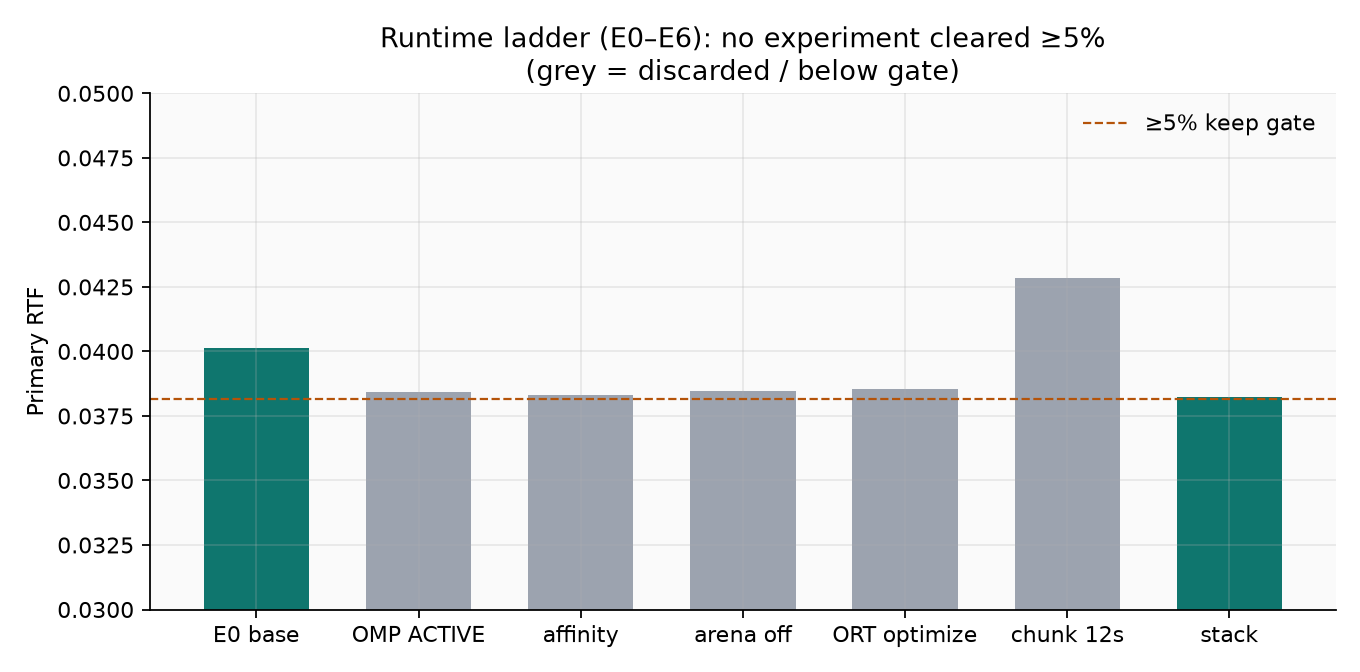 Runtime ladder
Conclusion from E0-E6: on this host and model, runtime-only knobs do not clear a honest ≥5% gate. The stack still ships sensible defaults (intra=8, inter=1, ORT_ENABLE_ALL, OMP PASSIVE) because they are correct operationally, not because they were the big win.
That negative result is useful. It stopped the project from shipping a pile of env-var folklore as "optimization."
Phase 3: Encoder static-quant ladder (C0-C3)
Script: scripts/autoresearch_encoder_opts.py
Ledger: results/autoresearch_encoder/ledger.jsonl
Hypothesis aligned with the profile: dynamic quant MatMuls pay a runtime tax; static QDQ on the FP32 encoder (calibrated, then exported) should cut encoder time if quality holds. Decoder/frontend stayed Hub dynamic INT8.
Calibration used mel features through nemo128 (not raw waveforms). Builds assembled full packs under models/… with external data for large encoder weights.
| ID | Variant | Primary RTF | vs C0 | Keep |
|---|---|---|---|---|
| C0 | Hub-style dynamic INT8 | 0.038742 | - | ref |
| C1 | QDQ MinMax per-tensor | 0.017709 | +54.3% | yes |
| C2 | QDQ MinMax per-channel | 0.017692 | +54.3% | best |
| C3 | MatMul/Gemm-only QDQ (+ some stack knobs) | 0.021249 | +45.2% | yes (not best) |
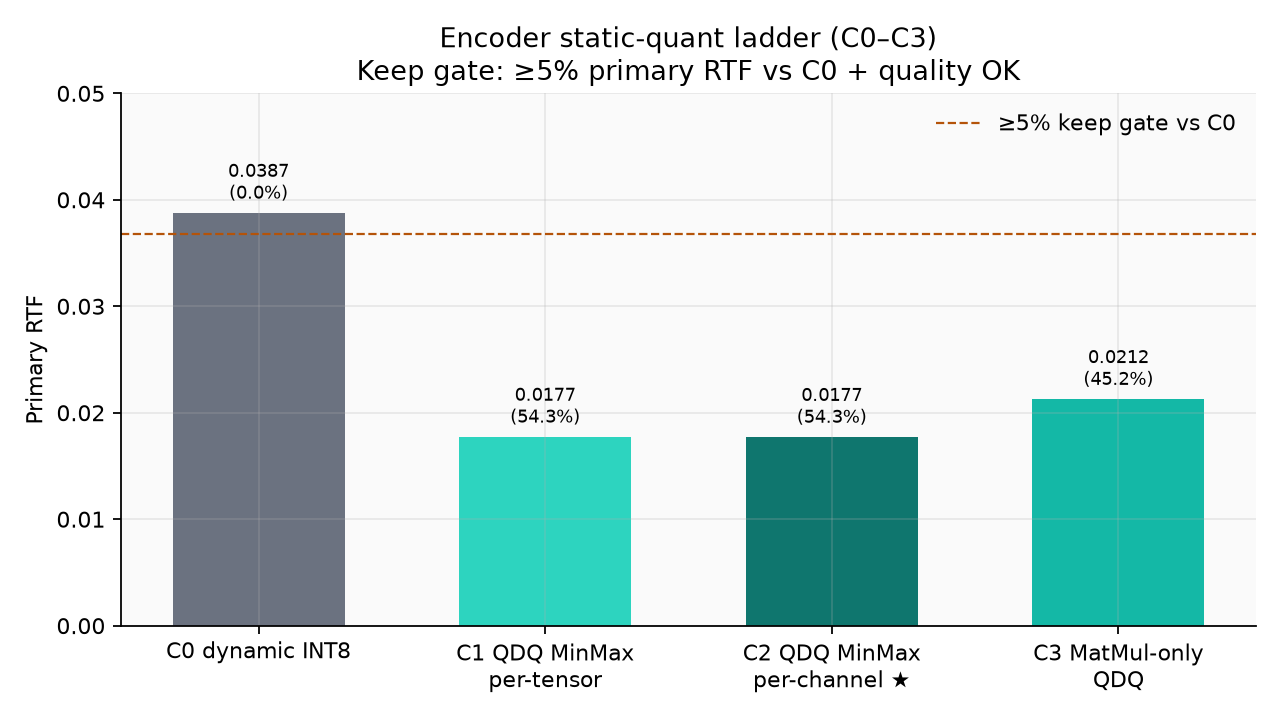 Encoder quant ladder
C2 won by a hair over C1; both crushed the 5% gate with quality OK on the ladder's real-speech check. Production freeze later remeasured C2-class pack at primary RTF 0.018432 vs baseline 0.038156 (51.7%).
Dead ends Neo hit and worked around (not theory)
These are the non-obvious failures that cost real iterations:
- QOperator + per-channel on the full FastConformer encoder failed (unknown initializers / Softmax-conv intermediates). QDQ format worked.
- Percentile calibration failed on variable-length mel batches (
inhomogeneous shape). MinMax was reliable without padding gymnastics. quant_pre_processpaths failed to serialize cleanly in places; quantizing the raw FP32 encoder with QDQ MinMax was the path that shipped.- Disk pressure: FP32 encoder is multi-GB; after static export it was freed. Large ONNX stays out of git (HF only).
- Security/policy on the sandbox blocked naive
rmof absolute paths; cleanup usedpathlibunlink from project cwd.
None of that is glamorous. All of it is the difference between a blog claim and a pack that actually loads.
Phase 4: Quality assessment and production freeze
Script: scripts/quality_baseline_vs_best.py
Report: results/quality_baseline_vs_best.md + .json
Freeze doc: reports/production_default.md
Compared baseline (configs/baseline.json → Hub dynamic pack) vs best (configs/best_config.json / production.json → static QDQ-pc pack) on the same clips.
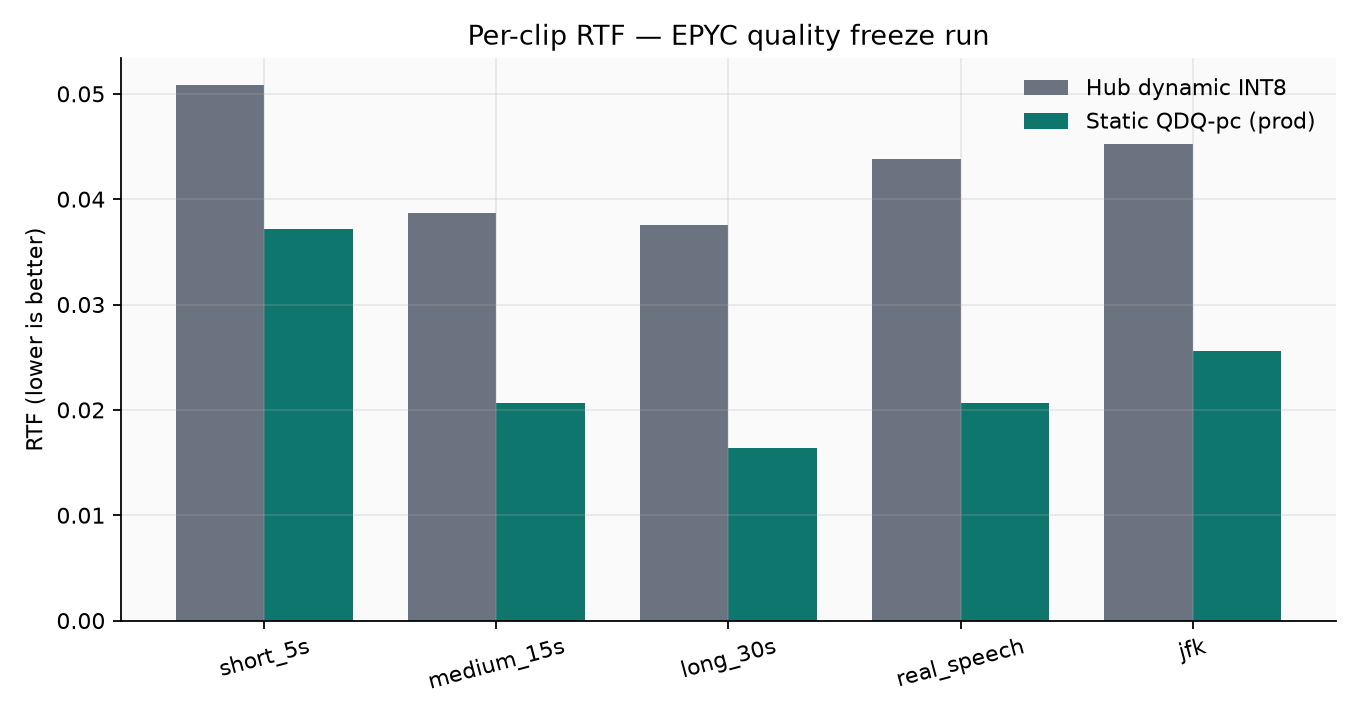 Per-clip RTF
Gates for freeze:
- No empty real-speech transcripts
- Pairwise quality vs baseline acceptable on this set
- Absolute JFK WER 0.0 both sides
- Primary RTF improvement ≥5% (measured 51.7%)
Caveat (stated in-repo): the eval set is small and mostly clean English (JFK line and loops). It is a regression gate, not a substitute for LibriSpeech / multilingual WER. If you extend this work, replace or grow that set first.
Also fixed along the way: onnx-asr / wave only likes WAV; FLAC JFK samples are converted to temp 16 kHz PCM before recognize.
Frozen production leaves "chunking": null (full-file path for short/medium RTF). Multi-minute files can OOM as encoder activations scale with T. Later, Neo added CLI chunking on apply_best_config.py (--chunk-window-s / --chunk-overlap-s) as an app-level escape hatch. That is for memory and long talks, not the frozen primary-RTF recipe (E5 already showed window+concat is not free speed).
Phase 5: Publish and portability check
- GitHub: code, configs, scripts, results, sample audio, docs. ONNX weights gitignored.
- Hugging Face: production static pack + model card under
gvij/…. - Apple Silicon: same packs and CLI; user-measured long-audio A/B (~1.42×). README documents both hosts so people do not treat EPYC RTFx as universal.
Docs were tightened so A/B and quality replication require both packs (production + Hub baseline), not only the static download.
What Neo actually did (process, not mythology)
This case study was not a hand-authored notebook with a few charts. From a single high-level goal, Neo:
- Explored the model packaging and host constraints
- Implemented profiling and metric collection
- Designed keep/discard ladders with fixed gates
- Ran experiments, logged ledgers, discarded noise
- Hit real quant/export failures and patched the approach
- Froze production, wrote reports, published git + HF
- Extended for long-audio CLI and dual-host docs when the product path needed it
The agent loop matters: implement → run → read stderr/metrics → edit → re-run. Grok 4.5 via BYOK was the planner/coder brain inside that harness for this run. If you care about reproducibility of agency, the artifacts are the ledgers and scripts in the repo, not a chat transcript.
How to replicate
git clone https://github.com/gauravvij/parakeet-optimization.git
cd parakeet-optimization
python3 -m venv venv && source venv/bin/activate
pip install -U pip && pip install -r requirements.txt
Download both packs if you want A/B or quality_baseline_vs_best.py (see README / models/README.md):
- Production:
gvij/parakeet-tdt-0.6b-v3-onnx-static-qdq-pc→models/parakeet-tdt-0.6b-v3-onnx-static-qdq-pc/ - Baseline:
istupakov/parakeet-tdt-0.6b-v3-onnxINT8 files →models/parakeet-tdt-0.6b-v3-onnx/
# Production warm RTF
python scripts/apply_best_config.py --config configs/production.json \
  --audio data/real_speech.wav --benchmark

# Baseline A/B
python scripts/apply_best_config.py --config configs/baseline.json \
  --audio data/real_speech.wav --benchmark

# Quality + primary RTF remeasure
python scripts/quality_baseline_vs_best.py --warmup 1 --repeats 3

# Long audio (memory), not the freeze RTF path
python scripts/apply_best_config.py --config configs/production.json \
  --audio /path/to/long.wav --chunk-window-s 30 --chunk-overlap-s 2 --benchmark
How to extend this with Neo
Clone the repo, open it in VS Code (or Cursor) with the Neo extension, point BYOK at a strong model (this study used Grok 4.5), and give a goal + constraints, not a step list. Examples that build on this codebase:
OpenVINO / EP bake-off (never completed here)
Using this repo's baseline and production packs, add an optional OpenVINO or ORT EP comparison on my CPU. Keep the same primary RTF definition and quality gates as
quality_baseline_vs_best.py. Do not break the existing CPU EP path. Report keep/discard vs production with a ledger.
Real WER suite
Replace the small JFK-based quality set with a proper English ASR subset (e.g. LibriSpeech test-clean sample). Re-run baseline vs production, keep RTF primary metric, and only freeze if WER regression stays under X%.
INT4 / mixed precision probe
Design a quality-gated encoder quant experiment beyond C2 (e.g. INT4 or mixed) with the same ≥5% RTF gate and a hard WER ceiling. Discard anything that fails quality even if it is faster.
Apple Silicon backend
On macOS, evaluate Core ML / ANE (or another local path) against the current ORT CPU production pack on the same long-audio file and chunk settings. Report RTF and transcript diffs; do not claim portability to EPYC.
Smaller model tradeoff
Find a smaller public Parakeet (or distill path) and run the same static-quant + quality protocol. I care about 3× vs Hub dynamic INT8 on CPU if WER stays within Y.
Server throughput
Add multi-stream / batch throughput benchmarks (not single-file RTF) for the production pack and document the metric separately from primary RTF.
Pattern that works well with Neo: metric definition + keep gate + quality gate + "do not re-run dead ends in failed-approaches". Point it at this repo's ledgers so it does not rediscover that E5 chunking is not a speed win.
Limits (read these before citing the 2×)
- Same architecture. Static QDQ is standard ORT quant on the public encoder, not a new FastConformer.
- Quality set is thin. Good for freeze/regression, weak for absolute ASR claims.
- OpenVINO not measured. Could still matter on some Intel boxes; unknown here.
- 3-4× vs Hub baseline likely needs a smaller model and/or a different backend (e.g. ANE), not another E-ladder pass. Runtime knobs already failed the 5% gate.
- Chunking ≠ free speed. It bounds RAM on multi-minute audio; E5 showed it can worsen RTF without true streaming/cache.
Artifacts map
| Path | Role |
|---|---|
scripts/profile_parakeet_cpu.py | RTF + stage/operator profiling |
scripts/autoresearch_cpu_opts.py | E0-E6 runtime ladder |
scripts/autoresearch_encoder_opts.py | C0-C3 static quant ladder |
scripts/quality_baseline_vs_best.py | Freeze quality + primary RTF |
scripts/apply_best_config.py | Config-driven inference, benchmark, long-audio CLI chunking |
configs/baseline.json / production.json | A/B and freeze configs |
results/autoresearch*/ledger.jsonl | Experiment truth |
reports/parakeet_tdt_v3_cpu_optimization.md | Full profiling write-up |
reports/production_default.md | Freeze decision |
blog/assets/*.png | Figures used in this post |
Bottom line
On EPYC, static QDQ MinMax per-channel on the Parakeet TDT 0.6B v3 encoder cut primary RTF by about half versus the public dynamic INT8 ONNX pack (2.07×), with freeze gates green on a small English set. On Apple Silicon long audio with chunking, the same packs still showed a clear relative win (1.42×). Runtime-only tuning did not clear a 5% keep gate. The encoder was always the bottleneck; the ladders just forced that conclusion with numbers instead of intuition.
If you want the code and weights, use the links at the top. If you want the next experiment, clone the repo and hand Neo a gated goal. That is how this one was produced.
Try NEO in Your IDE
Install the NEO extension to bring AI-powered development directly into your workflow:
- VS Code: NEO in VS Code
- Cursor: Install NEO for Cursor