
Performed using NEO AI Engineer
In plain English
OmniVoice turns text into speech. It already sounded good, but waiting for it was the problem. For chat, agents, and other interactive voice apps, that delay is the product.
We asked a practical question: how much faster can OmniVoice get without training a new model? Same weights. No distillation. Only change how inference runs. Then check whether the result still sounds acceptable.
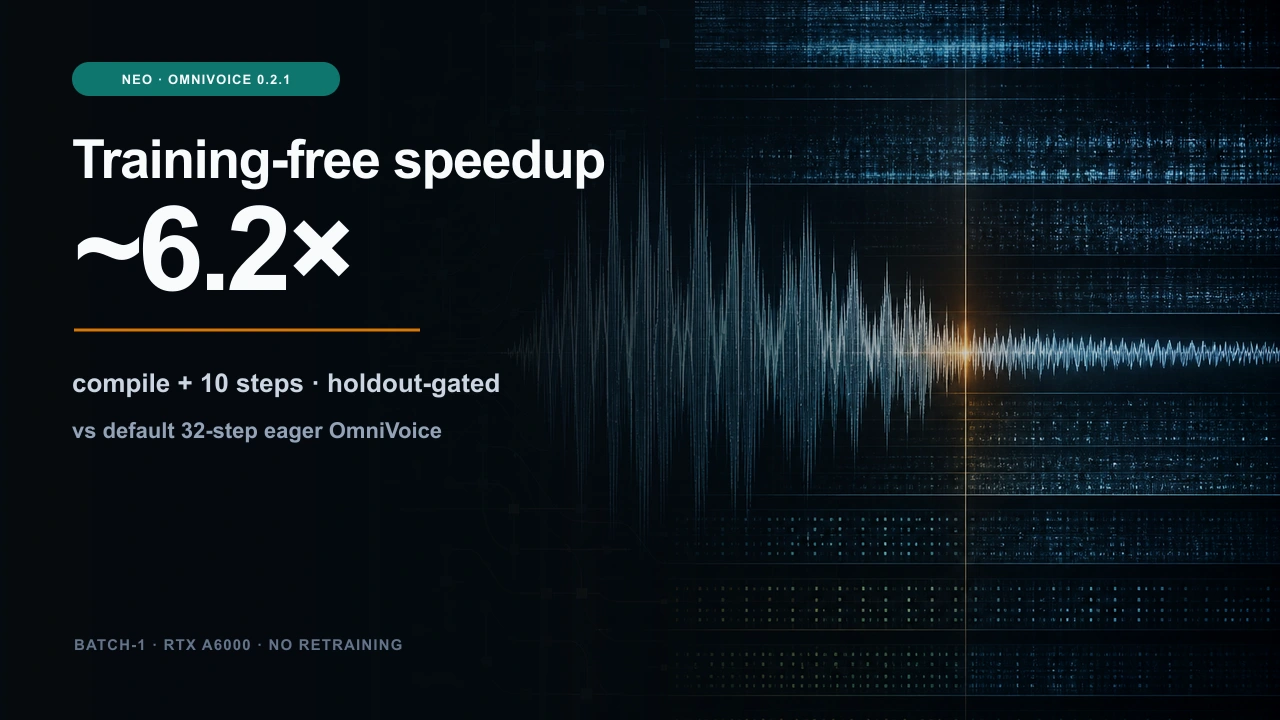
The short answer: about 6× faster than the slow default setting, and still about 3× faster than the maker’s own “fast” setting. That was on an NVIDIA RTX A6000, for single requests, after a one-time warm-up. Quality stayed inside the gates we set before optimizing.
Neo ran the experiments. Humans set the goal, accepted the speed/quality tradeoff, and confirmed the audio by ear.
What we changed (no new training)
- Ran the model more efficiently on the GPU (
torch.compile) - Asked it to refine the audio fewer times (10 steps instead of 32)
- Nudged one quality knob (guidance 2.5) so fewer steps still held up
That is the whole shipped recipe. No new checkpoint.
The journey, simply
- Measure first: lock fair comparisons before chasing speed
- Find where time goes: almost all of it was in the refine loop
- Speed up the engine: compile the hot path
- Do fewer refine steps: fewer loops means less waiting
- Reject a tempting false win: 8 steps looked great on paper, then failed a reserved quality check
- Ship the honest winner: compile + 10 steps + guidance 2.5
- Try clever extras, then stop: several ideas failed; we kept the config that already worked
Default (32 steps, slow)
    → Official fast (16 steps)
        → Our result (compile + 10 steps + guidance 2.5)
            ✗ 8 steps: faster, but failed quality check (not shipped)
Quick glossary
| We say… | Meaning |
|---|---|
| How long generation takes | Real-time factor / our speed score |
| Did the words come out right? | Word error rate (WER) |
| Still the same speaker? | Speaker similarity (SIM) |
| Does it sound natural? | Predicted speech quality (UTMOS) |
| Refine steps | How many times the model polishes the audio before finishing |
Hear it yourself
Real outputs from the study pack. Same text and settings in each pair. Play Before (default 32-step) next to After (final config).
Short clip (dev_ss_01)
Before (default 32-step)
After (compile + 10 steps + guidance 2.5)
Medium clip (dev_sm_01)
Before (default 32-step)
After (compile + 10 steps + guidance 2.5)
You may notice a small quality cost on harder long lines. On our reserved test clips it stayed inside the agreed limits, and for interactive use the wait drops a lot.
What we refused to ship
- 8 refine steps: faster on the development set, failed holdout word-error gate
- Clever decoding tricks that broke naturalness across OmniVoice’s multiple audio streams
- Kernel swaps that looked promising but were slower than the already-compiled path for single utterances
Publishing the misses is part of the result. A smaller true win beats a headline that dies in real checks.
Want Neo to run this kind of loop?
Full measurements, charts, failure ledger, and YAML live in the research repo. The detailed writeup continues below.
Full technical writeup
Outcome at a glance
- Task: make OmniVoice faster without changing weights
- Final configuration:
torch.compile(reduce-overhead) +num_step=10+guidance_scale=2.5- Post-warm-up speedup: ~6.2× vs default 32-step eager · ~3.2× vs official 16-step eager
- Quality rule: holdout must be faster and stay inside WER / SIM / UTMOS gates
- Tried and rejected: confidence-parallel unmasking, CFG late-off, Flash Attention 2 hooks, FlashInfer on batch-1
- Host: NVIDIA RTX A6000 48GB · OmniVoice 0.2.1 · batch size 1 · no weight updates
This section is the narrative companion to the research repository: raw JSON results, listening samples, the final YAML configuration, and charts generated from those artifacts.
Table of contents
- The brief
- Rules set before optimizing
- What OmniVoice actually does at generate time
- Phase 1: Build the harness
- Phase 2A: Profile before changing anything
- Phase 2B: Make compile the stack
- Phase 3: Choose the final configuration
- Phase 4: Test additive bets
- Phase 5: Check FlashInfer, then retain the configuration
- Listen: more clips and cloning
- Honest ceiling
- How the work was run
- Takeaways
1. The brief
Speech models are judged twice: once by how they sound, and once by how long you wait. Training-time tricks can move both, but they change the model. We did not want a new student checkpoint. The goal was to keep the same OmniVoice weights and find a meaningful speedup for the tested A6000 workload.
| Detail | Brief |
|---|---|
| Task | Make OmniVoice faster at inference without retraining |
| Hard constraints | Same weights; systems and decoding only; batch size 1 |
| Host / model | NVIDIA RTX A6000 48GB · OmniVoice 0.2.1 |
| Speed metric | Frozen weighted median RTF S (never redefined mid-run) |
| Quality | Holdout must pass WER / SIM / UTMOS gates vs baseline A |
| Acceptance | Faster and in-gate at a predefined phase evaluation, otherwise keep the existing configuration |
| Human role | Set the goal, accept the speed/quality tradeoff, confirm listening, steer packaging |
That is a hard systems problem. OmniVoice unmasks eight codebooks at once, with knobs like step count, guidance, t_shift, temperatures, and layer penalty. Clever decoding tricks can put those codebooks out of sync and ruin naturalness. The confidence-parallel experiment later demonstrated that failure mode directly.
2. Rules set before optimizing
Before testing candidates, we locked the comparison rules. Any idea that broke them would not ship.
Dual baselines (report both, not just the easy one)
| ID | Meaning |
|---|---|
| A | Default research path: num_step=32, guidance_scale=2.0, eager |
| B | Official fast path: num_step=16, same guidance, eager |
A speedup only versus A is easy to overclaim. Beating B is the harder, more honest bar. Both are reported throughout.
Primary speed metric S (never redefined mid-run)
S = Σᵢ wᵢ · median_RTFᵢ
RTF = t_generate / t_audio
All latency results below are measured after the required one-time compilation and graph-capture warm-up. “Post-warm-up” refers to fresh benchmark runs after that setup step.
- Batch size 1
- End-to-end
model.generatewith CUDA synchronize - Fixed English operating-point grid and weights in
configs/operating_points.json - Seeds paired
{11, 22, 33}on ladders
Quality gates (set from measured noise, not gut feel)
From Phase-1 repeated baseline noise:
| Gate | Threshold vs A |
|---|---|
| ΔWER | ≤ 0.05 |
| ΔSIM | ≥ −0.03 |
| ΔUTMOS | ≥ −0.15 |
Duration ratio was demoted to a diagnostic check after it falsely failed good configs (the manifest expected_duration was often about 2× the real audio length).
Holdout only at predefined phase gates
Reserved holdout clips (hold_ss_01, hold_sm_01, hold_dm_01) were excluded from development tuning. They were evaluated only at predefined phase gates, where a candidate had to be both faster and inside the quality thresholds.
Publish negatives
Failed ideas are part of the result, not something to hide. Dead ends go in ledger/failed_approaches.md. Reopening them without a new mechanism was out of scope on purpose.
3. What OmniVoice actually does at generate time
Before changing anything, the generate path had to be understood. This simplified picture drove the later choices.
The generate path is roughly:
generate
  → preprocess (voice clone prompt / encode)
  → iterative unmask loop  (dominates wall-clock)
       • each step: one forward on batch 2B (conditioned + unconditioned CFG fused)
       • multi-codebook token updates under schedule knobs
  → decode + post-process
Two facts drove the whole ladder:
- Unmask steps dominate (~95% of end-to-end time on the profiled short and medium inputs). Cutting steps is the first-order lever if quality holds.
- Classifier-free guidance (CFG) already runs as one fused 2B forward, where B is the request batch size, rather than two serial passes. “Turn CFG off late” does not automatically halve time.
Instruct mode is picky: free-form prose fails; comma-separated tokens like female, american accent, young adult work. Clone mode needs accurate ref_text for the reference WAV.
4. Phase 1: Build the harness
We began with the measurement harness: pin the environment, define the workload, lock baselines A and B, and test the inexpensive knobs before touching the model loop.
Deliverables: environment pins, workload manifest, benchmark runner, metrics, failure ledger, and the first baseline table.
Initial baseline picture (later refined; order of magnitude stable)
| Config | Role | Speed class |
|---|---|---|
| A · s32 eager | Scientific default | 1.0× |
| B · 16-step eager | Official fast path | ~1.9× vs A |
| 8-step eager | Aggressive official setting | ~3.5× vs A on the permissive English development set |
CFG late-off: a clean negative
One experiment patched the iterative loop so later steps could run conditioned-only, using half the usual CFG batch. Quality often survived, but wall-clock did not beat simply cutting steps. The fused CFG forward plus Python step overhead ate the theoretical win. Reference code stays at src/harness/cfg_economy.py.
Lesson
On this model, shortening the unmask schedule beats clever CFG width tricks for end-to-end latency.
Artifacts: artifacts/cold_results.json · reports/phase1_status.md · reports/profile_baseline.md
5. Phase 2A: Profile before changing anything
Before introducing more optimizations, profiling measured where the wall-clock time actually went. It ranked the real opportunities:
| Finding | Implication |
|---|---|
generate_unmask ≈ 95% of end-to-end time | Step count and work per step dominate latency |
| GPU utilization high, copy fraction low | The path is compute-bound, not limited by host-to-device copies |
| Efficient scaled dot-product attention (SDPA) / fused attention already active | Swapping in another attention package is not automatically faster |
torch.compile microbenchmark ~2.5× on the short path | Compilation is the strongest systems-level opportunity |
| Fused CFG vs conditioned-only latency ratio ≈ 0.98 on short-medium, ~1.14 on short-long | Turning CFG off late has little end-to-end headroom |
Artifact: reports/deep_profile.md (full traces were generated under artifacts/deep_profile/; large dumps are gitignored, summary remains).
6. Phase 2B: Make compile the stack
Next, torch.compile went under the hot path. Step counts were tested again on top of that compiled baseline, and only holdout-safe points survived.
What changed
- Wrap
OmniVoice.forwardwithtorch.compile(mode="reduce-overhead") - Warm each input shape once so CUDAGraph capture is paid before measurement
- Test the step-count ladder again on the compiled path
- Run a fresh post-warm-up benchmark, then the reserved holdout evaluation
Result
| Config | Post-warm-up S | vs A | Holdout |
|---|---|---|---|
| compile + 16 steps | ~0.036 | ~4.3× | PASS → first validated candidate |
| compile + 8 steps | ~0.022 | ~7× | FAIL: ΔWER ≈ +0.052 |
Eight steps narrowly exceeded the aggregate holdout WER gate (ΔWER ≈ +0.052 against a +0.05 limit), and one clip reached 0.30 WER. That miss is why Phase 3 tested intermediate step counts.
Artifacts: artifacts/phase2_cold_results.json · artifacts/phase2_holdout_results.json · reports/report.md
7. Phase 3: Choose the final configuration
Compile + 8 steps was faster on the development ladder, but failed holdout. This phase searched for an intermediate point that was both faster and defensible.
Hypothesis
Because each unmask step costs roughly the same under compile, fewer steps should translate into predictable speed gains:
| Steps | Expected speedup vs compile + 16 steps |
|---|---|
| 14 | ~1.14× |
| 12 | ~1.33× |
| 10 | ~1.60× theoretical (fixed overhead reduces the realized gain) |
The search also tested knobs that might recover quality at lower step counts: guidance_scale=2.5, position_temperature=0.0, layer penalty 3/7.
Development ladder (compressed)
- Kept for post-warm-up remeasurement: 10/12/14-step defaults and guidance 2.5 variants
- Best on development: compile + 10 steps + guidance 2.5 (S ≈ 0.025)
- Rejected:
position_temperature=0.0, because long-form WER and UTMOS collapsed (e.g. ΔUTMOS −0.5 on some cells)
Fresh post-warm-up benchmark
| Config | S | vs A | vs B | vs compiled 16-step |
|---|---|---|---|---|
| A: 32-step eager | 0.157 | 1.00× | - | - |
| B: 16-step eager | 0.082 | 1.92× | 1.00× | - |
| Compiled 16-step | 0.036 | 4.36× | 2.27× | 1.00× |
| Final: compile + 10 steps + guidance 2.5 | 0.0255 | 6.17× | 3.22× | 1.42× |
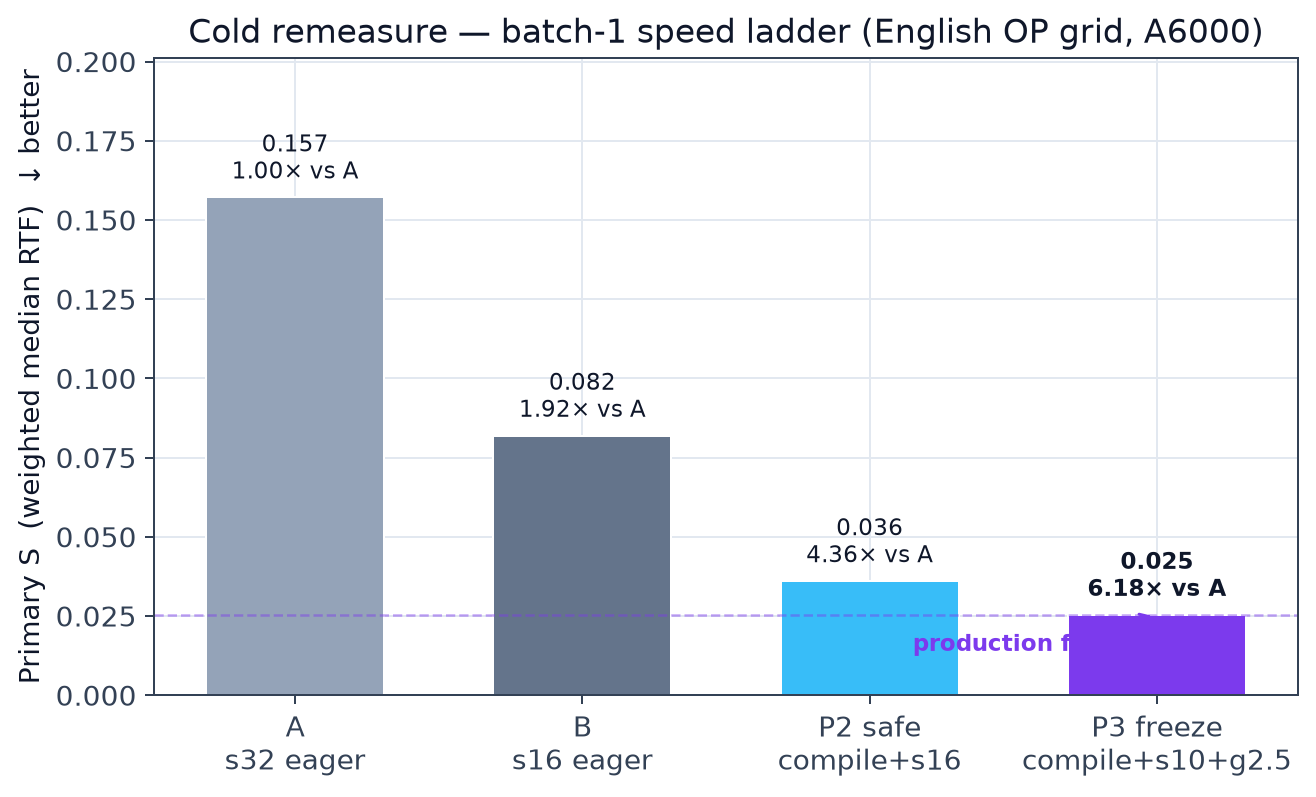 Post-warm-up benchmark: batch-1 speed ladder
Figure 2: Primary metric S (weighted median RTF) on a fresh post-warm-up benchmark. Lower bar = faster. The final 10-step configuration reaches S = 0.0255, or 6.17× faster than baseline A.
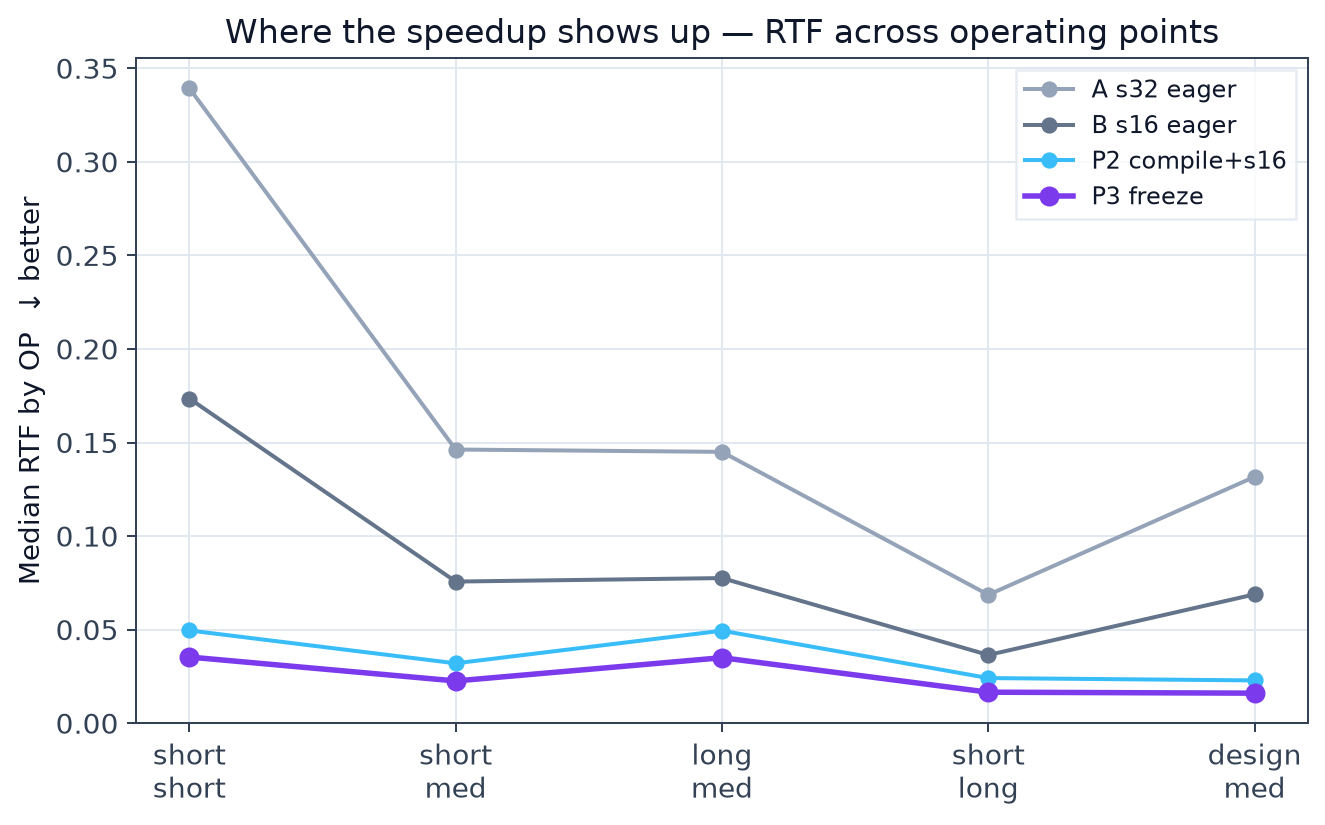 Median RTF by operating point
Figure 3: Same four configs, split by operating point. The final configuration wins everywhere on the grid; short-short still has the highest RTF (fixed overhead), but absolute latency is tiny.
Final holdout evaluation
| S | ΔWER | ΔSIM | ΔUTMOS | ||
|---|---|---|---|---|---|
| Final 10-step configuration | 0.0266 | +0.019 | −0.013 | −0.035 | PASS + faster → accept |
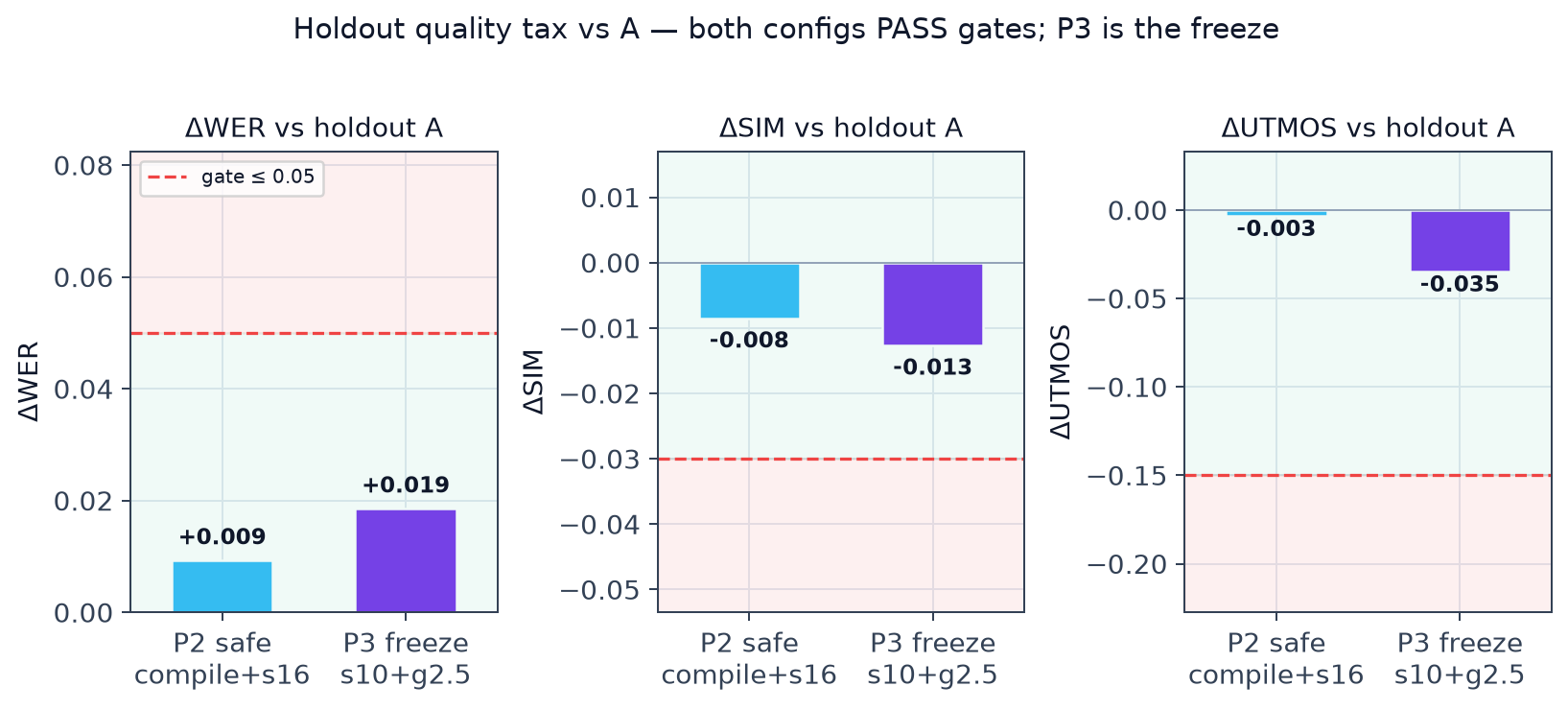 Holdout quality deltas vs gates
Figure 4: Holdout quality tax vs reserved baseline A. Green band = inside gate; red band = fail. Both the compiled 16-step and final 10-step configurations pass; the 10-step configuration is faster, so it is accepted. The tax is real but small (ΔWER ≈ +0.019, ΔSIM ≈ −0.013, ΔUTMOS ≈ −0.035).
The validated configuration for this A6000 benchmark was written to configs/production_infer.yaml. The previous compile + 16-step configuration remains available as previous_safe_phase2.
Artifacts: artifacts/phase3_ladder.json · artifacts/phase3_cold_results.json · artifacts/phase3_holdout_results.json · reports/phase3_report.md
8. Phase 4: Test additive bets
With a strong validated configuration in hand, Phase 4 looked for additive wins. None beat the batch-1 result without breaking quality, so the Phase-3 configuration stayed.
Confidence-parallel unmask (Fast-dLLM-style)
This approach unmasks every position above a confidence threshold at each step, fills anything left on the final step, and exits early if no masked positions remain.
Result: every confidence-threshold × step-limit combination failed quality. Speaker similarity and UTMOS collapsed, and WER often did too. Early exit almost never triggered; the only speed came from reducing the step limit, which is the same lever as Phase 3 with a worse schedule.
Why it hurts here: the eight codebooks are sensitive to which positions commit together. Confidence-parallel updates changed that coordination, so naturalness collapsed even when the transcript remained partly intelligible.
t_shift micro-grid
Only t_shift=0.05 showed a possible ~1% post-warm-up improvement over the final configuration. It was not faster on holdout, so it was rejected.
Flash Attention 2
The prebuilt wheel installed, but OmniVoice still reported that it does not support Flash Attention 2. Forcing the nested attention implementation then failed because the expected packed-sequence inputs did not match OmniVoice's 4D masks.
Throughput (secondary chapter)
Simple batches of 2, 4, and 8 under compile delivered fewer utterances per second than batch 1 because of padding and graph-capture overhead. Higher throughput needs a serving design; it is not another batch-1 S optimization.
Decision: retain the existing Phase-3 configuration.
Artifacts: artifacts/phase4_ladder.json · artifacts/phase4_holdout_results.json · artifacts/phase4_throughput.json · reports/phase4_report.md
9. Phase 5: Check FlashInfer, then retain the configuration
OmniVoice's upstream research path includes a FlashInfer implementation for packed classifier-free guidance. We added that official integration to the harness (src/harness/omnivoice_flashinfer.py + flashinfer_accel.py) and ran a full smoke test → microbenchmark → development ladder → post-warm-up benchmark → holdout gate protocol without stacking compile by default.
| Stage | Outcome |
|---|---|
| Smoke | OK: non-empty WAV |
| Microbenchmark vs final configuration | FlashInfer delivered only ~0.63–0.72× the final configuration's speed (slower) |
| Ladder | Quality gates passed, but speed was still worse (~0.88× the final configuration) |
| Holdout | Retain existing configuration: production_infer.yaml unchanged |
| Secondary throughput | FlashInfer scaled better at batch 8 (~8.5 utterances/s): a serving signal only |
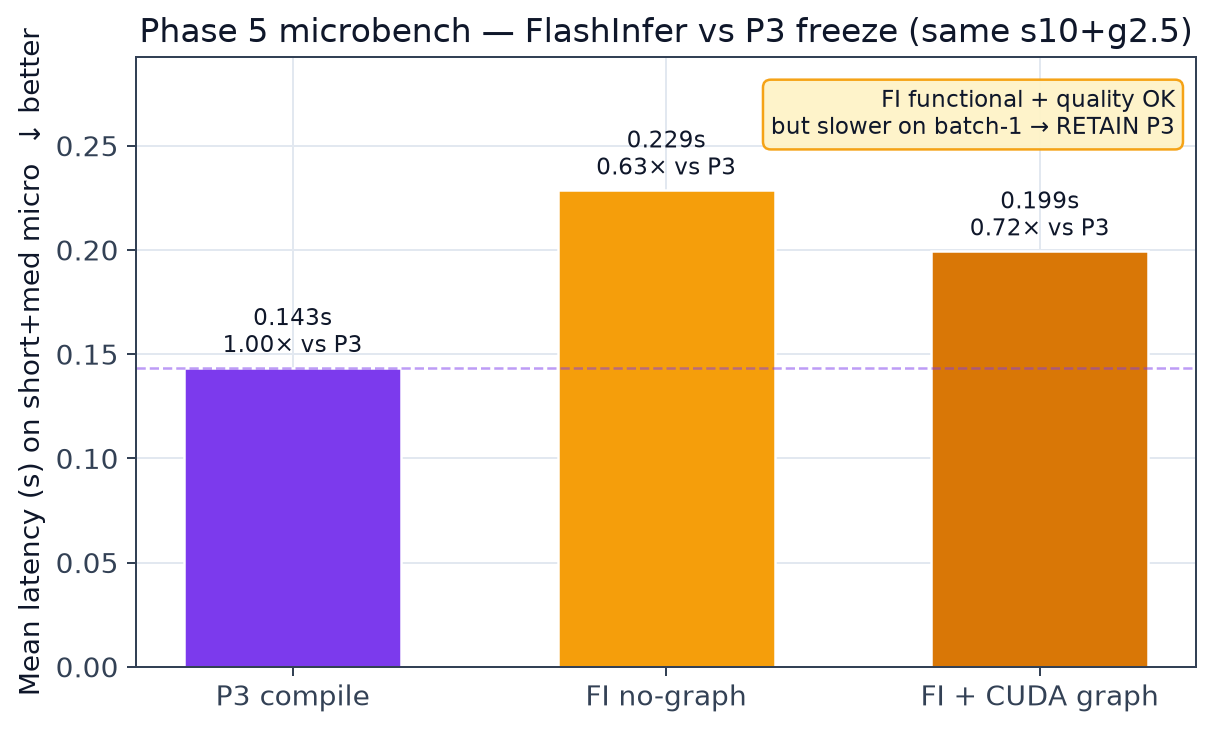 FlashInfer vs final configuration
Figure 5: Same decoding settings (10 steps + guidance 2.5), three backends. FlashInfer achieved 63–72% of the final configuration's speed, making it roughly 1.4–1.6× slower. The integration worked correctly but did not improve latency.
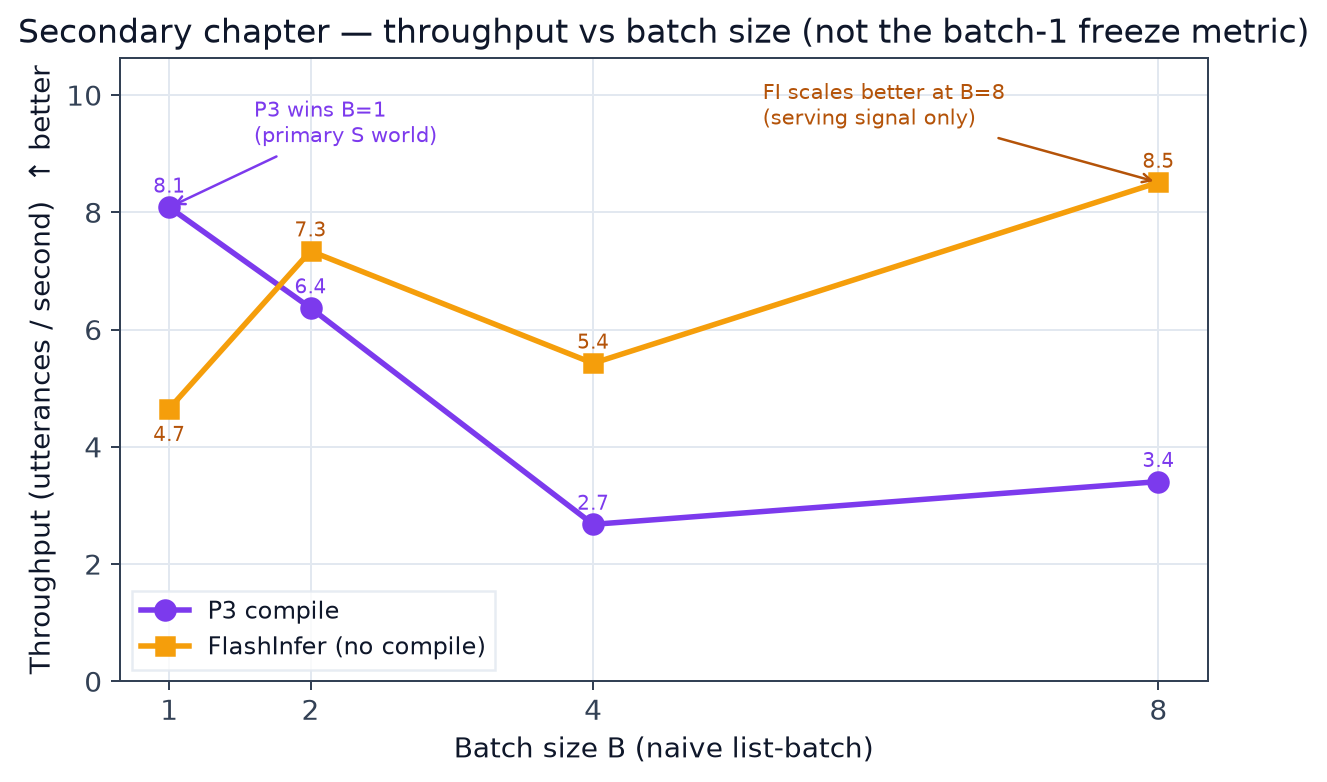 Throughput vs batch size: final configuration vs FlashInfer
Figure 6: Throughput in utterances per second (higher is better). The final compiled configuration dominates batch 1, the target setting for this study. FlashInfer improves at batch 8, a useful serving signal but not a reason to change the batch-1 configuration.
Interpretation: The final configuration's torch.compile(reduce-overhead) path already fuses the backbone efficiently for single short and medium utterances. FlashInfer's packed prefill and Python-side iterative loop did not beat that complete batch-1 path, even if individual kernels looked better. A speedup over eager execution is not necessarily a speedup over an already-compiled baseline.
Artifacts: artifacts/phase5_smoke.json · artifacts/phase5_micro.json · artifacts/phase5_ladder.json · artifacts/phase5_holdout_results.json · reports/phase5_report.md
10. Listen: speed and cloning under the final configuration
If you already compared the short clip above, this section adds the medium pair, latency chart, and voice-clone demo from the same research pack.
Baseline A vs final configuration
The listening pack contains nine matched pairs at seed 11, with the same text, reference audio, and instruction settings in each comparison.
| Pack stat | Value |
|---|---|
| Mean latency speedup | 7.55× |
| Median latency speedup | 6.56× |
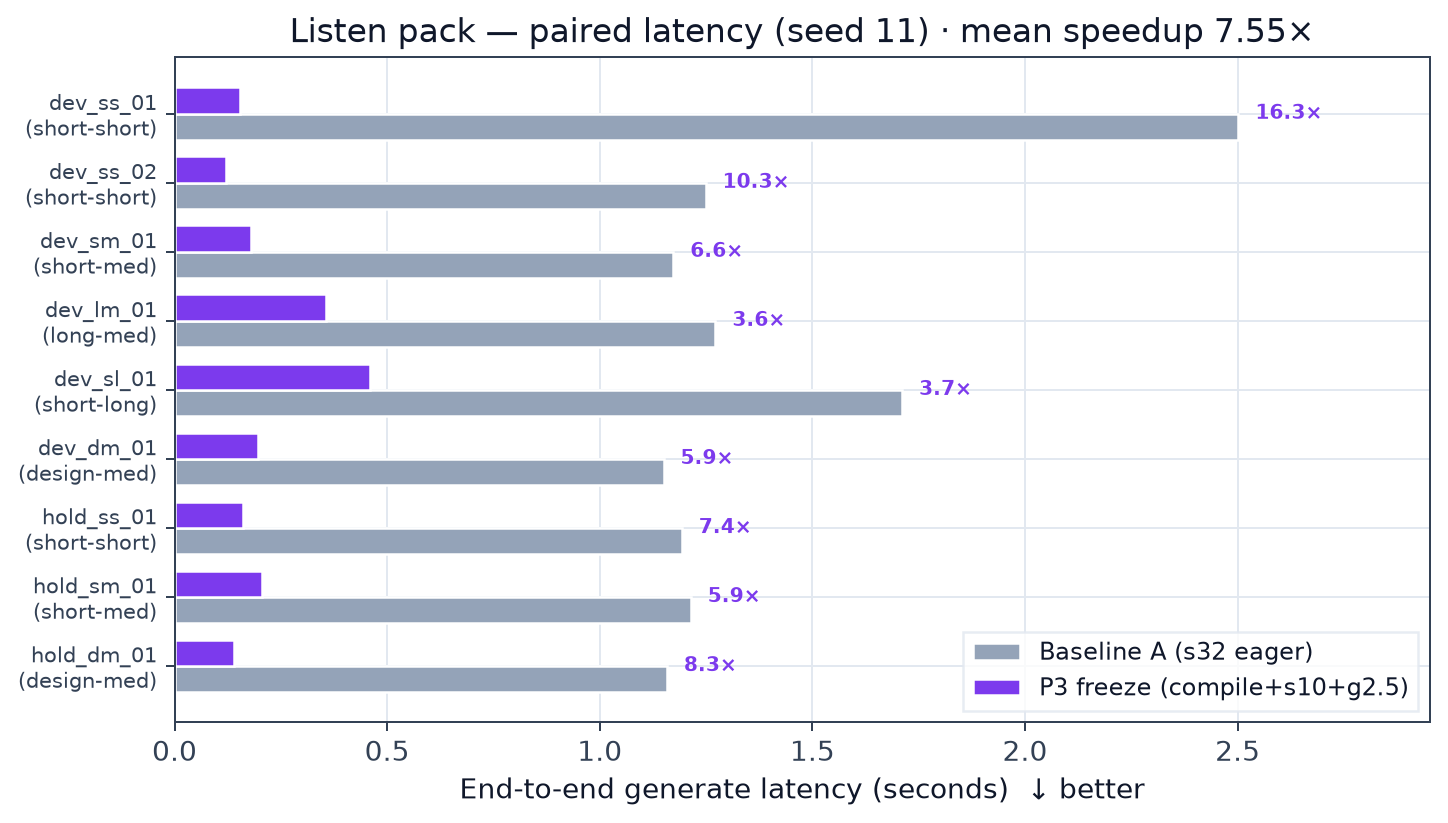 Listening pack: paired baseline A vs final-configuration latency
Figure 7: Nine paired clips (seed 11). Grey = baseline A wall-clock; purple = the final configuration. Numbers on the right are per-clip latency speedups. Short lines can exceed 10×; long lines still clear ~3.5–4×.
Short clips show larger multipliers because fixed overhead dominates their baseline latency. Longer clips still reach roughly 3.5–4× on this pack.
Short clip (dev_ss_01, seed 11)
Baseline A (32-step eager)
Final configuration (compile + 10 steps + guidance 2.5)
Medium clip (dev_sm_01, seed 11)
Baseline A (32-step eager)
Final configuration (compile + 10 steps + guidance 2.5)
For the remaining pairs and listening notes, see artifacts/listening_trial_p3/LISTEN_HERE.md.
Voice clone demo (stock speakers)
The clone test gives P3 a reference WAV and its transcript, then asks it to speak new target text in the same voice.
| Pack stat | Value |
|---|---|
| Mean SIM | ~0.80 |
| Mean WER | 0.00 |
Reference (dev_ss_01, female short)
final-configuration clone (same speaker id, new target text, seed 11)
For the full clone pack, see artifacts/voice_clone_demo/README.md.
Side-by-side listening on the speed pack confirmed the final configuration is usable in practice. You can hear a quality cost on hard long lines, but it stays inside the agreed quality gates.
11. Honest ceiling
This is the measured ceiling on this host and workload, plus the ideas that are unlikely to deliver another large batch-1 gain without a genuinely new mechanism.
On this English operating-point mix, A6000, OmniVoice 0.2.1, batch 1:
S ≈ 0.025–0.026 under compile + 10 steps + guidance 2.5 + SDPA
That is roughly:
- 6× vs default 32-step eager
- 3× vs official 16-step eager
- Now bounded by roughly 10 unmask steps, the compiled graph, and fixed per-request overhead
What will not unlock another factor on batch-1 (given what we tried)
- More official knob grids without a new mechanism
- Classifier-free guidance width tricks
position_temperature=0.0for deterministic positions- Confidence-parallel force-fill schedules
- Flash Attention 2 flags the model rejects
- FlashInfer alone vs an already-compiled graph
What still might help (outside this study’s scope)
- Serving: continuous batching or ragged multi-utterance batches (FlashInfer's scaling above batch 1 is a useful signal)
- Training-time students / consistency / fewer-step distillation
- Custom kernels designed around OmniVoice’s actual mask layout
- Broader validation: multilingual and difficult long-form inputs, plus Whisper large-v3 scoring, before making broader claims
12. How the work was run
Neo executed the research loop from the high-level brief. Human involvement focused on setting the goal and acceptance criteria, confirming the audio by ear, and deciding how the result should be packaged.
What humans did
- Set the goal: training-free OmniVoice speedup with holdout-gated quality
- Accepted the speed/quality tradeoff once a final candidate was ready
- Confirmed listening on the speed and clone packs
- Steered packaging so the repo and this writeup stayed usable
What the run delivered
- Built the harness, pins, operating-point grid, and quality gates
- Profiled the generate path and ranked real bottlenecks before inventing knobs
- Put
torch.compileunder the hot path and re-laddered step counts - Closed the 8-step vs 16-step gap and froze
configs/production_infer.yaml - Tried additive algorithmic bets and FlashInfer, then retained the existing configuration when they lost
- Published negatives in the failure ledger instead of burying them
- Packed listening WAVs, clone demos, JSON artifacts, and phase reports
How the loop ran
plan → harness → measure noise → profile → rank windows
    → implement one window → ladder with gates
    → post-warm-up remeasure → holdout at a predefined phase gate
    → either accept the candidate or retain the existing configuration
    → log failures → next phase only if headroom remains
That pattern is why the result is narrowly scoped and trustworthy:
- Keeps the speed metric stable (
Sis frozen early) - Stops holdout overfitting (phase-gated evaluation, never development tuning)
- Avoids stacking optimistic development numbers as if they were final benchmark results
- Turns failures into reusable knowledge instead of undocumented dead ends
The same harness can re-run every phase via scripts/run_phase*.py.
Replicate or extend the work
Clone the repo, open it in VS Code or Cursor, and use Neo to continue from the existing harness. Useful next goals include:
- "Re-measure the final 10-step configuration on a different GPU and report post-warm-up S vs A and B with the same gates"
- "Extend the holdout set with longer hard lines and decide whether to accept the candidate or keep production_infer.yaml"
- "Build a tiny serving benchmark for batch sizes 1/2/4/8 under the final configuration, and say whether FlashInfer wins anywhere"
13. Takeaways
- Training-free optimization can still deliver a multi-fold gain when inference is dominated by repeated steps and compilation can fuse the hot path.
- Dual baselines keep the claim honest: beating the 32-step default is useful; beating the official 16-step path is the stronger comparison.
- Holdout protects you from pretty development numbers: eight steps would have shipped without it.
- A decoding trick does not transfer automatically: confidence-parallel unmasking damaged multi-codebook TTS quality.
- A faster kernel does not guarantee a faster request: FlashInfer worked, but the compiled final path still won at batch 1.
- Knowing when to stop is part of the result: Phases 4 and 5 found no defensible replacement for the final configuration.
- Pair quantitative metrics with listening samples: the committed audio is part of the evidence, not decoration.
Validated configuration for this benchmark
If you only need the validated configuration, use this:
# Validated configuration from configs/production_infer.yaml
num_step: 10
guidance_scale: 2.5
t_shift: 0.1
torch_compile: true
torch_compile_mode: reduce-overhead
# position_temperature: 5.0  # do not set to 0.0
Warm up the compiled graph, measure RTF with CUDA sync, gate on WER / speaker similarity / UTMOS, then listen.
Closing
We asked for honesty over a headline multiplier. The usable result for this GPU and workload is simple: compile the model, use 10 refine steps, set guidance to 2.5, and keep quality checks honest. Everything that failed is documented so the same dead ends do not get replayed.
If you only take one thing: the process matters as much as the YAML. Frozen metrics, reserved holdout checks, and published failures are why this speedup is trustworthy.
Companion README: README.md · Upstream model: k2-fsa/OmniVoice · Research loop executed with Neo
Try NEO in Your IDE
Install the NEO extension to bring AI-powered development directly into your workflow:
- VS Code: NEO in VS Code
- Cursor: Install NEO for Cursor