NEO is a fully autonomous ML engineering agent capable of solving complex Data science, Machine learning and Gen AI engineering tasks.
It automates the entire ML workflow and saves developers thousands of hours of grunt work.
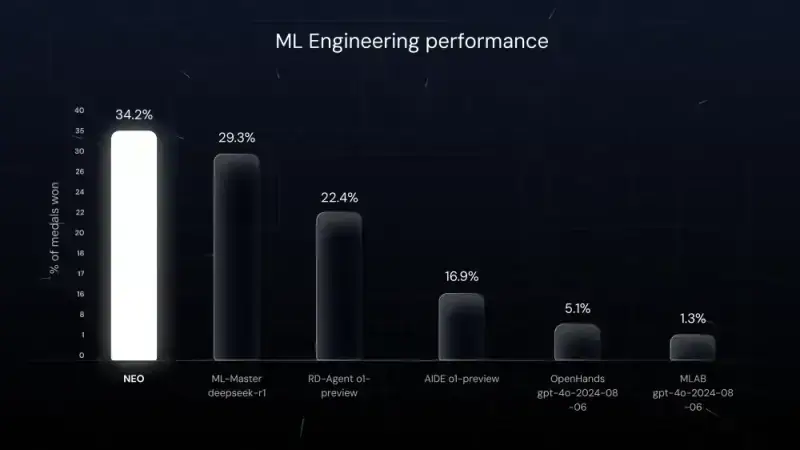
NEO has achieved state of the art scores by participating in 75 Kaggle competitions as per the MLEBench grading and achieved a mean 34.2% across 3 separate runs.
More details on performance later.
As we see, Machine Learning has evolved over the last 50 years—beginning with the simplest statistical models and requiring substantial human effort at every stage. The field's progress has been built on the backs of data scientists and engineers, who spent years developing, refining, and experimenting with new ideas through hands-on exploration.
Even in 2025 we see ML engineers and Data scientists working endlessly on solving core challenges associated with developing and productionizing end to end ML pipelines such as:
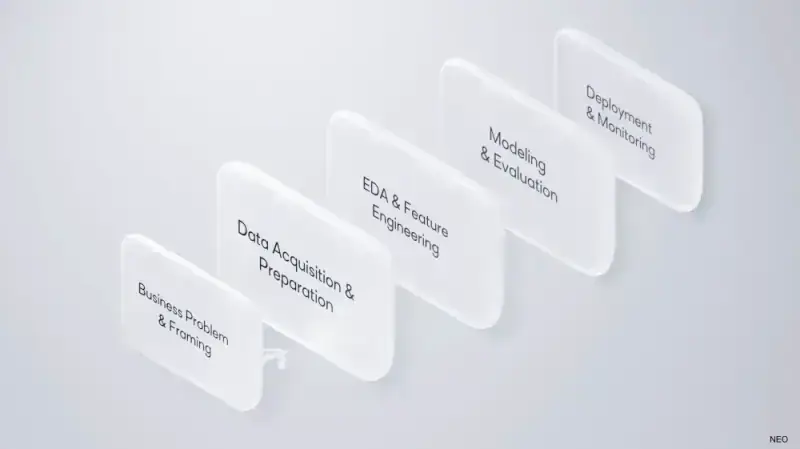
Most ML projects start with chaotic, unstructured data—JSON logs, PDFs, free-text, or images from inconsistent sources. Data scientists often spend days (or weeks) on raw data ingestion, cleaning, deduplication, schema mapping, and normalization, with manual parsing scripts and custom ETL pipelines. Detecting missing values, fixing corrupt records, and aligning timestamps are everyday challenges.
Once the data's clean, EDA isn't just plotting histograms—it's running distribution checks, correlation matrices, and outlier detection, plus addressing class imbalance or upsampling. Feature engineering is a mix of hand-crafted transformations, encoding categorical variables, dimensionality reduction, and domain-specific logic. This is still very manual and iterative, with notebooks full of trial-and-error code.
Selecting models means sifting through scikit-learn baselines, XGBoost, ensemble methods, and various neural architectures. Hyperparameter tuning (via grid/random search, Optuna, Ray Tune) can take days, with dozens of experimental runs tracked in MLflow or spreadsheets.
Scaling up introduces another pain point: managing environments. Version mismatches—like PyTorch with CUDA, or conflicting pip/conda dependencies—can break pipelines overnight. GPU jobs can fail due to OOM errors, and distributed training often hits network/storage bottlenecks. Reproducibility is tough—"it works on my machine" is still a meme in most teams.
Shipping models isn't just a pickle.dump(). Deploying to production means dealing with Docker, Kubernetes, CI/CD, and REST/gRPC APIs. Post-deployment, drift monitoring (e.g., custom KL-divergence checks), real-time metrics, and autoscaling are required to keep models reliable. When data or usage patterns shift, models can degrade silently—requiring rollback, retraining, or hotfixes at odd hours. Most of this still needs human vigilance and bespoke scripting.
All these steps—data wrangling, analysis, model experimentation, infrastructure, and deployment—have traditionally demanded substantial human effort, critical thinking, and relentless troubleshooting by large ML and data science teams. This "grunt work" has shaped the very nature of progress in the field, driving innovations in tools, automation, and process.
Today, we're finally entering a new era defined by intelligent autonomous agents. Meet NEO - a fully autonomous AI4AI agent.
NEO streamlines machine learning workflows, enabling engineers to build and deploy pipelines 10x faster. Developed with a keen understanding of the needs of machine learning engineers and data scientists, NEO is designed to adapt its execution workflows as per the ML task needs and collaborate with engineers using "Human in the loop" mode.
This marks a true shift: from teams of experts painstakingly managing each stage, to a single intelligent agent orchestrating and scaling end-to-end machine learning workflows, fundamentally changing how organizations build, deploy, and maintain AI at scale.
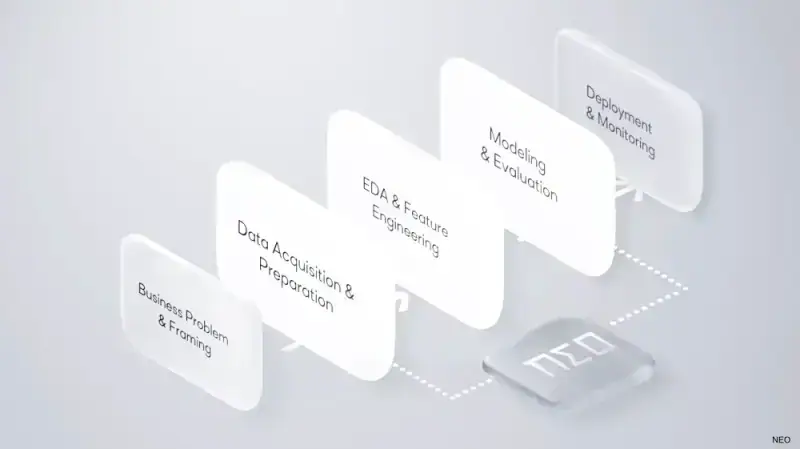
NEO leverages state-of-the-art deep learning and large language model advances to take on the entire ML lifecycle, from raw data ingestion and feature engineering to model experimentation, evaluation, deployment, and ongoing monitoring. Unlike traditional tools, NEO reasons through data, automates the grunt work, adapts to changing requirements, and even recovers from failures, all with minimal human input.
NEO works in a GPU/CPU sandbox environment and utilizes a structured, multi-step approach to achieve its objectives by breaking down complex problems into manageable components. This approach involves a continuous loop of planning, coding, executing, and debugging — ensuring thorough refinement at each stage. As NEO progresses through these steps, it adapts and iterates until optimal results are achieved.
"Human in the loop" mode enables developers to provide feedback, guidance and ask questions via interactive chat interface. This provides control back in the user's hands and enables them to collaborate with NEO and makes the process a lot more transparent.
NEO's interface also provides an artifacts viewer that provides a direct access to all the processed datasets, generated code artifacts and models developed during the task progression.
When NEO was asked to build a speech recognition model for clinical transcriptions, it finetuned Whisper small model, successfully reducing the word error rate:
When NEO was asked to come up with a solution for building an ETA prediction model using a publicly sourced dataset, here is what it implemented:
When NEO was asked to analyse a sleep stage prediction wearable dataset, it went ahead to download the dataset, performed exploratory analysis, engineered features and handled class imbalance along:
Still not convinced of NEO's capabilities? We have it sorted for you as well. We have evaluated NEO on the MLE bench. MLE-bench is an innovative benchmark that puts AI agents to the test on real-world machine learning engineering tasks. What makes this benchmark particularly compelling is its practical approach — instead of creating artificial challenges, it leverages 75 actual Kaggle competitions to assess the agent's capabilities in machine learning engineering.
When put to the test across all 75 Kaggle competitions across 3 separate runs each, NEO didn't just participate — it excelled, securing medals in 34.2% of the competitions beating the scores of prominent agents including RD-Agent and AIDE scaffolded OpenAI O1. Earning a medal on Kaggle signifies exceptional performance, as medals are awarded based on the competition size and ranking. This reflects the intense competition and high standards required to achieve these accolades.
NEO's performance isn't just about numbers; it represents a breakthrough in AI-assisted machine learning engineering, effectively bringing world-class ML expertise at your fingertips. This isn't just an AI tool — it's like having a distinguished ML champion as your personal collaborator, ready to tackle complex data challenges with proven competition-winning capabilities.
Neo is getting ready for early beta users.
To try out NEO join our waitlist here.
Want to try what NEO built?
Try Neo AI Engineer →