
3-Tier Memory for LLM Agents: 35-45% Token Reduction Without Losing Context

 Pipeline Architecture
The Problem
Context windows are finite and LLMs forget. The naive fix is truncation — keep the last N turns, discard the rest. Simple to implement, terrible in practice: the information you discard might be exactly what the agent needs three steps later. The other naive fix is dumping everything into context, which works until costs spike, latency climbs, and you hit the context limit anyway. There's no good off-the-shelf solution between these two extremes.
NEO autonomously built the Multi-Agent Memory Management System to find a better path. The result is a 3-tier memory architecture that cuts token usage by 35 to 45 percent while maintaining 87% semantic recall accuracy across 25-turn conversations.
The 3-Tier Architecture
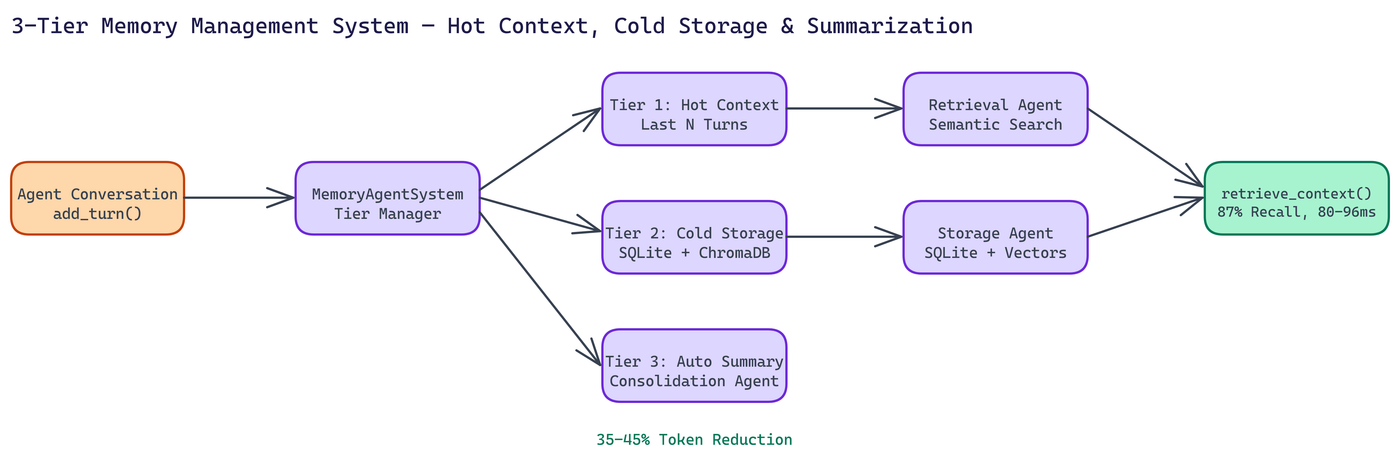
Hot context holds the last N conversation turns in full fidelity. This is always-present, always-accurate, zero-retrieval-cost memory. Recent exchanges stay exactly as they happened.
Cold storage is a SQLite + ChromaDB backed store for older conversation history. Rather than discarding past turns, the system embeds them as vectors and persists them. When the agent needs something from earlier in the conversation, semantic search retrieves it in 80 to 96 milliseconds.
Automatic summarization bridges the two. When conversation history exceeds a threshold, the Consolidation Agent generates a compressed summary and stores it in cold storage. The full verbatim text isn't needed, but the semantic content is preserved and retrievable.
Three autonomous agents manage these tiers:
The Retrieval Agent handles semantic search against cold storage. It interprets the current query, searches the vector index, and returns relevant historical context to be injected into the hot context window.
The Consolidation Agent monitors conversation length and triggers summarization when thresholds are hit. It decides what to summarize, generates the summary, and coordinates the storage operation.
The Storage Agent manages the persistence layer. SQLite holds structured conversation metadata. ChromaDB holds the vector embeddings. The Storage Agent keeps these synchronized and handles the mechanics of reads and writes.
Why This Works Better Than Alternatives
Simple truncation loses information permanently. This approach never discards anything; it changes how information is stored and accessed. The efficiency gain comes from not loading every historical turn into the context window on every request. You load what's relevant.
The 87% semantic recall figure comes from benchmarks across 50 simulated 25-turn conversations. NEO measured whether the system could retrieve relevant past context when needed. 87% accuracy with sub-100ms retrieval latency is competitive with much more complex retrieval-augmented generation setups.
The 35 to 45 percent token reduction means real cost savings at scale. If you're running thousands of agent sessions per day, cutting token consumption by 40% cuts your inference costs by roughly the same amount.
Fully Local, No Cloud Dependency
The entire system runs locally. No external API calls for memory storage or retrieval. SQLite and ChromaDB are both embedded databases, meaning no database server to manage. The system runs on any machine that can run Python 3.12.
For development and testing, there's a mock mode that works without any API keys at all. You can validate the memory architecture and run benchmarks before connecting to a real LLM provider.
Performance at a Glance
From NEO's benchmark suite across 50 simulated conversations:
- Average retrieval latency: 80 to 96ms
- Semantic recall accuracy: ~87%
- Token reduction versus naive full-history approach: 35 to 45%
- Summarization trigger: configurable conversation length threshold
The benchmark suite is included in the repository. Run it yourself to see how the system performs on your hardware and with your specific conversation patterns.
Getting Started
The MemoryAgentSystem class is the main entry point. It handles tier management, agent coordination, and the interface between your application and the memory stack.
from memory_system import MemoryAgentSystem

memory = MemoryAgentSystem(session_id="user_123")

# Add turns as they happen
await memory.add_turn(role="user", content="What was the dataset we discussed earlier?")

# Retrieve relevant context before generating a response
context = await memory.retrieve_context(query="dataset discussed earlier")

# Per-session metrics
stats = memory.get_session_stats()
print(f"Token savings: {stats.token_reduction_percent}%")
The smoke test script gets you running immediately. The benchmark script gives you detailed performance metrics across simulated workloads.
Where This Makes the Most Difference
Long-running agent sessions are the obvious target. Customer support bots, research assistants, coding agents with long project contexts, and any workflow where a session spans dozens or hundreds of turns all benefit directly.
It's also valuable for multi-session systems where a user interacts with an agent across multiple days or weeks. Persistent cold storage means the agent can recall relevant context from previous sessions without bloating every new conversation with historical data.
How to Build This with NEO
Open NEO in VS Code or Cursor and describe what you want to build. A good starting prompt for this project:
"Build a 3-tier memory management system for LLM agents in Python. Tier 1 is hot context holding the last N turns in full fidelity. Tier 2 is cold storage using SQLite for structured metadata and ChromaDB for vector embeddings, with semantic search returning results in under 100ms. Tier 3 is automatic summarization triggered when conversation length exceeds a threshold, with the Consolidation Agent generating compressed summaries stored to cold storage. Three autonomous agents manage the tiers: a Retrieval Agent for semantic search, a Consolidation Agent that monitors length and triggers summarization, and a Storage Agent that keeps SQLite and ChromaDB synchronized. Include mock mode that works without any API key."
NEO generates the project structure and core implementation. From there you iterate: ask it to implement the Consolidation Agent with configurable length threshold and summary generation, add the semantic retrieval pipeline with ChromaDB vector search and 80-96ms latency targets, or build the benchmark script that measures retrieval latency, semantic recall accuracy, and token reduction across 50 simulated 25-turn conversations. Each follow-up builds on what's already there.
To run the finished project:
git clone https://github.com/abhishekgandhi-neo/Multi-Agent_Memory_Management_System_BY_NEO
cd Multi-Agent_Memory_Management_System_BY_NEO
pip install -r requirements.txt
python smoke_test.py
python benchmark.py
Run smoke_test.py first in mock mode to verify the full 3-tier pipeline works end-to-end, then set your OpenAI API key and run benchmark.py to measure retrieval latency and token reduction on your hardware.
NEO built a 3-tier memory management system for LLM agents where semantic retrieval from cold storage replaces naive truncation, cutting token usage by 35-45% while maintaining 87% recall accuracy. See what else NEO ships at heyneo.com.
Try NEO in Your IDE
Install the NEO extension to bring AI-powered development directly into your workflow:
- VS Code: NEO in VS Code
- Cursor: Install NEO for Cursor