
Mistral Small 22B R1 Distilled: STEM Reasoning via LoRA r=64 and GGUF Q4_K_M


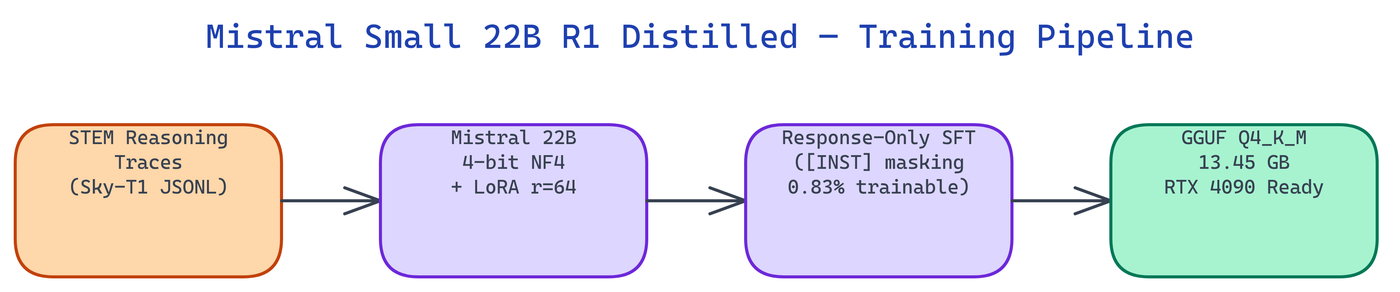 Pipeline Architecture
The Problem
Applying reasoning distillation to 20B+ models requires solving four problems at once: correct chat format handling, response-only gradient flow, fitting training into a single GPU, and compressing the result enough for practical inference. Getting any one of these wrong breaks the whole pipeline.
NEO built this distillation pipeline for Mistral Small 3.1, wiring all four together with a DRY_RUN=1 mode that makes CI pass without GPU hardware.
The Four Engineering Problems
Chat format is the first constraint. Mistral uses [INST]/[/INST] delimiters, not the <|im_start|> format Qwen uses or the Llama header format. Using the wrong template produces malformed training examples.
Response-Only Training is the second. Without masking [INST] tokens, the model wastes training capacity memorizing user prompts instead of learning reasoning patterns. The pipeline automatically masks all tokens between [INST] and [/INST], setting them to labels = -100.
[INST] Solve 3x² - 11x + 6 = 0 [/INST]   →  labels = -100

<think>                                     →  labels = token_id ✅
Step 1: identify coefficients...            →  labels = token_id ✅
Step 2: apply quadratic formula...          →  labels = token_id ✅
</think>                                    →  labels = token_id ✅

FINAL ANSWER: x = 3 or x = 2/3            →  labels = token_id ✅
LoRA efficiency is the third. Full fine-tuning of 22B parameters requires multiple A100 80 GB GPUs. LoRA r=64 reduces the trainable parameter count to 0.83% of the full model, fitting training onto a single RTX 4090.
GGUF quantization is the fourth. The merged 22B model at fp16 is 44 GB, too large for most inference setups. Q4_K_M quantization brings this to 13.45 GB, fitting comfortably in the 24 GB VRAM of an RTX 4090.
LoRA Configuration
| Parameter | Value |
|---|---|
| Rank (r) | 64 |
| Alpha | 128 |
| Target modules | q_proj, k_proj, v_proj, o_proj, gate_proj, up_proj, down_proj |
| Trainable overhead | ~0.83% of 22B |
| Max sequence length | 8192 |
| Quantization (training) | 4-bit NF4 |
The higher rank (64 vs 16 for smaller models) is appropriate here. A 22B model has more capacity to absorb reasoning patterns, and the feed-forward layers (gate_proj, up_proj, down_proj) are included alongside attention projections.
GGUF Size Reference
| Quantization | Size | VRAM Needed |
|---|---|---|
| Q4_K_M | 13.45 GB | 24 GB (RTX 4090) |
| Q5_K_M | 15.74 GB | 24 GB |
| Q6_K | 18.22 GB | 24 GB |
| Q8_0 | 23.56 GB | 32 GB |
| F16 | 44.35 GB | 2x A100 80 GB |
What the Reasoning Output Looks Like
Math example:
[INST] Solve the quadratic equation: 3x² - 11x + 6 = 0. Show all steps. [/INST]
<think>
Step 1: Identify coefficients: a=3, b=-11, c=6
Step 2: Apply quadratic formula: x = (11 ± √(121 - 72)) / 6
Step 3: Simplify: x = (11 ± √49) / 6 = (11 ± 7) / 6
Step 4: x₁ = 18/6 = 3, x₂ = 4/6 = 2/3
Step 5: Verify both solutions satisfy original equation ✓
</think>

FINAL ANSWER: x = 3 or x = 2/3
Physics example:
[INST] Train A leaves Station A at 60 mph. Train B (300 miles away) heads toward A at 90 mph. When do they meet? [/INST]
<think>
Step 1: Let t = time in hours until trains meet.
Step 2: Train A travels 60t miles, Train B travels 90t miles.
Step 3: 60t + 90t = 300 → 150t = 300 → t = 2 hours
Step 4: Verification: 120 + 180 = 300 ✓
</think>

FINAL ANSWER: The trains meet after 2 hours.
Reasoning Quality Evaluation
The ReasoningQualityEvaluator measures depth scores (0.4–1.0) and step counts per domain:
Total samples  : 10
Avg depth      : 0.6152  (range: 0.4680–1.0000)
Avg steps      : 6.3     (range: 4–11)
math           count=3   avg_depth=0.5220  avg_steps=5.0
physics        count=4   avg_depth=0.5375  avg_steps=5.8
coding         count=3   avg_depth=0.8120  avg_steps=8.3
Coding samples score highest on depth, reflecting the more structured step-by-step nature of algorithm problems.
How to Build This with NEO
Open NEO in VS Code or Cursor and describe what you want to build. A good starting prompt for this project:
"Build a DeepSeek-R1-style reasoning distillation pipeline for Mistral Small 3.1 22B using Unsloth and LoRA r=64. The pipeline should handle Mistral's [INST]/[/INST] chat format correctly, automatically mask all instruction tokens to labels=-100 so training is response-only, configure LoRA on q_proj/k_proj/v_proj/o_proj/gate_proj/up_proj/down_proj with rank 64 and alpha 128, train in 4-bit NF4 to fit a single RTX 4090, then export the merged model to GGUF Q4_K_M targeting 13.5 GB. Include a DRY_RUN=1 mode that validates config, masking stats, and GGUF size estimates without GPU hardware."
NEO generates the project structure and core implementation. From there you iterate: ask it to implement the token masking logic with labels=-100 assignment for instruction spans, add the GGUF export command with Q4_K_M quantization and Hub push support, or build the ReasoningQualityEvaluator that measures depth scores and step counts per domain. Each follow-up builds on what's already there.
To train yourself (RTX 4090 or A100 required), or use the released model directly:
To run training yourself, clone the repo and install:
git clone https://github.com/dakshjain-1616/mistral-small-r1-distilled
cd mistral-small-r1-distilled
pip install -r requirements.txt
pip install "unsloth[colab-new] @ git+https://github.com/unslothai/unsloth.git"
Set your HuggingFace token and run training (RTX 4090 or A100 required):
export HF_TOKEN=hf_your_token_here
python -m mistral_r1_distill train
Export to GGUF and push to Hub:
export HF_REPO_ID=your-username/Mistral-Small-3.1-22B-R1-Distilled
python -m mistral_r1_distill export
python -m mistral_r1_distill push
To use the released model directly, pull it from HuggingFace:
pip install huggingface_hub transformers
huggingface-cli download daksh-neo/mistral-small-3-1-22b-r1-distilled --local-dir ./model
Load and run inference:
from transformers import AutoModelForCausalLM, AutoTokenizer

model = AutoModelForCausalLM.from_pretrained("daksh-neo/mistral-small-3-1-22b-r1-distilled")
tokenizer = AutoTokenizer.from_pretrained("daksh-neo/mistral-small-3-1-22b-r1-distilled")
inputs = tokenizer("[INST] Solve step by step: What is 15% of 240? [/INST] <think>", return_tensors="pt")
outputs = model.generate(**inputs, max_new_tokens=256)
print(tokenizer.decode(outputs[0]))
Or load the GGUF directly with llama.cpp:
from llama_cpp import Llama

llm = Llama(model_path="outputs/gguf/model-q4_k_m.gguf", n_ctx=8192, n_gpu_layers=-1)
output = llm("[INST] Why does ice float? [/INST] <think>", max_tokens=1024, stop=["</s>"])
print(output["choices"][0]["text"])
Run python demo.py first to validate the full pipeline config and masking stats in under a second with no GPU required.
NEO built a complete reasoning distillation pipeline for Mistral 22B that fits training on a single RTX 4090 and inference on the same card. See what else NEO ships at heyneo.com.
Try NEO in Your IDE
Install the NEO extension to bring AI-powered development directly into your workflow:
- VS Code: NEO in VS Code
- Cursor: Install NEO for Cursor