
LLM Council: How NEO Built a Multi-Model Consensus Engine in ~200 Lines of Python

 Pipeline Architecture
The Problem
Single-model outputs have a ceiling. No matter how good GPT-4 or Claude gets, they still hallucinate, still get overconfident on edge cases, and still reflect biases baked into their training data. The fix isn't always a bigger model — but most teams have no practical way to leverage multiple models together, so they accept the limitations of a single provider.
NEO built LLM Council — a minimal, production-usable framework that queries multiple language models concurrently, then synthesizes or votes across their responses to produce a better final answer. The core is roughly 200 lines of Python, and it ships with two consensus strategies depending on your use case.
Why Multi-Model Consensus Works
Think about how expert panels work. A single doctor can miss a diagnosis. Three doctors reviewing the same case independently, then comparing notes, are much harder to fool. LLMs operate on a similar principle. Each model has different training data, different RLHF tuning, different failure modes. When they agree, you can be more confident. When they diverge, that divergence itself is informative.
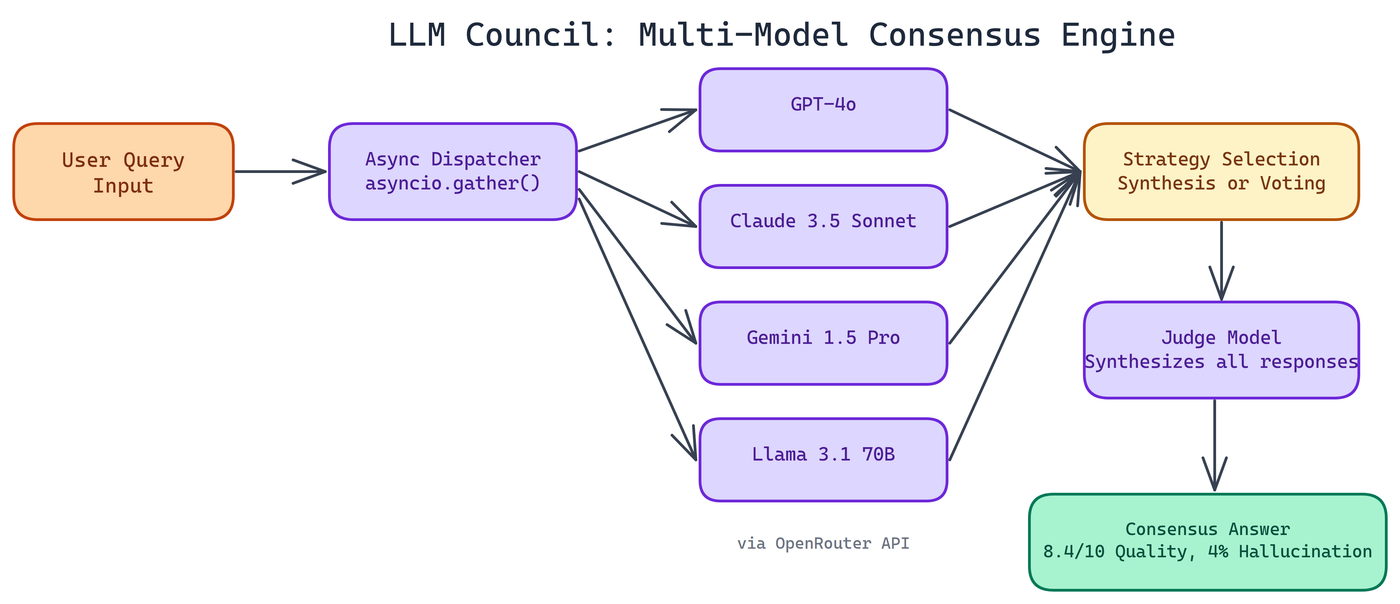
NEO's benchmarks confirmed this. Single GPT-4 queries scored 7.2/10 quality with a 12% hallucination rate across the test set. Running the same queries through the Council's synthesis approach pushed that to 8.4/10 quality with only a 4% hallucination rate. That's a meaningful improvement without any fine-tuning or prompt hacking.
The Architecture: Small Core, Serious Capability
The entire framework depends on only two libraries: OpenAI and Pydantic. NEO kept it that way intentionally. Heavy frameworks introduce hidden complexity, and hidden complexity breaks in production.
Under the hood, the framework uses asyncio.gather() to fire off all model queries simultaneously. Total latency approximates the slowest model in the council, not the sum of all response times. If you're querying four models and the slowest takes 3 seconds, you wait 3 seconds total, not 12. That makes the Council practical for real applications, not just offline experiments.
The framework integrates with OpenRouter, which gives access to 200+ models through a single API. You can run a council of GPT-4o, Claude 3.5 Sonnet, Gemini 1.5 Pro, and Llama 3.1 70B in one shot. Mix providers freely.
Two Consensus Strategies
NEO shipped two approaches because different tasks need different aggregation logic.
Synthesis uses a judge model to read all responses and produce a unified answer. The judge understands nuance, can weigh conflicting information, and produces coherent prose. This works best for open-ended questions, complex reasoning, and anything where "correct" isn't a single word or number.
Voting takes the most frequent response across models. Simpler and faster. This shines on factual lookups, classification tasks, and objective questions where the right answer is discrete. If five out of seven models say Paris, Paris is almost certainly right.
Both approaches handle failure gracefully. If one model times out or throws an error, the council continues with the remaining responses. Individual failures don't break the whole run.
Real Use Cases
Research and analysis: When you need a thorough answer to a complex question, synthesis across three or four strong models produces outputs that are noticeably more balanced and accurate than any single model alone.
Fact verification: Use voting across a large council to check whether a statement is widely agreed upon or contested across models.
Production AI features: Applications where hallucinations carry real cost (medical, legal, financial) benefit from the reduced error rate of consensus-based generation.
Red teaming: Disagreement across models is a signal. If your council splits 50/50 on an answer, that's a flag worth investigating before shipping.
Getting Started
Setup is straightforward. You configure your model list and consensus strategy through environment variables or directly in code. The NEO VSCode extension handles virtual environment creation, dependency installation, and running queries without leaving your editor.
council = LLMCouncil(
    models=["openai/gpt-4o", "anthropic/claude-3.5-sonnet", "google/gemini-pro-1.5"],
    strategy="synthesis",
    judge_model="openai/gpt-4o"
)
response = await council.query("Explain the tradeoffs between RLHF and DPO for alignment")
Error handling, retries, and timeouts are built in. You don't need to write defensive wrappers around each model call.
What NEO Learned Building This
The biggest insight was that synthesis quality depends heavily on the judge model. A weak judge that just concatenates responses adds little value. A strong judge explicitly prompted to find agreement, flag conflicts, and synthesize coherently makes a real difference.
Voting, by contrast, degrades gracefully even with weaker models in the mix. Majority signal is robust to outliers.
NEO also found that council size matters less than council diversity. Three models with different architectures and training regimes outperform five models from the same provider family.
Try It
LLM Council is open source. The core is small enough to read in an afternoon, modify easily, and integrate into any Python project. If you're building applications where answer quality matters and hallucinations carry cost, it's worth adding to your stack.
How to Build This with NEO
Open NEO in VS Code or Cursor and describe what you want to build. A good starting prompt for this project:
"Build a Python async multi-model consensus framework using the OpenAI SDK and Pydantic. It should query a configurable list of OpenRouter models simultaneously using asyncio.gather(), then support two aggregation strategies: a synthesis strategy where a judge model reads all responses and produces a unified answer with conflict flags, and a voting strategy that returns the most frequent response. Handle individual model failures gracefully so the council continues with remaining responses."
NEO generates the project structure and core implementation. From there you iterate: ask it to add the confidence scoring and conflict detection logic to the synthesis judge prompt, wire in the voting strategy with majority-answer breakdown, or build out configurable retry and timeout handling per model. Each follow-up builds on what's already there.
To run the finished project:
git clone https://github.com/abhishekgandhi-neo/llm_council_by_neo
cd llm_council_by_neo
pip install -r requirements.txt
export OPENROUTER_API_KEY=sk-or-...
python -c "import asyncio; from council import LLMCouncil; council = LLMCouncil(models=['openai/gpt-4o','anthropic/claude-3.5-sonnet','google/gemini-pro-1.5'], strategy='synthesis', judge_model='openai/gpt-4o'); print(asyncio.run(council.query('What are the tradeoffs between PostgreSQL and MongoDB?')).answer)"
Try swapping strategy="voting" to compare how synthesis and majority-vote differ on the same query, or add a fourth model to the council to see how council diversity affects output quality.
NEO built a multi-model consensus engine where hallucination reduction and answer quality improvement happen through model diversity, not just bigger models. See what else NEO ships at heyneo.com.
Try NEO in Your IDE
Install the NEO extension to bring AI-powered development directly into your workflow:
- VS Code: NEO in VS Code
- Cursor: Install NEO for Cursor