

llm-cache: Semantic Response Caching for OpenAI and Anthropic SDKs

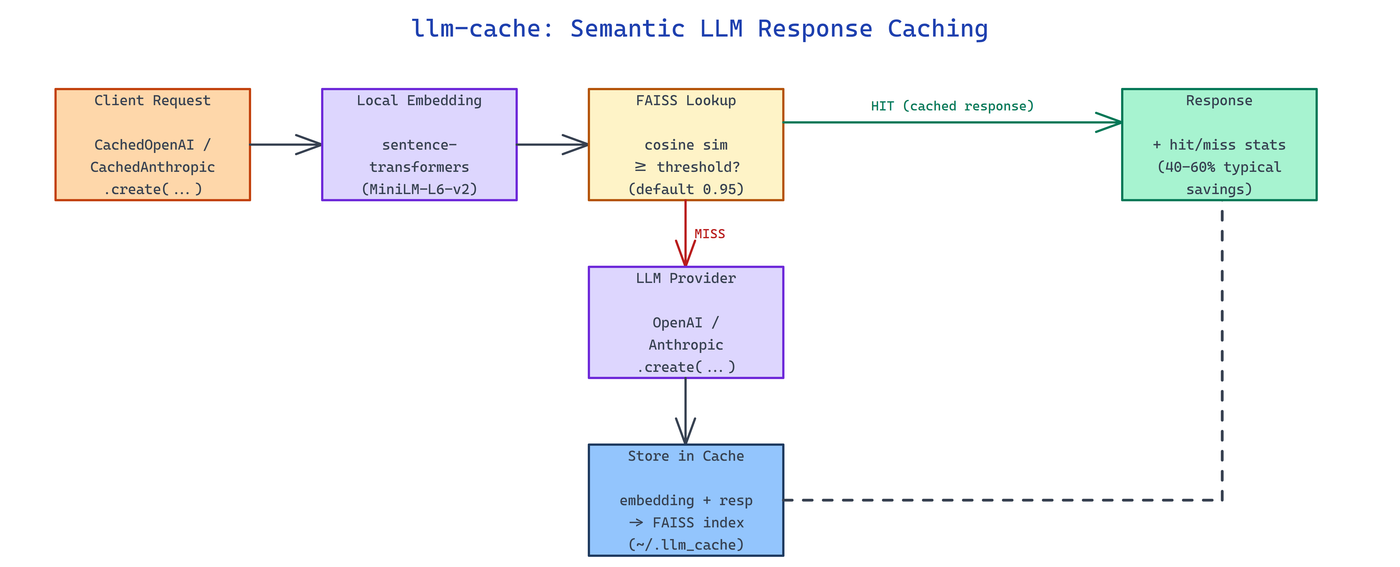 Pipeline Architecture
The Problem
Production LLM workloads re-ask the same question in a dozen different wordings and pay full token price every time because exact-match caches only fire on identical strings.
NEO built llm-cache to sit in front of the OpenAI and Anthropic SDKs and return a cached response whenever a new prompt is semantically close enough to one it has already answered.
Drop-In Client Wrappers
llm-cache ships CachedOpenAI and CachedAnthropic (plus AsyncCachedOpenAI and AsyncCachedAnthropic) that mirror the upstream SDK surface, so existing call sites keep working. The wrapper intercepts chat.completions.create, computes a local embedding for the incoming prompt, and looks it up in a per-client semantic index before deciding whether to hit the provider.
from llm_cache import CachedOpenAI

client = CachedOpenAI(api_key="sk-...", threshold=0.90)

response = client.chat.completions.create(
    model="gpt-4o",
    messages=[{"role": "user", "content": "What is the capital of France?"}]
)

# Paraphrase — served from cache at zero API cost
response2 = client.chat.completions.create(
    model="gpt-4o",
    messages=[{"role": "user", "content": "What city is the capital of France?"}]
)
For callers that want the cache without the SDK wrapper, SemanticCache exposes set, get, get_similar, delete, clear, save, and stats directly.
Local Embeddings + FAISS Index
Embeddings are computed locally with sentence-transformers (default model all-MiniLM-L6-v2, ~90 MB) — no external embedding service and no internet required after the first download. Vectors are L2-normalized and indexed in FAISS so lookup is a cosine-similarity search, and the index persists to ~/.llm_cache/ with a checkpoint every 10 writes by default.
| Parameter | Default | Purpose |
|---|---|---|
threshold | 0.95 | Cosine-similarity score required for a cache hit |
cache_name | "default" | Namespace; use different names to isolate caches per project |
cache_dir | ~/.llm_cache | On-disk location for the index and metadata |
persist | True | Toggle disk persistence |
embedding_model | all-MiniLM-L6-v2 | Sentence-transformer used to embed prompts |
The threshold is the main tuning knob. 0.98–1.0 matches near-exact duplicates only, 0.92–0.97 catches clear paraphrases, and 0.88–0.91 is recommended for batch workloads where false positives are cheap. Going below 0.85 risks returning the wrong cached answer.
Hit-Rate Stats and Cache Management
Every client exposes a rolling stats view so you can see what the cache is actually doing:
stats = client.get_stats()
print(f"Hit rate: {stats['hit_rate']:.1%}  |  Hits: {stats['hits']}  |  Misses: {stats['misses']}")
SemanticCache adds inspection and maintenance methods — get_similar(query, k=5) returns the top-k nearest entries for debugging threshold choices, delete(entry_id) removes a single entry, and clear() wipes the namespace. Typical savings on repetitive workloads land in the 40–60% range according to the project's own benchmarks.
Limitations Worth Knowing
- Streaming calls (
stream=True) are passed through and not cached. - Tool and function calls bypass the cache.
- The cache is model-agnostic by default — entries are shared across models unless you isolate them with a separate
cache_name. - Responses must be pickle-serializable.
- There is no TTL or automatic eviction; the on-disk cache grows until you call
clear()or manage it yourself.
pip install faiss-cpu sentence-transformers openai anthropic
pip install -e .
python examples/openai_example.py      # demos run without an API key
How to Build This with NEO
Open NEO in VS Code or Cursor and describe what you want to build. A good starting prompt for this project:
"Build a Python library that wraps the OpenAI and Anthropic SDKs with a semantic cache. Use sentence-transformers (all-MiniLM-L6-v2) to embed prompts locally and FAISS with L2-normalized vectors for cosine-similarity lookup. Expose CachedOpenAI, CachedAnthropic, AsyncCachedOpenAI, AsyncCachedAnthropic as drop-in replacements, plus a SemanticCache class with set/get/get_similar/delete/clear/save/stats. Persist the index to ~/.llm_cache with periodic checkpoints, make threshold and cache_name configurable, and expose hit/miss counters and hit rate. Pass streaming and tool calls through uncached."
NEO generates the package scaffolding, the wrapper classes, and the FAISS-backed cache. From there you iterate — add a TTL and LRU eviction policy, key the cache on (model, prompt) so different models don't share entries, plug in a Redis backend for multi-process setups, or expose a /stats HTTP endpoint for production dashboards. Each request builds on what's already there.
To run the finished project:
git clone https://github.com/dakshjain-1616/llm-cache
cd llm-cache
pip install faiss-cpu sentence-transformers openai anthropic
pip install -e .
python examples/openai_example.py
See what else NEO ships at heyneo.com.
Try NEO in Your IDE
Install the NEO extension to bring AI-powered development directly into your workflow:
- VS Code: NEO in VS Code
- Cursor: Install NEO for Cursor