Kokoro 82M vs Supertonic 3 vs Inflect-Nano-v1: A Real CPU TTS Benchmark

A complete evaluation of three open-weight TTS models across speed, latency, throughput, and audio quality, run entirely on CPU, no GPU involved, with an objective MOS score for every sample.
There are a lot of TTS benchmarks floating around that test on high-end hardware, cherry-pick favorable configurations, or only report one metric. This one tries to be more honest. We ran Kokoro 82M, Supertonic 3, and Inflect-Nano-v1 head-to-head on a CPU, measured everything that actually matters for a production decision, scored the audio quality with an objective neural MOS model, and listened to the outputs.
The short version: the fastest configuration is not the one you should ship, and the smallest model in the field punches well above its weight.
The Models
Kokoro 82M is a StyleTTS2-inspired model with 82 million parameters. It was released under Apache 2.0 (weights included), which is rare for a model of this quality. It outputs 24kHz audio and has two deployment paths: a native PyTorch pipeline via the hexgrad/Kokoro-82M HuggingFace repo, and an ONNX version from onnx-community/Kokoro-82M-v1.0-ONNX. At the time of its release it ranked first on the HuggingFace TTS Arena leaderboard.
Supertonic 3 is a newer model from Supertone with roughly 99 million parameters. Its architecture uses a Vector Estimator flow-matching backbone, which means the number of inference steps is a tunable parameter at runtime via total_steps. Lower steps = faster but lower quality. It supports 31 languages and outputs 44.1kHz audio. The license is OpenRAIL-M, which has some commercial use restrictions.
Inflect-Nano-v1 (owensong/Inflect-Nano-v1) is the new entrant and the outlier: a tiny 4.63M-parameter model, about 18× smaller than Kokoro and 21× smaller than Supertonic. It pairs a compact FastSpeech-style acoustic model (3.47M params) with a Snake-activation HiFi-GAN vocoder (1.17M params), outputs 24kHz audio, and is Apache-2.0. It ships only as a HuggingFace git repo (no pip package) and exposes a single English male voice. It uses a g2p_en grapheme-to-phoneme frontend rather than espeak. There were no published speed or quality benchmarks for it, so we made some.
What We Measured
The benchmark ran 5 configurations:
- Supertonic-3 at
total_steps=2(speed mode) - Supertonic-3 at
total_steps=5(default quality) - Kokoro-82M via PyTorch CPU
- Kokoro-82M via ONNX Runtime CPU
- Inflect-Nano-v1 via PyTorch CPU
Each configuration was tested across 6 text lengths: tiny (12 chars), short (59), medium (196), long (483), paragraph (851), and extended (1712 characters). Every cell got 5 timed repetitions after one discarded warmup run. That is 150 total timed runs.
The primary metric is RTF (Real-Time Factor): wall-clock synthesis time divided by the duration of the audio produced. RTF below 1.0 means the model synthesizes faster than real-time. Lower is faster.
How we scored audio quality (MOS and UTMOS)
MOS (Mean Opinion Score) is the standard way to rate how natural synthesized speech sounds. In a formal listening test, human listeners hear each clip and score it from 1 to 5: 1 means bad or robotic, 5 means excellent and natural. Those ratings are averaged into a single MOS per clip. That is the gold standard for TTS evaluation, but running a listener panel for dozens of samples is slow, expensive, and hard to repeat across runs.
UTMOS (UTokyo Mean Opinion Score) is a neural model that predicts that human MOS from audio alone. It was trained on human listening data, so its output is meant to track what a panel would score without needing one. You feed in a waveform; it returns a single number on the same 1-5 scale. In this benchmark we used the utmos22_strong checkpoint, loaded via torch.hub in mos_eval.py. Each of our 30 saved WAV files is scored once, and we report the mean per configuration in the tables below.
How to read the scores in this post:
| UTMOS range | What it tends to mean in our results |
|---|---|
| ~4.4+ | Clearly usable, natural-sounding (Kokoro, Supertonic 5-step) |
| ~3-3.5 | Mid-range on paper; listen before trusting (Inflect-Nano over-rated here) |
| ~1.5 or below | Robotic, hard to understand (Supertonic 2-step) |
UTMOS is fast and repeatable, but it is not a replacement for your ears. It correlates well at the extremes yet can be too generous to small HiFi-GAN vocoders that sound clean but mechanical. We listened to every embedded sample and flag where the score disagrees with what you hear.
We also recorded wall-clock latency in seconds, throughput in characters per second, and saved one audio sample per configuration per text length (30 WAV files total) for both MOS scoring and human listening.
Hardware: Intel Xeon Platinum 8272CL, 4 cores available, 15.6GB RAM, no GPU. CUDA_VISIBLE_DEVICES was set to empty for all runs. ONNX sessions were forced to CPUExecutionProvider.
The Headline
| Config | Mean RTF | vs Real-Time | Mean MOS (UTMOS) | Params |
|---|---|---|---|---|
| Inflect-Nano-v1 | 0.1376 | 7.3× | 3.48† | 4.6M |
| Supertonic-3 (2-step) | 0.1781 | 5.6× | 1.53 | ~99M |
| Supertonic-3 (5-step) | 0.3164 | 3.2× | 4.37 | ~99M |
| Kokoro-82M (ONNX) | 0.5711 | 1.8× | 4.44 | 82M |
| Kokoro-82M (PyTorch) | 0.7865 | 1.3× | 4.45 | 82M |
 Quality vs Speed
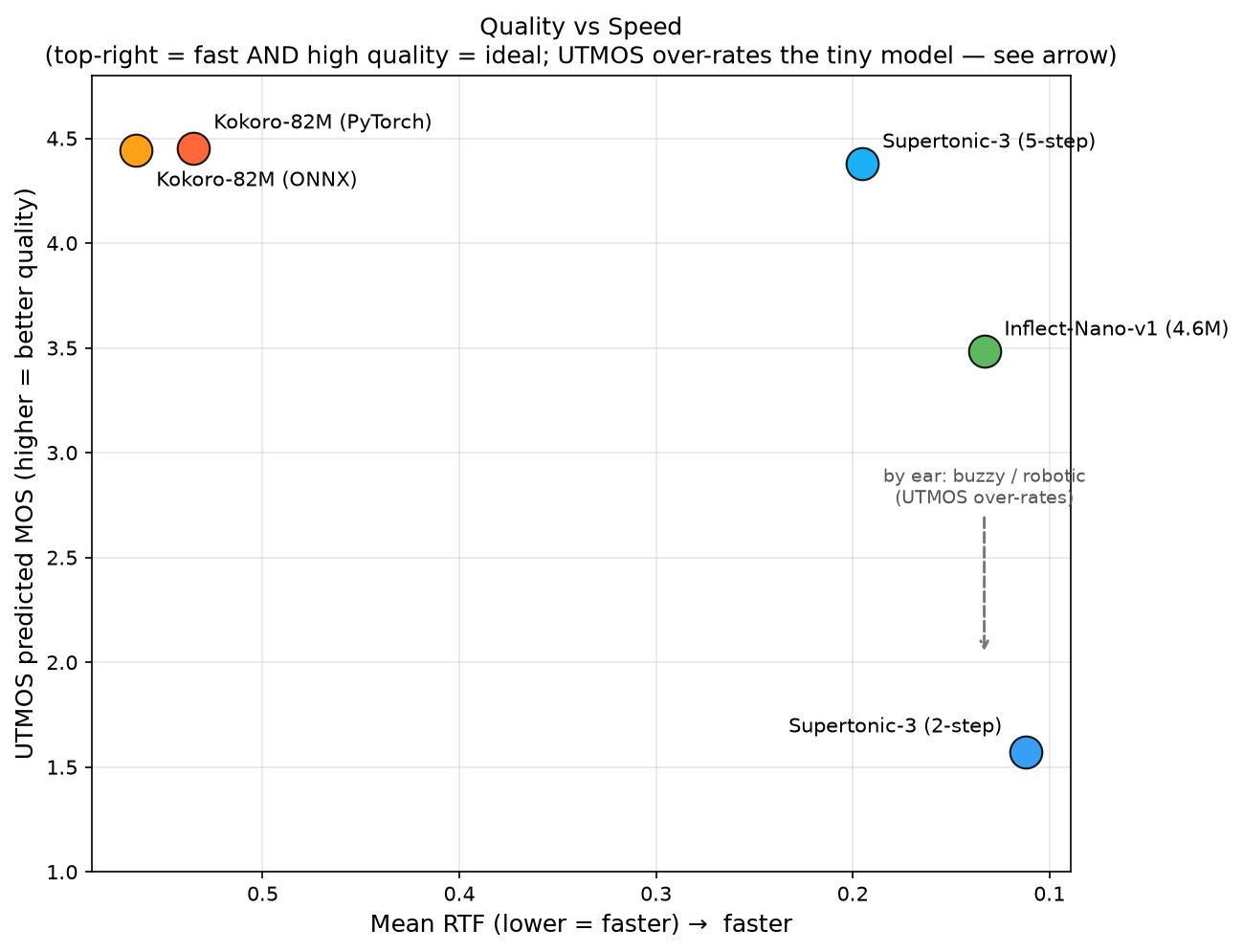
Quality (UTMOS MOS) against speed (mean RTF) (results/charts/quality_vs_speed.png). Faster is to the right; higher is better. The ideal corner is top-right. Inflect-Nano is the fastest config, but its 3.48 is plotted as-measured and UTMOS over-rates it: by ear it is robotic (see below), so its real-quality position is lower than the dot suggests. Supertonic-2step is nearly as fast but bottom-of-the-barrel on quality; Kokoro is top-left (best quality, slowest); Supertonic-5step lands in usable territory.
The single most important thing this chart shows: speed and quality are not the same axis: the two fastest configs (Inflect-Nano and Supertonic 2-step) are not the best-sounding, and Supertonic 2-step is the worst by a wide margin. The objective MOS confirms what your ears tell you, with one exception: it over-rates the tiny Inflect-Nano (†), which sounds robotic despite its mid-range 3.48. More on that below.
The Numbers
RTF by Configuration and Text Length
 RTF Comparison by Configuration
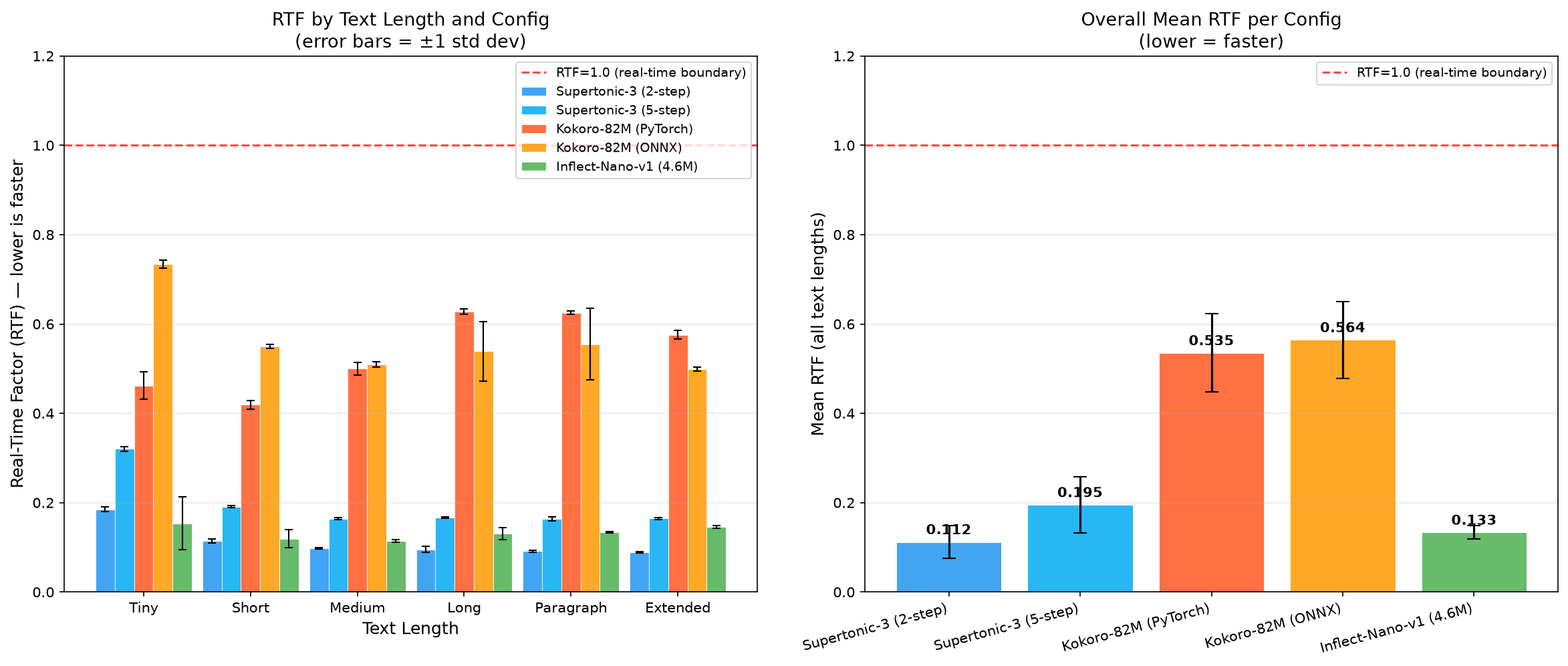
Mean RTF per configuration across all text lengths (results/charts/rtf_comparison.png). Lower is faster. All five configs run below RTF 1.0 (the real-time boundary).
| Config | Tiny | Short | Medium | Long | Paragraph | Extended | Mean |
|---|---|---|---|---|---|---|---|
| Supertonic-3 (2-step) | 0.2992 | 0.1645 | 0.1665 | 0.1480 | 0.1451 | 0.1456 | 0.1781 |
| Supertonic-3 (5-step) | 0.4827 | 0.3105 | 0.2987 | 0.2701 | 0.2668 | 0.2697 | 0.3164 |
| Kokoro-82M (PyTorch) | 0.7943 | 0.7028 | 0.7826 | 0.9926 | 0.8448 | 0.6018 | 0.7865 |
| Kokoro-82M (ONNX) | 0.6918 | 0.5445 | 0.5178 | 0.5126 | 0.5053 | 0.6548 | 0.5711 |
| Inflect-Nano-v1 | 0.1555 | 0.1190 | 0.1196 | 0.1371* | 0.1402* | 0.1541* | 0.1376 |
Inflect-Nano and Supertonic 2-step sit below RTF 0.2; Supertonic 5-step is faster than real-time but higher. Kokoro is the slowest of the three families on this CPU, with Kokoro-PyTorch ranging from 0.60 up to 0.99 and Kokoro-ONNX from 0.51 to 0.69, and their RTF actually rises on longer inputs rather than amortizing down the way the others do.
Note: Values marked * for Inflect-Nano reflect partial synthesis: the model truncates inputs longer than ~15s of audio. See the caveat below.
Wall-Clock Latency (seconds)
| Config | Tiny | Short | Medium | Long | Paragraph | Extended |
|---|---|---|---|---|---|---|
| Supertonic-3 (2-step) | 0.417s | 0.699s | 2.273s | 5.043s | 9.077s | 17.530s |
| Supertonic-3 (5-step) | 0.672s | 1.320s | 4.078s | 9.207s | 16.686s | 32.484s |
| Kokoro-82M (PyTorch) | 1.211s | 2.846s | 9.802s | 30.126s | 44.734s | 66.539s |
| Kokoro-82M (ONNX) | 0.649s | 1.905s | 6.186s | 15.747s | 26.462s | 68.102s |
| Inflect-Nano-v1 | 0.126s | 0.369s | 1.123s | 2.048s* | 2.093s* | 2.302s* |
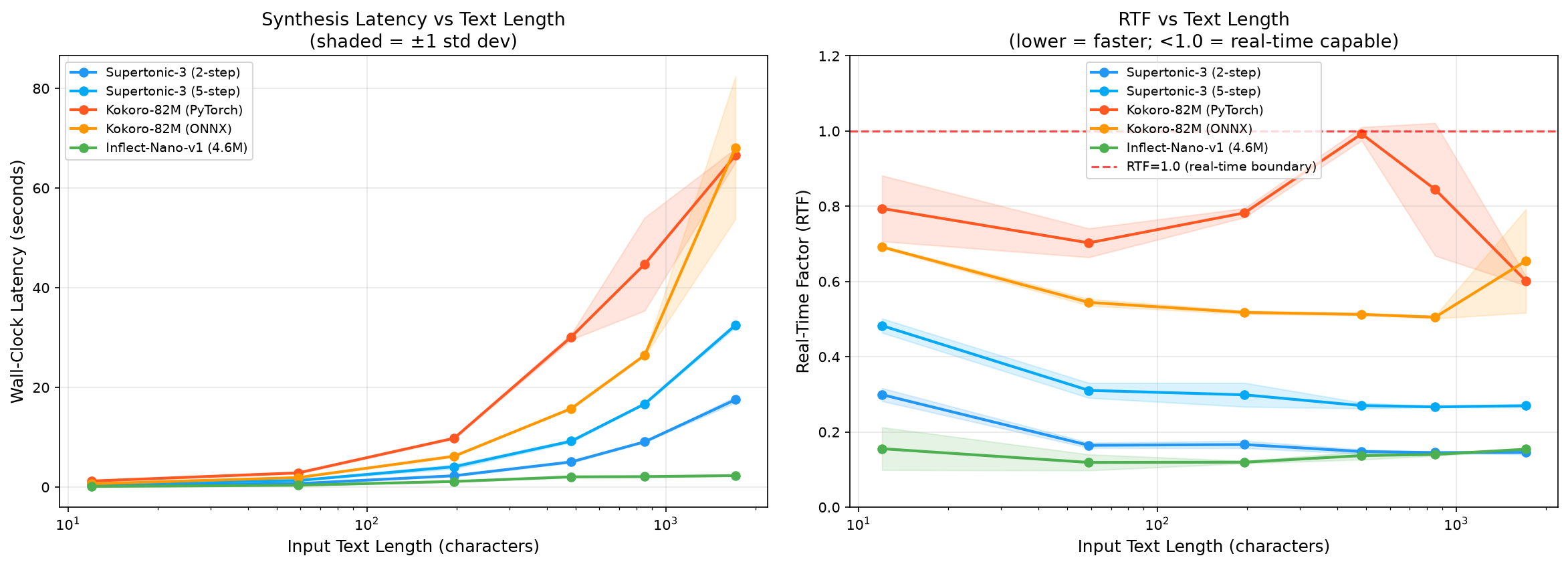 Latency vs Text Length
Wall-clock latency in seconds as text length grows (results/charts/latency_vs_length.png).
Throughput (chars/sec)
| Config | Tiny | Short | Medium | Long | Paragraph | Extended |
|---|---|---|---|---|---|---|
| Supertonic-3 (2-step) | 28.8 | 84.5 | 86.2 | 95.9 | 93.9 | 97.6 |
| Supertonic-3 (5-step) | 17.9 | 44.7 | 48.1 | 52.5 | 51.1 | 52.7 |
| Kokoro-82M (PyTorch) | 9.9 | 20.8 | 20.0 | 16.0 | 19.0 | 25.7 |
| Kokoro-82M (ONNX) | 18.5 | 31.0 | 31.7 | 30.7 | 32.2 | 25.1 |
| Inflect-Nano-v1 | 95.2 | 160.2 | 174.3 | 236.7* | 406.8* | 743.6* |
Note: Inflect-Nano's throughput at long text lengths looks enormous because it stops generating after ~15s of audio regardless of how much text you give it. Those chars/sec figures are not real synthesis rates.
Audio Quality: UTMOS Predicted MOS (higher = more natural)
Per-length breakdown (see How we scored audio quality above for what MOS and UTMOS mean):
| Config | Tiny | Short | Medium | Long | Paragraph | Extended | Mean |
|---|---|---|---|---|---|---|---|
| Supertonic-3 (2-step) | 1.45 | 2.07 | 1.48 | 1.47 | 1.37 | 1.34 | 1.53 |
| Supertonic-3 (5-step) | 4.18 | 4.35 | 4.53 | 4.41 | 4.49 | 4.24 | 4.37 |
| Kokoro-82M (PyTorch) | 4.06 | 4.51 | 4.55 | 4.54 | 4.53 | 4.53 | 4.45 |
| Kokoro-82M (ONNX) | 4.04 | 4.51 | 4.54 | 4.55 | 4.52 | 4.49 | 4.44 |
| Inflect-Nano-v1 | 3.02 | 4.15 | 3.90 | 3.45 | 3.01 | 3.37 | 3.48 |
In our results, UTMOS tracks listening well at the extremes: Supertonic-2step's "robotic" output scores 1.53, while Kokoro and Supertonic-5step cluster around 4.4, but it is too generous to Inflect-Nano. Its 3.48 suggests "middle of the pack," yet to the ear Inflect-Nano is buzzy and robotic (see below). This is a known UTMOS failure mode: it rewards small HiFi-GAN vocoders for being clean even when they are not natural. Read Inflect-Nano's 3.48 as an optimistic upper bound, not a usability verdict.
The Tiny-Model Story: Inflect-Nano-v1
The most surprising result in the whole benchmark is what a 4.6M-parameter model can do. Inflect-Nano-v1 is the fastest configuration overall (RTF 0.1376, 7.3× real-time), edging out even Supertonic's quality-destroying 2-step mode, and it does this with under 5% of Kokoro's parameter count.
But it is not high-fidelity. On its UTMOS score (3.48) it looks mid-pack, and it is genuinely more intelligible than Supertonic-2step, but a careful listen tells a blunter story: the voice is buzzy and robotic, with a metallic vocoder texture and flat, monotone prosody. It is clearly synthetic in a way Kokoro and Supertonic-5step are not. So the honest framing is narrow: if you are choosing purely on a maximum-speed budget, Inflect-Nano is a more intelligible option than Supertonic-2step at the same latency, not a natural-sounding one. Don't let its 3.48 UTMOS (which over-rates small vocoders) read as "good."
The catch: a hard ~15-second output cap
There is one critical limitation you must know about. Inflect-Nano-v1's acoustic model is configured with max_frames = 1400, which caps synthesis at ~14.93 seconds of audio no matter how long the input text is. Feed it a 1700-character essay and it renders the first ~15 seconds and silently drops the rest.
You can see this directly in the audio durations: for the long, paragraph, and extended inputs, Inflect-Nano produces an identical 14.93s of audio, while every other model scales to 30-120s. That means its RTF and throughput on those three rows are inflated: it is doing far less work than the models it is being compared against. The honest comparison for Inflect-Nano is the tiny/short/medium rows, where the full text fits inside the cap.
For long-form synthesis (audiobooks, documents) you would need to split text into sub-15-second chunks yourself before feeding it in. For short, interactive utterances (chatbot replies, voice-assistant responses, notifications), the cap rarely bites, and this is exactly where a 4.6M-param model that runs at 7.3× real-time is compelling.
Audio Quality: Where the Story Changes
RTF numbers alone would point you at the fastest configs: Inflect-Nano or Supertonic 2-step. But the MOS scores and our ears tell a more complicated story.
The text used for the short samples below is the classic pangram: "The quick brown fox jumps over the lazy dog."
Supertonic-3 at 2-step sounds robotic (MOS 1.53). Words blur together and some are difficult to make out. This is not a bug: it is a fundamental property of flow-matching models. Fewer denoising steps means less waveform refinement. The RTF of 0.1781 is impressive on paper, but the output is not something you would put in front of a user.
Supertonic-3 (2-step), short text:
Supertonic-3 at 5-step (MOS 4.37) is a different story: clearly intelligible, fully audible, and usable. It lacks some of the warmth and natural prosody of Kokoro, but it is not robotic. If latency is your primary constraint and you can accept slightly flat delivery, this is a reasonable choice.
Supertonic-3 (5-step), short text:
Kokoro 82M (both PyTorch and ONNX, MOS ~4.45) produces human-like speech. The prosody is natural, the pacing feels right, and it does not sound like a TTS system in the way older models do. The PyTorch and ONNX variants are perceptually indistinguishable; their MOS scores match to two decimals.
Kokoro-82M (PyTorch), short text:
Kokoro-82M (ONNX), short text:
Inflect-Nano-v1 (UTMOS 3.48 overall) is a single male voice that is buzzy and robotic to the ear: a metallic vocoder texture and flat prosody, despite the mid-range metric score. It is more intelligible than Supertonic-2step, but it does not approach Kokoro or Supertonic-5step. Impressive that a sub-5-megabyte model is intelligible at all; just don't expect natural.
Inflect-Nano-v1, short text:
The quality gap is clearer on longer text. Here are the medium samples (196 chars), within Inflect-Nano's length cap, so a fair comparison:
Supertonic-3 (2-step), medium text:
Inflect-Nano-v1, medium text:
Kokoro-82M (PyTorch), medium text:
The Combined Picture
| Config | Mean RTF | MOS | Params | Practical Verdict |
|---|---|---|---|---|
| Inflect-Nano-v1 | 0.1376 | 3.48† | 4.6M | Tiny + fast, but buzzy/robotic; short utterances only; ~15s cap |
| Supertonic-3 (2-step) | 0.1781 | 1.53 | ~99M | Prototyping only (robotic) |
| Supertonic-3 (5-step) | 0.3164 | 4.37 | ~99M | Latency-critical, quality-acceptable |
| Kokoro-82M (ONNX) | 0.5711 | 4.44 | 82M | Quality-first, lightweight deploy |
| Kokoro-82M (PyTorch) | 0.7865 | 4.45 | 82M | Quality-first, PyTorch stack |
A few takeaways:
- If audio quality matters, Kokoro 82M wins (MOS ~4.45). It is the slowest of the three families on this CPU, but the output is human-like, and it is Apache 2.0, which matters for commercial use.
- For the best speed/quality balance, Supertonic-3 at 5-step (MOS 4.37 at 3.2× real-time) is hard to beat: usable quality at a fraction of Kokoro's latency.
- Inflect-Nano-v1 is an impressive engineering demo more than a production voice: 4.6M params at 7.3× real-time is remarkable, and it is more intelligible than Supertonic-2step, but it is buzzy and robotic by ear, and it caps output at ~15 seconds. Reach for it only when footprint and speed dominate and voice quality is genuinely secondary.
- Supertonic-3 at 2-step is a prototyping tool, not a production config. Its MOS of 1.53 is the objective version of "it sounds robotic."
- UTMOS over-rated the tiny model. Its 3.48 for Inflect-Nano disagreed with every human listen (buzzy/robotic). Objective MOS is a useful signal at the extremes, but on small HiFi-GAN vocoders it can flatter clean-but-mechanical output. Worth remembering before trusting a single quality number.
† Inflect-Nano's 3.48 UTMOS over-rates its perceived quality; by ear it is buzzy/robotic.
How This Benchmark Was Run
This evaluation was produced by Neo, an autonomous AI engineering agent, from a single prompt: benchmark these three CPU TTS models across speed, latency, throughput, and audio quality.
From that prompt, Neo:
- Researched each model's architecture and API, including that Inflect-Nano-v1 ships only as a HuggingFace git repo with an importable
synthesize()rather than a pip package - Measured all five configurations on a single machine for an apples-to-apples comparison
- Wrote an
InflectNanoRunnerfor the existing harness and fixed two real-world integration snags along the way: the model's LFS weights andnumba/nltkdata were undeclared dependencies, andkokoro-onnx 0.5.0feeds the v1.0 ONNX model'sspeedinput asint32(it expectsfloat) and returns 2-D audio that broke long-text concatenation. Both patched at the session boundary without editing the installed package - Added
mos_eval.py, scoring every sample with UTMOS (utmos22_strong) loaded from torch.hub - Discovered and reported Inflect-Nano's ~15s output cap rather than letting its inflated long-form numbers stand unqualified
- Regenerated the report, charts, and this writeup
These are the kinds of things that would slow down a manual setup. Neo handled them autonomously as part of the run.
Replicate or Extend This Benchmark
The full benchmark code, raw results, charts, and audio samples are in the benchmark repository.
git clone https://github.com/gauravvij/kokoro-tts-vs-supertonic-3-tts.git
cd kokoro-tts-vs-supertonic-3-tts
The key files:
benchmark.py: the full harness, runs all 150 timed experiments (5 configs)mos_eval.py: scores every saved WAV with UTMOS, writesresults/mos_results.csvreport.py: reads the CSVs, generates the markdown report and chartsresults/raw_results.csv: raw timing data, 150 rowsresults/mos_results.csv: per-sample MOS scoresresults/benchmark_report.md: the full reportresults/charts/: RTF comparison, latency vs length, and quality-vs-speed chartsresults/audio_samples/: 30 WAV files for quality listening
To re-run from scratch you need Python 3.10+, espeak-ng installed system-wide, and the Python packages: supertonic, kokoro, kokoro-onnx, onnxruntime, soundfile, matplotlib, pandas, numpy, torch, torchaudio, numba, plus g2p_en/transformers and the Inflect-Nano repo (git clone https://huggingface.co/owensong/Inflect-Nano-v1 models/Inflect-Nano-v1). The Kokoro ONNX model files and voices binary go in models/ (see the download commands in the README).
What You Can Build on Top of This
Extend the benchmark:
"Add Coqui XTTS-v2 as a sixth configuration and re-run the comparison"
"Wrap Inflect-Nano-v1 in a sentence-chunking layer so it can synthesize long-form text past its 15-second cap, then re-benchmark its true long-input RTF"
"Swap UTMOS for DNSMOS or a human MOS panel and compare the rankings"
Build something with the models:
"Build a FastAPI TTS service that uses Kokoro 82M ONNX for synthesis, with a /synthesize endpoint that accepts text and returns a WAV file"
"Build a low-latency voice-assistant reply pipeline on Inflect-Nano-v1 for sub-15-second utterances, falling back to Kokoro for longer text"
Neo works as an autonomous agent in VS Code or Cursor via the Neo extension. You give it a goal, it plans the implementation, writes the code, runs it, and iterates until it works. The benchmark in this repo is a good starting point for any of the above.
Files in This Repo
benchmark.py                    # Full benchmark harness (150 timed runs, 5 configs)
mos_eval.py                     # UTMOS quality scoring
report.py                       # Report and chart generator
results/
  raw_results.csv               # 150 rows of raw timing data
  mos_results.csv               # 30 rows of per-sample MOS
  benchmark_report.md           # Full analysis report
  charts/
    rtf_comparison.png          # Grouped bar chart by config
    latency_vs_length.png       # Line chart across text lengths
    quality_vs_speed.png        # MOS vs RTF scatter
  audio_samples/                # 30 WAV files (1 per config x text length)
Hardware: Intel Xeon Platinum 8272CL, 4 cores, 15.6GB RAM, no GPU. Python 3.12.3. supertonic 1.3.1, kokoro 0.9.4, kokoro-onnx 0.5.0, onnxruntime 1.27.0, torch 2.12.1, UTMOS utmos22_strong.
Evaluation harness and all result files: https://github.com/gauravvij/kokoro-tts-vs-supertonic-3-tts
Built by Neo
Try NEO in Your IDE
Install the NEO extension to bring AI-powered development directly into your workflow:
- VS Code: NEO in VS Code
- Cursor: Install NEO for Cursor