
Kimi K2.6 vs Claude Opus 4.7: An Autonomous Head-to-Head Benchmark

The Problem
Every new frontier model ships with a glossy benchmark deck where it wins. What you actually want is a small set of hard, discriminating tasks, run head-to-head with a neutral judge, with budgets set so neither model is artificially starved. That doesn't exist as a one-click thing — so NEO built it, ran it, and wrote the report.
NEO compared moonshotai/kimi-k2.6 against anthropic/claude-opus-4.7, both served through OpenRouter, on 10 hard reasoning, coding and analysis tasks. Judging was anonymized A/B with openai/gpt-5.4 as an independent third party — neither contestant scores itself.
Results (run: 2026-04-24)
Judge-decided wins
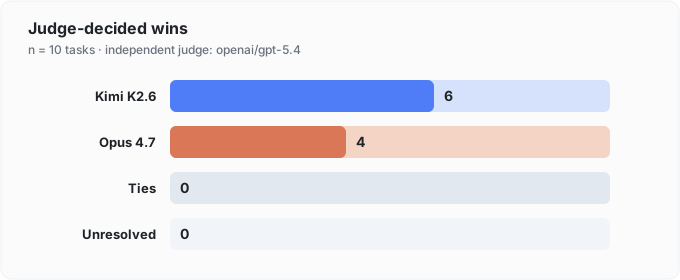 wins
wins
| Metric | Opus 4.7 | Kimi K2.6 |
|---|---|---|
| Judge wins | 4 | 6 |
| Avg judge score (/10) | 8.0 | 7.2 |
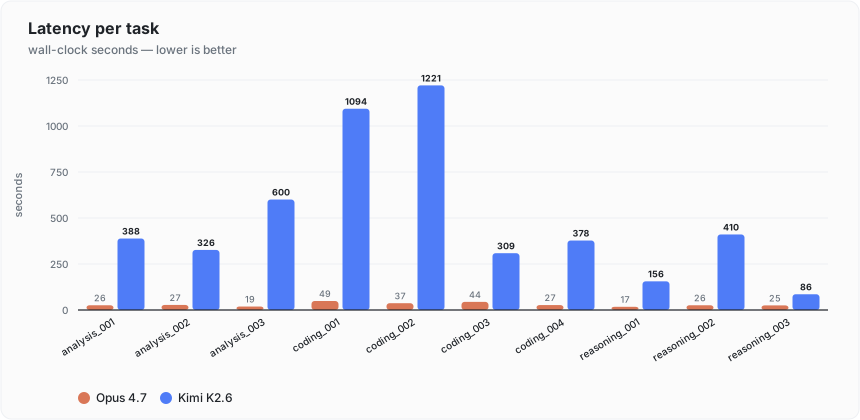
| Avg latency | 29.7 s | 496.8 s |
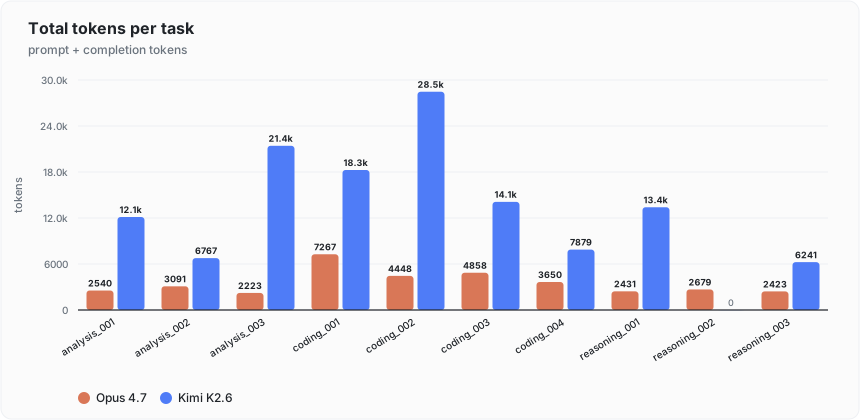
| Avg total tokens | 3,561 | 14,297 |
Kimi takes more raw wins; Opus holds the higher average quality score and is ~17× faster. The story is in the spread between those two facts.
Averages
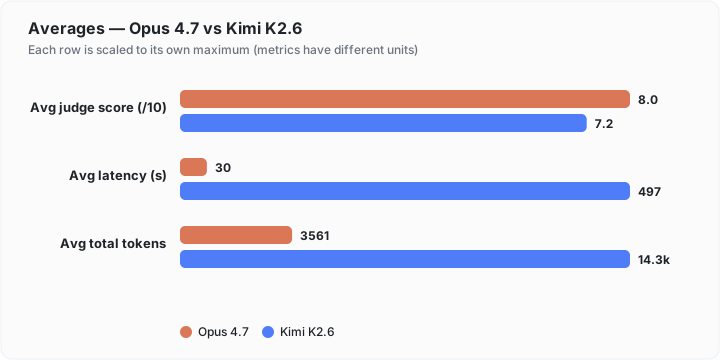 summary
Per-task judge scores
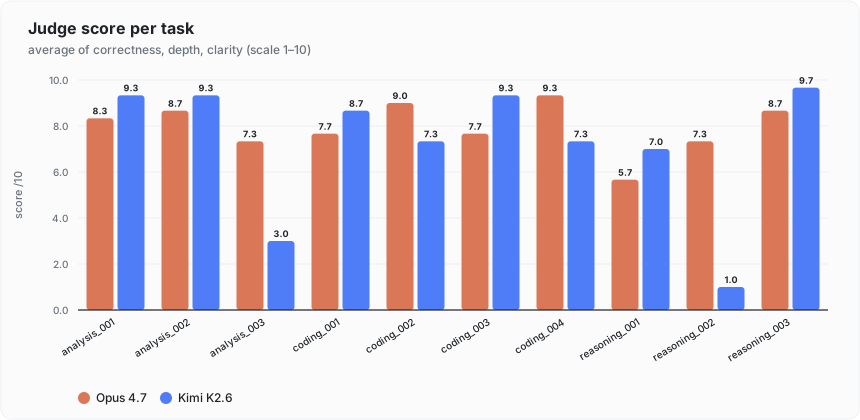 scores
Per-task winners (GPT-5.4 judge): Opus on analysis_003, coding_002, coding_004, reasoning_002. Kimi on analysis_001, analysis_002, coding_001, coding_003, reasoning_001, reasoning_003.
Per-task latency
 latency
Per-task token usage
 tokens
The Task Set
Ten tasks, three categories, one per slot:
| id | category | gist |
|---|---|---|
reasoning_001 | logical | Zebra / Einstein's riddle variant |
reasoning_002 | mathematical | St. Petersburg paradox, bounded rationality |
reasoning_003 | causal | Ice-cream-drownings confounding; study design |
coding_001 | algorithm | Thread-safe token-bucket rate limiter w/ Redis fallback |
coding_002 | system design | Distributed 64-bit K-sortable ID generator (Snowflake-class) |
coding_003 | debugging | uWSGI + SQLAlchemy production memory leak |
coding_004 | optimization | O(N·M·P) Python join → optimized under constraints |
analysis_001 | ethical | Self-driving-car trolley problem variant |
analysis_002 | scientific | Critique a flawed Alzheimer's trial |
analysis_003 | strategic | Repeated duopoly w/ collapse + trembling hand |
The prompts are deliberately picked to split the models — no softballs like "write a Python hello world."
How NEO Ran It
The runner is a single Python script (run_comparison.py) using the OpenAI SDK pointed at https://openrouter.ai/api/v1. Six steps:
- Load
OPENROUTER_API_KEYfrom.env. GET /modelsand resolve the exact slugs containingopus-4.7/opus-4-7underanthropic/andkimi-k2.6/kimi-k2undermoonshotai/. Abort if either is missing — no silent fallback to the wrong model.- For each task: randomize A/B assignment, call both models, record
content,reasoning,finish_reason, latency and prompt/completion/total tokens. - Write
outputs/<task_id>.json. - Judge pass: call
openai/gpt-5.4with an anonymized A/B prompt demanding a single JSON object{scores, winner, reasoning}. Writeoutputs/<task_id>.judge.json. - Assemble
REPORT.md.
Chart generation lives in a separate make_charts.py so you can regenerate the five SVGs above without re-running the models.
Budgets uncapped for fairness
Both models run with max_tokens=32000 and no reasoning.max_tokens cap, so Kimi's thinking chain is never truncated and both finish on their own terms. Under this budget 8/10 Kimi responses complete cleanly with finish_reason=stop. The trade-off is wall-clock — Kimi averages ~497s per task (up to ~20 min on coding_002) versus ~30s for Opus. A full run is ~90 minutes.
Three Illustrative Tasks
Kimi win — reasoning_003 (causal inference)
Judge: Kimi 9.67 vs Opus 8.67. Both correctly identify the confounder (temperature driving both ice cream sales and swimming exposure) and both land on Person C. Kimi wins on pedagogical structure — it distinguishes direct causation, spuriousness and confounding as separate concepts before applying them, where Opus goes straight to the answer.
Opus win — coding_004 (query optimization)
Judge: Opus 9.33 vs Kimi 7.33. Both diagnose the O(U·O·P) nested-scan and propose hash-index joins. The judge preferred Opus for a tighter complexity walk-through and a more realistic runtime estimate. Kimi reports 1M × 10M × 100K = 10²¹ and "~317,000 years"; Opus reports 10¹⁸ operations and flags it as "catastrophically slow — would take years." Small arithmetic, but the judge noticed.
Failure mode — reasoning_002
Judge: Opus 7.33 vs Kimi 1.00. Kimi hit a transient upstream JSONDecodeError from OpenRouter/Moonshot mid-stream and returned no content — the judge was forced to score an empty response. Not a budget issue (the same prompt sometimes completes fine), just upstream flakiness, and it's the single largest drag on Kimi's average score.
On analysis_003 Kimi burned 21k completion tokens entirely inside its reasoning trace (well under the 32k ceiling) and never emitted a final content — a model-side wrap-up failure rather than a cap. In both these cases the judge saw the raw reasoning trace as a fallback, prefixed [NOTE: only reasoning returned...]. Opus completed cleanly on all 10.
What the Numbers Mean
Kimi wins more tasks; Opus wins per-task quality. Kimi's 6 wins are real — its extended reasoning pays off on open-ended reasoning and pedagogical tasks (analysis_001, analysis_002, reasoning_001, reasoning_003). But when Opus wins, it wins by a larger margin, which is why its average judge score (8.0) sits above Kimi's (7.2) despite fewer wins.
Latency is not a tiebreaker, it's a product decision. A ~17× latency gap (30s vs 497s) changes the shape of what you can build. Kimi is a "ask once, wait for the essay" model; Opus is a "put in an interactive loop" model. Neither is wrong — they're different products.
Token counts reflect the same thing. Kimi averages 14,297 total tokens per task versus 3,561 for Opus. Four times the tokens for roughly comparable quality means Kimi is the more expensive choice per answer, before you even factor in the upstream reliability issues.
Treat it as a qualitative sanity check, not a rigorous eval. n=10 is small. The judge is a single model. The sample is biased toward hard tasks. This is the kind of evidence that should push you to run your own version on your own task distribution, not the kind that settles the question.
Run it Yourself
pip install -r requirements.txt
echo "OPENROUTER_API_KEY=sk-or-v1-..." > .env

python run_comparison.py --dry-run                          # validate setup & resolve slugs
python run_comparison.py                                    # full run (~90 min)
python run_comparison.py --only coding_001                  # single task
python run_comparison.py --skip-judge                       # responses only
python run_comparison.py --rejudge-only                     # reuse outputs/*.json, re-judge
python run_comparison.py --judge anthropic/claude-opus-4.7  # swap the judge
python make_charts.py                                       # regenerate charts/*.svg
Cost is ~$5–10 for a full run (30 model calls — 10 Opus + 10 Kimi + 10 judge). A rejudge-only pass is under $1.
How to Build This with NEO
Open NEO in VS Code or Cursor and describe what you want to build. A good starting prompt for this project:
"Build a head-to-head benchmark comparing two OpenRouter-hosted LLMs (Kimi K2.6 and Claude Opus 4.7) on 10 hard discriminating tasks across logical, mathematical, causal, algorithmic, system-design, debugging, optimization, ethical, scientific and strategic reasoning. Use the OpenAI SDK pointed at OpenRouter, resolve exact model slugs via GET /models and abort if missing, uncap budgets with max_tokens=32000 so neither model is starved, and randomize A/B labels per task before handing the two responses to an independent judge model (default openai/gpt-5.4) that returns a single JSON object {scores, winner, reasoning}. Persist outputs/<task_id>.json and outputs/<task_id>.judge.json, assemble a REPORT.md, and ship a make_charts.py that emits wins, summary, per-task latency, per-task scores and per-task tokens as SVGs. Support --dry-run, --only
, --skip-judge, --rejudge-only and --judge flags."
NEO generates the runner, the task prompts, the judge prompt, the chart generator and the report assembler. From there you iterate — ask it to add a second judge for cross-validation, a --bootstrap flag that resamples task subsets to get confidence intervals on the win rates, a cost tracker that reads OpenRouter's per-call pricing and annotates REPORT.md with $/answer, or a --pair <slug-a> <slug-b> flag so you can point the same harness at Gemini-vs-Grok or any other pair without forking the script.
To run the finished project:
git clone https://github.com/dakshjain-1616/kimi-K2.6-Vs-Opus-4.7
cd kimi-K2.6-Vs-Opus-4.7
pip install -r requirements.txt
echo "OPENROUTER_API_KEY=sk-or-v1-..." > .env
python run_comparison.py
The outputs/ folder fills up with per-task responses and judge verdicts, REPORT.md is regenerated, and charts/*.svg shows you wins, averages, latency, per-task scores and per-task tokens.
NEO built a reproducible model-comparison harness that turns "which one is better?" into a concrete, re-runnable answer with a neutral judge, uncapped budgets and five charts. See what else NEO ships at heyneo.com.
Try NEO in Your IDE
Install the NEO extension to bring AI-powered development directly into your workflow:
- VS Code: NEO in VS Code
- Cursor: Install NEO for Cursor