

Contrastive Prompt Optimizer: Learning Better Prompts from Success and Failure

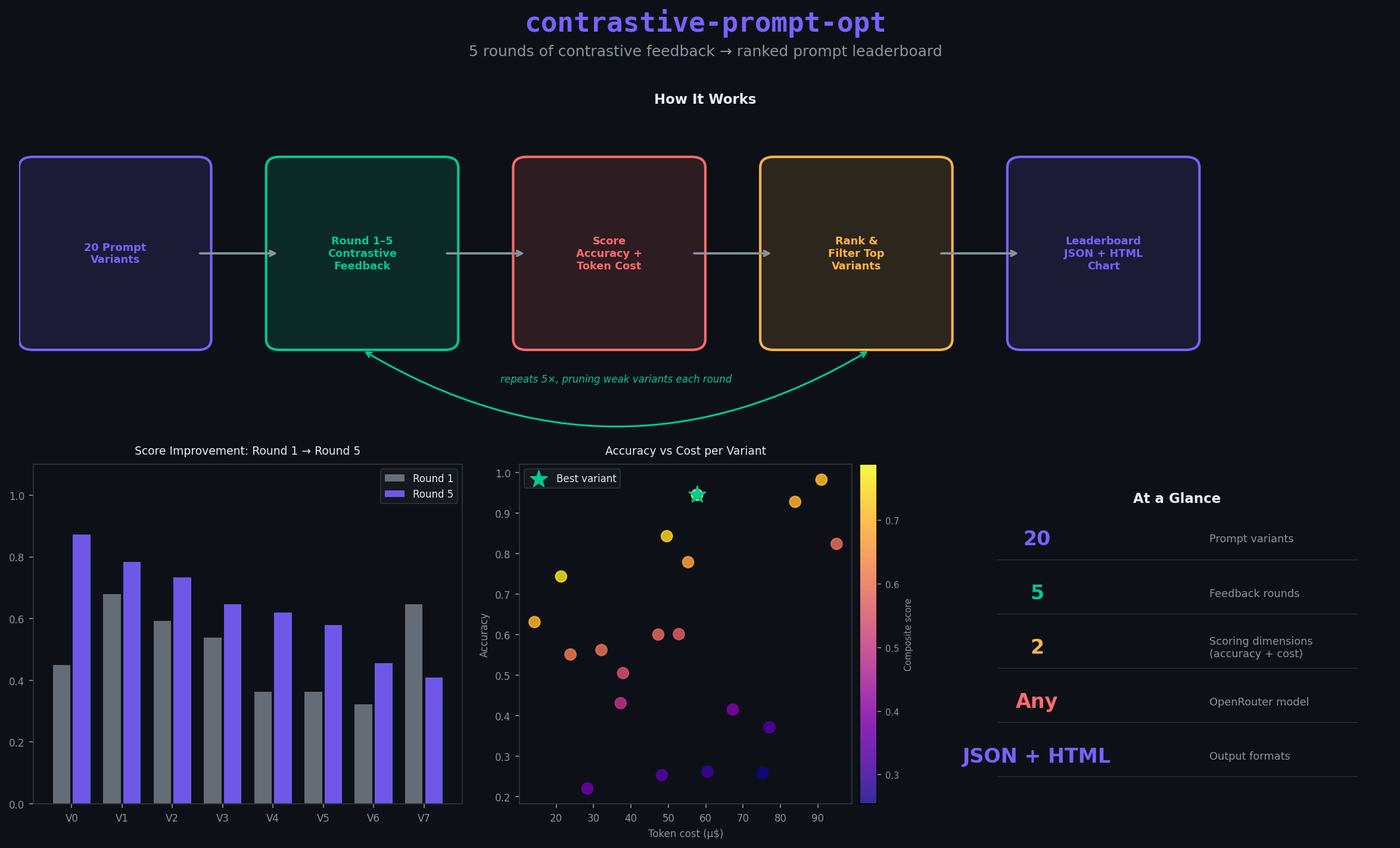 Pipeline Architecture
The Problem
Most prompt optimization approaches treat prompts as independent experiments — try one, score it, try another. They miss the signal hiding in the relationship between successes and failures.
NEO built Contrastive Prompt Optimizer to exploit that signal directly: by collecting pairs of prompts and outputs, identifying the contrastive patterns between what worked and what failed, and using those patterns to steer gradient-free optimization toward better prompts.
Contrastive Pair Collection and Scoring
Contrastive Prompt Optimizer begins by running automatic A/B scoring over a prompt pool. Each candidate prompt is executed against a shared evaluation dataset and scored using a configurable metric — exact match accuracy, ROUGE-L, semantic similarity, or a custom LLM-as-judge rubric. The outputs are then sorted into a positive set (high-scoring) and a negative set (low-scoring) based on a configurable threshold.
The core data structure is a ContrastivePair: a tuple of (positive_prompt, positive_output, negative_prompt, negative_output, task_input). Pairs are only valid when the two prompts received meaningfully different scores on the same input — a delta of at least min_score_gap (default 0.15). This filtering step ensures the optimizer is learning from genuinely informative contrasts rather than noisy variation.
pair = ContrastivePair(
    positive_prompt="You are a precise JSON extractor...",
    negative_prompt="Extract the JSON from the following:",
    task_input="Order details: name=Alice, qty=3",
    score_delta=0.42,
)
Pairs are stored in a local SQLite database and deduplicated by prompt hash before being passed to the optimizer.
Gradient-Free Optimization via Contrastive Analysis
With a library of contrastive pairs, the optimizer runs a meta-analysis step using an Analyzer LLM. The Analyzer reads a batch of positive/negative pairs and produces a structured report: which elements of positive prompts are absent from negative ones, what phrasing patterns correlate with high scores, and which constraints or examples appear to be load-bearing.
This report becomes the rewrite instruction for the next candidate generation step. The Generator LLM produces n_candidates (default 5) new prompt variants, each required to incorporate the identified positive patterns while avoiding the negative ones. This is gradient-free — no backpropagation, no differentiable loss — just structured reasoning about what distinguishes good outputs from bad ones.
The loop runs for a configurable number of rounds. Each round extends the pair library with new high/low examples, giving the Analyzer more signal. Score progression and pair library growth are logged to optimization_run.json after every round.
DSPy-Compatible Interface
The optimizer exposes a DSPy-compatible ContrastiveOptimizer class that drops into any DSPy pipeline as a teleprompter-style optimizer. It wraps the pair collection and meta-analysis steps behind the standard compile() interface, so teams already using DSPy can adopt contrastive optimization without restructuring their codebase.
from contrastive_prompt_opt import ContrastiveOptimizer

optimizer = ContrastiveOptimizer(
    metric=my_metric,
    n_rounds=4,
    n_candidates=5,
    min_score_gap=0.15,
)
compiled_program = optimizer.compile(my_dspy_program, trainset=trainset)
Outside of DSPy, the StandaloneOptimizer class accepts a plain Python callable as the prompt executor, making integration with LangChain, direct API calls, or local models equally straightforward.
How to Build This with NEO
Open NEO in VS Code or Cursor and describe what you want to build. A good starting prompt for this project:
"Build a contrastive prompt optimization tool in Python. Collect pairs of high-scoring and low-scoring prompt outputs on a shared evaluation dataset, use an Analyzer LLM to identify what patterns separate the successful prompts from the failing ones, and use those patterns to generate improved prompt candidates. Support gradient-free optimization across multiple rounds, store contrastive pairs in SQLite, log score progression to JSON, and expose a DSPy-compatible compile interface."
NEO generates the project structure and core implementation. From there you iterate — ask it to add support for LLM-as-judge scoring, build a dashboard that visualizes pair library growth across rounds, or extend the DSPy interface with teleprompter chaining. Each request builds on what's already there.
To run the finished project:
git clone https://github.com/dakshjain-1616/contrastive-prompt-opt
cd contrastive-prompt-opt
pip install -r requirements.txt
python main.py --task sentiment --rounds 4
Point it at your own evaluation dataset and initial prompt candidates to run contrastive optimization on any classification or generation task.
NEO built a contrastive prompt optimizer that learns from success/failure pairs and uses structured meta-analysis to iteratively generate better prompts without gradient computation. See what else NEO ships at heyneo.com.
Try NEO in Your IDE
Install the NEO extension to bring AI-powered development directly into your workflow:
- VS Code: NEO in VS Code
- Cursor: Install NEO for Cursor