

AI API Failover Router: One Endpoint, Any Backend, Zero Downtime

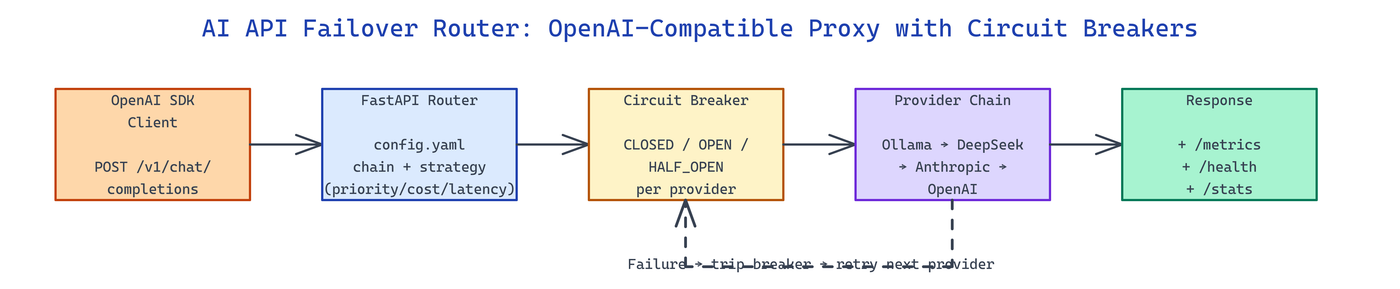 Pipeline Architecture
The Problem
Production apps that depend on a single LLM provider get paged at 2am every time that provider has an incident, and migration pain locks teams into paying whatever rate hike lands next quarter.
NEO built AI API Failover Router to front any set of providers with one OpenAI-compatible endpoint that routes, fails over, and enforces circuit breakers automatically.
OpenAI-Compatible Proxy with Provider Chains
AI API Failover Router exposes the standard POST /v1/chat/completions and POST /v1/completions endpoints, so any existing OpenAI SDK client works without code changes. Behind the endpoint, a config.yaml file defines ordered provider chains — Ollama, OpenAI, Anthropic, DeepSeek, or any OpenAI-compatible generic provider — and each request flows through according to a configurable strategy: priority, cost, latency, or health.
providers:
  - name: ollama
    type: ollama
    endpoint: http://localhost:11434
    default_model: llama3
  - name: deepseek
    type: openai_compatible
    api_key: ${DEEPSEEK_API_KEY}
    default_model: deepseek-chat
  - name: anthropic
    type: anthropic
    api_key: ${ANTHROPIC_API_KEY}
    default_model: claude-haiku-4-5

routing:
  strategy: cost
  fallback_chain: [ollama, deepseek, anthropic]
Swapping the chain or re-ordering for a cost optimization is a config edit — no app redeploy required.
Circuit Breakers and Health Endpoints
Each provider sits behind a classic three-state circuit breaker (CLOSED → OPEN → HALF_OPEN). Consecutive failures above threshold trip the breaker into OPEN and the router skips the provider for a cool-off window. After the window, a probe request moves the breaker to HALF_OPEN; success closes it, failure re-opens. This prevents one sick provider from cascading latency across the chain.
| State | Behaviour | Transition Trigger |
|---|---|---|
| CLOSED | Normal routing | 5 consecutive failures → OPEN |
| OPEN | Skip provider | 60s cool-off → HALF_OPEN |
| HALF_OPEN | Probe request | Success → CLOSED, failure → OPEN |
Live state is visible at GET /health for per-provider status, GET /stats for aggregated counters, and GET /metrics for Prometheus exposition. An admin endpoint (POST /admin/circuit/{provider}/reset) exists for manual recovery when the breaker is stuck after a provider-side fix.
Rolling Latency Stats and Cost Tracking
Middleware records rolling p50/p95/p99 latency, token counts per direction, and cost per request using configurable per-provider pricing tables. The cost routing strategy consults these tables in real time, so as provider prices change, traffic follows the cheapest viable option that also meets the SLA. Request logging, optional auth, rate limiting, and idempotency caching ship in-box.
pip install -r requirements.txt
cp .env.example .env
uvicorn src.main:app --host 0.0.0.0 --port 8000
python3 -m pytest tests/ -v   # 55 tests
Point any OpenAI SDK at http://localhost:8000/v1 and it routes through the chain transparently.
How to Build This with NEO
Open NEO in VS Code or Cursor and describe what you want to build. A good starting prompt for this project:
"Build a FastAPI proxy that exposes OpenAI-compatible /v1/chat/completions and /v1/completions endpoints and routes requests through configurable provider chains (Ollama, OpenAI, Anthropic, DeepSeek, generic). Support four routing strategies (priority, cost, latency, health). Implement three-state circuit breakers per provider with automatic recovery and admin reset endpoint. Expose Prometheus metrics, rolling latency stats, token and cost tracking. Include middleware for logging, optional auth, and rate limiting."
NEO generates the project structure and core implementation. From there you iterate — add per-model cost ceilings, build a dashboard for live circuit state, or wire in a Redis-backed idempotency cache so retries don't re-bill. Each request builds on what's already there.
To run the finished project:
git clone https://github.com/dakshjain-1616/AI-API-Failover-Router
cd AI-API-Failover-Router
pip install -r requirements.txt
uvicorn src.main:app --host 0.0.0.0 --port 8000
Point any OpenAI-compatible client at http://localhost:8000/v1; scrape /metrics for Prometheus and hit /health for per-provider circuit status.
NEO built a production-grade proxy that makes multi-provider LLM traffic a routing decision, not a code change. See what else NEO ships at heyneo.com.
Try NEO in Your IDE
Install the NEO extension to bring AI-powered development directly into your workflow:
- VS Code: NEO in VS Code
- Cursor: Install NEO for Cursor