

Agent Session Manager: Durable Memory for Long-Running LLM Agents

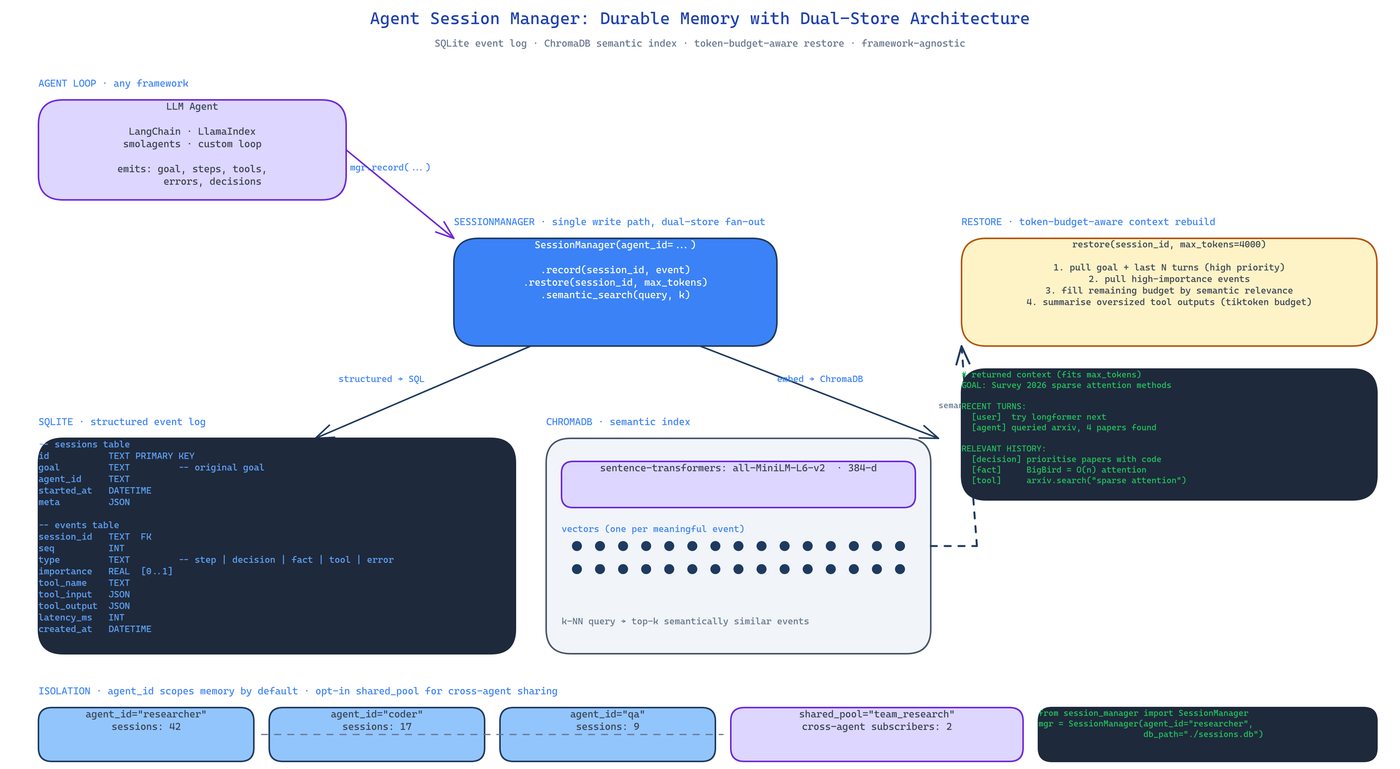 Pipeline Architecture
The Problem
Every agent that runs longer than a single conversation faces the same three bad options: stuff the whole history into the prompt until the context window dies, hand-roll a JSON file that does not scale past a prototype, or pay a third-party "agent memory" service that charges per call and adds latency. None of these are acceptable for a real system.
NEO built Agent Session Manager as the fourth option: durable local memory, semantic recall, and token-budget-aware restoration — all in a library light enough to drop into an existing agent loop.
Two Stores, Two Jobs
The architecture splits memory across two stores because they answer fundamentally different questions:
SQLite stores the structured event log. Every session has a goal, a list of completed steps with tool outputs, a queue of pending steps, an error history, and arbitrary metadata. SQL answers what happened, in what order, with what result. It is append-only and fast.
ChromaDB stores the semantic index. Every meaningful event — a decision, a fact learned, a tool output — is embedded with sentence-transformers and written to the vector store. ChromaDB answers what is semantically similar to this thing I am looking for right now.
The two stores are kept in sync through a single write path. You do not write to one and forget the other. The SessionManager object exposes one record() method that fans out to both.
Semantic Recall
Keyword search fails the moment the agent's vocabulary drifts. If the agent wrote "I disabled two-factor auth for the test account" three sessions ago and today asks "did we turn off 2FA anywhere?", keyword match does nothing. Semantic recall closes that gap.
The library uses all-MiniLM-L6-v2 by default — 384 dimensions, fast on CPU, no GPU needed. It is configurable at SessionManager construction if you want to trade speed for fidelity. ChromaDB handles the ANN index; you get the top-k semantically similar events for any query string.
Token-Budget-Aware Restoration
Restoring a session is not "dump everything back into the prompt". The SessionManager accepts a max_tokens budget. It prioritises recent turns, the original goal, and any events flagged as high-importance, then fills the remaining budget with semantically relevant history. Tool outputs that exceed budget are summarised, not truncated mid-JSON.
tiktoken is used for accurate token counting across OpenAI-compatible tokenisers. The budget is calculated against the model family you declare at construction time.
Multi-Agent Isolation
SessionManager takes an agent_id at construction. By default each agent gets its own isolated namespace — no accidental cross-agent memory bleed. If you explicitly want sharing, a session can be tagged with a shared_pool identifier that other agents can subscribe to. You pick the topology; the library does not assume one.
Drop-In Integration
The library is framework-agnostic. It does not assume LangChain, LlamaIndex, or any specific agent runtime. You instantiate a SessionManager, call record() on events you care about, call restore() when you want to rebuild context for a new prompt. That is the whole API surface.
from session_manager import SessionManager

mgr = SessionManager(agent_id="researcher", db_path="./sessions.db")
session = mgr.start_session(goal="Survey 2026 sparse attention methods")

# During agent run
mgr.record_step(session.id, step="queried arxiv", result={...})
mgr.record_decision(session.id, text="prioritise papers with code releases")

# Later, in a fresh run
context = mgr.restore(session.id, max_tokens=4000)
How to Build This with NEO
Open NEO in VS Code or Cursor and describe what you want to build. A good starting prompt for this project:
"Build a Python library that gives LLM agents durable local memory across runs. Store structured events — goal, completed steps, tool outputs, errors, metadata — in SQLite. Store semantic embeddings in ChromaDB using sentence-transformers all-MiniLM-L6-v2 for meaning-based recall. Provide a SessionManager class with record(), restore(), and semantic_search() methods. Restoration must respect a max_tokens budget using tiktoken for accurate counting, prioritising recency and high-importance events. Support multi-agent isolation by default with optional shared pools. Framework-agnostic — should integrate with LangChain, LlamaIndex, or custom loops."
NEO scaffolds the dual-store architecture and the SessionManager API. From there you iterate — add importance scoring based on how often a memory is recalled, write a CLI for session inspection, or plug the memory layer into an existing LangChain agent.
NEO built a local-first, framework-agnostic session memory library for long-running agents with dual SQLite + ChromaDB storage and token-budget-aware restoration. See what else NEO ships at heyneo.com.
Try NEO in Your IDE
Install the NEO extension to bring AI-powered development directly into your workflow:
- VS Code: NEO in VS Code
- Cursor: Install NEO for Cursor